

The headlines are about the talent war. Banks are rushing to hire Chief AI Officers. UBS appointed its first chief AI officer. HSBC appointed its first-ever Chief AI Officer. Commonwealth Bank of Australia named Ranil Boteju... its chief AI officer. Wells Fargo and BNP Paribas bolstering their AI leadership teams. A conference in New York is now devoted entirely to Chief AI Officers, drawing 400 executives.
In 2025, only one in four companies had a Chief AI Officer. By 2026, it's three in four. The corporate world is undergoing what someone called a "revolution" in under 12 months.
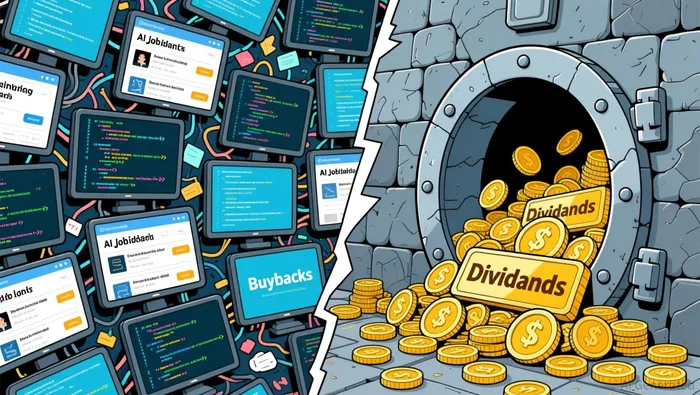
The headlines want you to believe the story is about artificial intelligence. It's not. The story is about capital allocation - and what the biggest banks are doing with their profits tells you everything.
The money flows in two directions
Here's what happened in the first quarter of 2026 while banks were posting job listings for AI talent.
The eight globally systemically important banks - the ones too big to fail - returned a combined $46.17 billion to shareholders in dividends and share buybacks. That was up 34 percent from a year earlier. On the buyback side alone, the largest US banks spent a record $33 billion in Q1. A 34% increase on top of what was already a massive base.
That is the real story. Not the C-AIO hiring sprint. The payout machine.
Global banking net income rose to $1.3 trillion in 2025, up 7 percent from an already record-setting year. McKinsey calls it what it is: the industry outdid itself again. Banks are printing cash at a pace not seen since the post-crisis rate environment shifted in their favor. And instead of hoarding it, they're sending it straight back to shareholders.
From an income and risk/reward point of view, this matters because it means bank dividends aren't just safe - they're accelerating. The payout trajectory is the variable that should dominate your thinking, not the AI theater.
The AI spend is real. The ROI is not.
JPMorgan Chase plans to spend $19.8 billion on technology in 2026 - a 10 percent increase, nearly $2 billion more than 2025. Of that, approximately $2 billion goes directly to AI. Jamie Dimon told Bloomberg in October 2025 that the bank is achieving a matched $2 billion in direct savings from that AI spend. Dollar for dollar.
That sounds tidy. But it's the outlier, not the rule.
Deloitte's 2025 survey of organizations investing in AI found something uncomfortable: only 6 percent reported payback in under a year. Even among the most successful projects, just 13 percent saw returns within 12 months. Meanwhile, 85 percent of organizations increased their AI investment over the past year, and 91 percent plan to increase it again.
The pattern should be familiar. It's the same as the hyperscaler capex boom - global hyperscale AI spending hit $430 billion in 2025 and could exceed $1 trillion by 2029. Everyone throws money at the infrastructure because the alternative is falling behind. The ROI math rarely catches up.
I don't think banks are being paid to believe their Chief AI Officer will magically restructure their cost base. The Chicago Fed has flagged AI as a tail risk for banks - not because the technology is dangerous, but because the investment cycle is so front-loaded and so uncertain. A 40 percent reduction in a bank's cost structure from AI, as some optimistic McKinsey models suggest, is never going to happen. Banks are legacy organizations with decades of institutional architecture. AI doesn't erase that overnight.
But here's what's important: the AI spend doesn't need to pay for itself for the dividend story to hold. The banks can afford it because net income is growing. The payout growth is funded by earnings power, not by AI efficiency gains. That distinction is everything.
What the hiring frenzy actually means
Let's be clear about what Chief AI Officers actually do at a bank. They're not building self-driving fraud detectors. They're cost optimization managers with better titles. Their job is to find where AI can reduce headcount, automate routine workflows, and compress operating expenses.
From the bank's perspective, that is a rational move. Cost optimization is one of the four major trends facing banks in 2026, alongside expense allocation, improved efficiency, and digital transformation. But from the shareholder's perspective - the dividend investor's perspective - the question is different.
The question is whether the cost optimization actually flows to the dividend, or whether it gets eaten by the next round of compliance, by the next cybersecurity incident, by the next regulatory requirement.
I believe it flows to the dividend. The evidence is the capital return numbers. Banks are not sitting on excess cash. They're returning it, systematically and at an accelerating pace. The Q1 2026 data - $46 billion across eight banks, up 34 percent - shows the mechanism in action. Shareholders are getting paid for the cost discipline, whether AI delivers on its promises or not.
The dividend investor's actual edge
Most investors are reading these AI headlines and thinking about who wins the technology war. That's the wrong question. The right question is: which banks have the balance sheet strength, the pricing power over deposit costs, and the payout durability to keep growing dividends regardless of whether AI hits its targets?
The answer is the big ones. The globally systemically important banks. The ones returning $46 billion in a quarter. The ones that can afford a $2 billion AI bet because their earnings base is so large that a miss doesn't threaten the dividend - and a hit accelerates it.
This is where the equity yield curve framework matters. You don't chase the highest current yield. You look for the businesses where the payout is growing because the underlying cash flow is growing. Big banks fit this profile because their earnings compound through rate environments, their deposit franchises create pricing power, and their cost optimization - whether AI-driven or not - feeds margin expansion.
The risk isn't that AI fails. The risk is that a banking crisis or a regulatory shock interrupts the earnings trajectory. That's a tail event, not a base case. And it's the same risk you carry in any dividend growth portfolio - it just requires you to pick businesses with balance sheets that can absorb the hit.
So what
The Chief AI Officer hiring wave is real. It's also a distraction from the variable that actually determines whether you build growing income from bank stocks.
I don't think investors need to understand generative AI to profit from the largest banks. What matters is the payout machine: record capital returns, accelerating dividends, and earnings that grew 7 percent on top of a record base. The AI spend is a cost optimization experiment that may or may not deliver. The dividend growth is happening regardless.
If you're building a retirement-income sleeve or a compounding dividend portfolio, the question isn't whether your bank stock has a Chief AI Officer. The question is whether it has a balance sheet that can fund 34 percent growth in shareholder returns year over year.
A small number of names have that profile. They belong in the income-growth sleeve of a portfolio precisely because the payout is being driven by earnings power, not by a technology bet. That makes the dividend durable through AI hype cycles, through regulatory shifts, and through whatever macro regime comes next.
The compounding math takes care of the rest.