

Beyond The Hype has been watching Barton Gold Holdings (ASX:BGD) turn exploration headlines into market cap for months. The latest: "Drilling Completed at High-Grade Tolmer Silver Discovery." The headline asks you to believe that completed drill holes at a remote South Australian property are the opening act for something investment-grade. The evidence tells a different story.
Let's separate what Barton has actually done from what the market is being asked to price.
What Barton Actually Has
Barton Gold controls the Tolmer property, roughly 5km west of... Tarcoola... and... ~130km SE of the Central Gawler Mill (Challenger) - a geological province in South Australia known for gold deposits that have produced real mines, including the Challenger operation 130km away. Tolmer itself has never been a mine. It has never had a JORC resource estimate (the regulatory standard investors need to trust that underground metal is mineable).
What Barton does have are two headline numbers:
- December 2025:Peak assays of 465 g/t Ag & 20.2 g/t Au from diamond drilling into a high-grade target zone. That means in the very best intervals of the very best holes, the rock contained those grades. Not the whole deposit. Not a bulk sample. Peak intercepts from a narrow window.
- May 2026:100,000 g/t Silver Trial Gravity Concentrate - meaning they took sample material and ran it through gravity separation equipment - that yielded 100,000 g/t silver in concentrate. That number is stunning on its face. It is also a process test on unknown quantities of unknown-grade material.
Then on June 1, Barton announced expedited follow-up drilling to target high-grade extensions. The competitor headline says that program is now "completed." No assay results have been released as of today. Completed drilling means nothing until the assays come back.
What the Market Is Pricing
Barton Gold trades at roughly A$0.76, giving the company a market capitalization of approximately A$194 million. The stock is down about 6% on the day, suggesting the market has been volatile around this story rather than calmly endorsing it. By late January 2026, market cap was near A$200 million. The stock has been holding above where it was six months ago, buoyed by the Tolmer sequence.
A$194 million for a company that has no revenue, no JORC resource at Tolmer, and no mine in production is not free option value. It is a price that assumes: Tolmer is real, it's big enough, it's mineable, and Barton can build it without diluting shareholders into oblivion.
The Gravity Concentrate Trap
The 100,000 g/t silver concentrate number demands scrutiny because it is the anchor of the "high-grade" narrative. Here is what investors need to understand: gravity concentration separates heavy particles from lighter ones using density differences. Silver minerals are dense. When you run high-grade silver-bearing ore through gravity equipment, you get a small amount of very high-grade concentrate. That does not tell you how much ore exists, what grade the bulk of the deposit runs at, or whether mining it is economic.
Think of it this way: if you take a teaspoon of glitter and mix it into a swimming pool, you can still build a filter that catches the glitter and produces a highly concentrated handful of it. The concentration number is impressive. The economics of scaling it is entirely different.
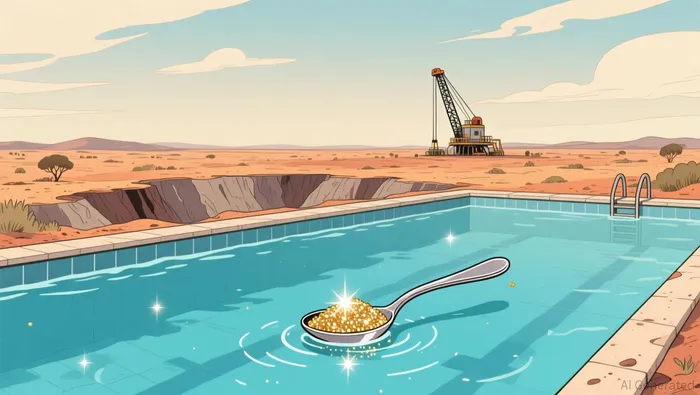
Barton has not published a metallurgical study showing what percentage of the silver can be recovered, what the ore body's average grade is, or what it costs per tonne to extract. Those are the numbers that determine whether a deposit is a mine or a geology project. Without them, the 100,000 g/t figure is a lab curiosity, not a business case.
No Track Record, No Margin for Error
Barton Gold's stated ambition is production of 150,000ozpa gold and 250,000ozpa silver. That is a mine of meaningful scale - not a small operation, but one that would rank among the medium producers on the ASX. For context, a company that delivers that scale would need to have already completed a feasibility study, secured financing in the hundreds of millions, and navigated years of regulatory and construction risk.
Barton has none of this. The company has been an exploration-only entity. It holds a significant exploration position in the central Gawler Craton, with Tarcoola and Tolmer as the headline targets. It has no history of delivering a mine. It has no revenue. Every dollar it spends comes from raising capital - and every capital raise dilutes existing shareholders.
Any astute miner investor would have noted that Barton is operating in a geological jurisdiction - the Gawler Craton - that has produced world-class deposits but also dozens of promising projects that never became mines. The Challenger mill 130km away provides some infrastructure context. It also means Barton needs to justify trucking ore 130km or building its own processing capacity. One of those is a material capital cost either way.
The Missing Assays
The competitor headline celebrates that drilling is "completed." Here is the part investors are being asked to overlook: the results don't exist yet. Drilling completion is the easy part. It costs money and takes a rig crew a few weeks. What matters - the assays, the structural continuity, the width of mineralization, the depth to waste rock - is not public. Barton knows the results. The market does not.
That asymmetry is how exploration companies time their announcements. Drill completion generates a headline. Assay release generates a reaction. If the June extension drilling hit grades that validate the December peaks, Barton will announce it. If the extension missed, the silence will be telling.
The Cross-Currents
The cross-currents are:
- Silver price environment. Silver has been supported by both industrial demand (solar panels, electronics) and monetary bid. Higher silver makes marginal projects look more viable. That is a tailwind for Barton's narrative - but it also inflates market caps before the work is done, making later dilution less painful for insiders.
- Exploration option value. At A$194 million, Barton is not cheap, but exploration stocks rarely are when the headline is compelling. The question is whether the June assays justify adding more zeroes or whether they reveal the narrowness of what the December peaks showed.
- Execution gap. Barton has never built anything. There is a massive distance between "we found high-grade intercepts" and "we are producing 150,000 ounces of gold per year." Most ASX explorers never cross it. That is the real risk, not the drilling completion.
You Decide Which Was Marketing Fluff and Which Was Analysis
Barton Gold has not produced a mine. It has not published a JORC resource for Tolmer. It has not released the assays from the "completed" June drilling program. The 100,000 g/t gravity concentrate is a process test, not a mine design. And the market is pricing A$194 million of market cap on drill intercepts and a press release.
Directionally, the investment case requires the June assays to be strong enough to justify a JORC resource estimate, which then needs to be large enough and high-grade enough to support a feasibility study, which then needs to attract the hundreds of millions in financing Barton will need. Every one of those gates is open. Every one of them is where projects fail.
The drilling completion is a milestone. It is not a business. Barton's stock price treats it like one.