

The primary bullish driver for Bitcoin's 2026 thesis is the measurable, methodical flow of capital from large, long-term investors. This isn't speculative trading; it's institutional adoption treating Bitcoin as a strategic financial tool. As Binance's co-CEO noted, 200 public companies now hold Bitcoin, and the exchange's 2025 volume report shows spot volume at around $7.1 trillion. This institutional base is fundamentally changing market dynamics, providing a steady, less volatile demand layer that absorbs cycle-based selling.
This institutional demand is a key pillar of Charles Hoskinson's bullish $250,000 thesis. Hoskinson frames his prediction on a simple economic principle: Bitcoin's supply is limited, while demand from large investors keeps growing. His math depends on this institutional buying pressure being consistent and long-term, creating a sustained squeeze against a fixed supply. The credibility of his call rests on this understanding of capital flows, not just hype.
This marks a structural shift of crypto from a speculative asset class to integrated financial infrastructure. The trend is accelerating as traditional finance evolves, with firms like Morgan Stanley now allowing wealth managers to recommend Bitcoin. As institutions diversify and governments pilot clearer regulations, crypto is becoming financial infrastructure. This industrialization provides a deeper, more resilient foundation for price action than past cycles, even as long-term holders consider taking profit.
The Long-Term Holder Stress Test
The bullish institutional thesis faces a direct counter-pressure from the market's most resilient holders. Nearly half of all Bitcoin in circulation is now trading at a loss, with the Bitcoin Impact Index surging to 57.4 and landing in the "high impact" zone. This level of stress, not seen since January, signals a market where a large cohort of long-term investors has been forced underwater, creating a latent source of selling pressure.
This stress is translating into tangible selling. Over the past month, long-term holders have sold approximately 143,000 BTC, worth around $9.5 billion. This marks the fastest pace of divestment since August 2025, reversing a brief accumulation phase earlier in the year. The scale of this selling adds significant supply to the market and directly challenges the narrative of unwavering holder conviction.
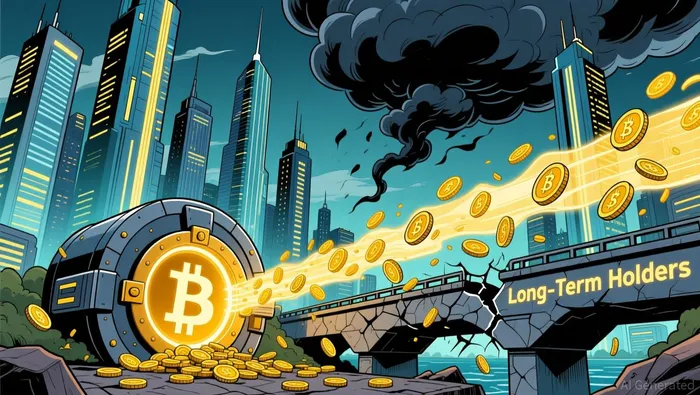
The reversal is broad-based. Capital flows that had supported the market earlier in the year have pulled back, with stablecoin inflows turning to outflows and ETFs moving from accumulation to selling. While holders are not yet rushing to deposit BTC on exchanges-a key support-this coordinated shift in behavior from both long-term holders and institutional channels introduces a new layer of vulnerability.
The market has absorbed much of this selling so far, but the divergence between price action and on-chain conviction is a historical warning sign.
The Quantum Defense Debate: Hoskinson's Technical Critique
Charles Hoskinson's bullish price forecast for Bitcoin is set against a stark technical critique of the network's own proposed defense against future quantum threats. His argument centers on BIP-361, a plan to phase out vulnerable addresses. Hoskinson contends the proposal is mischaracterized as a soft fork and would in practice require a hard fork, clashing directly with Bitcoin's entrenched anti-hard fork culture. This creates a fundamental tension: a plan to secure the network may be structurally impossible to implement without fracturing the community.
The technical flaw is a significant coverage gap. Hoskinson argues the plan's recovery mechanism cannot protect about 1.7 million older bitcoins, including roughly 1 million attributed to Satoshi Nakamoto. These early coins were created before the BIP-39 seed phrase standard existed and lack the cryptographic proofs needed for the proposed zero-knowledge recovery. If adopted, the plan would permanently freeze these coins, a vulnerability that undermines the very security it aims to provide.
This highlights a deeper governance risk. The controversy over BIP-361 underscores Bitcoin's lack of formal on-chain governance, leaving high-stakes upgrades to be negotiated through developer mailing lists and social consensus. For a network betting on long-term security and immutability, this inability to manage contentious, protocol-level changes is a material counterpoint to any price optimism. The debate is less about quantum risk and more about Bitcoin's capacity to evolve.
Catalysts and Risks: The Path to $250k
Hoskinson's $250,000 target implies an 187% gain within six months from current levels. This is an extreme call that demands a perfect alignment of catalysts. The bullish math rests on institutional demand, with U.S. spot ETFs controlling over $117 billion in BTC and new issuance falling post-halving. For the target to be credible, this steady buying must continue unabated.
The key watchpoint is liquidity stability. Institutional flows are critical, but they must be able to absorb the 143,000 BTC, worth around $9.5 billion in selling from long-term holders. If ETF inflows slow or reverse, the market's ability to absorb this supply will be tested. The recent shift from ETF accumulation to selling is a red flag that could derail the supply squeeze Hoskinson's thesis depends on.
The major external risk is a broader tech sector correction. Hoskinson himself warns that parts of the technology sector, especially artificial intelligence stocks, may be overvalued. Given that crypto often moves in tandem with high-growth stocks, a tech bubble burst would likely drag Bitcoin down, regardless of on-chain fundamentals. This creates a parallel risk to the on-chain stress from long-term holders.