

Tom Lee's specific forecast from February was clear: the crypto winter would end by April at the latest, citing technical analysis from Tom DeMark. He attached concrete price floors, identifying Bitcoin support at $60,000 as the key level to hold. As of early April, Bitcoin has decisively cleared that threshold, trading near $74,300. The asset also officially breached the $70,000 level after a long consolidation, marking a significant technical breakout.
The core question now is whether this price action is backed by institutional capital flows or remains speculative. Lee's own firm, BitMine, appeared to act on the thesis by expanding its Ethereum holdings and launching a $200 million strategic investment push around the same time. Yet, market sentiment remains locked in extreme fear, creating a disconnect between price and perceived risk.
This sets up a critical test for the market's forward trajectory. The price has moved decisively above the identified floor, but the sustainability of the move hinges on whether broader institutional capital is flowing in to support it, or if it's driven by short-term speculation.
Flow Analysis: Capital Inflows and Regulatory Catalysts
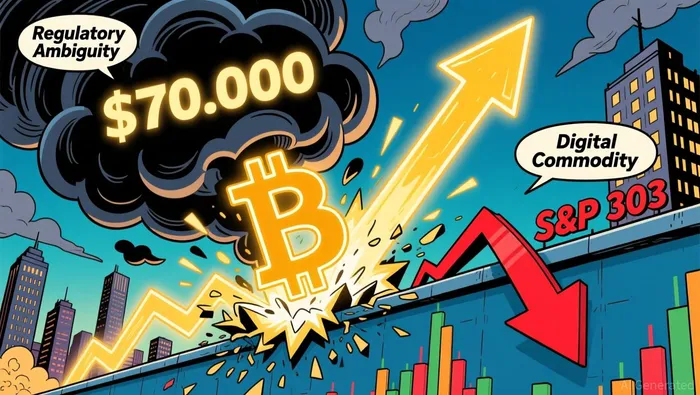
The primary catalyst for institutional capital is now in place. On March 17, the SEC and CFTC formally classified Bitcoin as a "Digital Commodity", ending years of regulatory ambiguity. This legal clarity is the essential green light that allows large financial institutions to move toward production-scale integration, directly addressing the capital constraint that has limited growth.
Yet, this institutional tailwind faces a powerful headwind from the broader market. The S&P 500 hit fresh all-time highs in April, erasing losses from recent geopolitical shocks. This resilience creates a direct competition for capital, as the stock market's momentum draws liquidity away from risk assets like crypto. The flow of money into equities is a tangible counter-force to the speculative capital potentially flowing into Bitcoin.
This sets up a critical divergence in sentiment. While price action has cleared key technical levels, analyst Willy Woo has dismissed Tom Lee's forecast, predicting a bear market lasting until April 2027. His call of "high on hopium" underscores a deep skepticism about the sustainability of the current rally. The flow of capital must now prove whether it can overcome this bearish sentiment and the competitive pull of a surging stock market.
Catalysts and Risks: The Path to Validation
The immediate price target is clear. Bitcoin must break above the $70,000 level to confirm the technical breakout, but the next major hurdle is resistance in the $90,000-$95,000 range. Clearing this zone is essential for a major bull case, as it would signal a move toward the asset's all-time high near $126,250. Without a decisive move above this range, the rally risks being labeled a failed breakout, leaving the market vulnerable to a retest of key support.
The primary risk to the recovery thesis is a failure of institutional capital flows to materialize. Despite the regulatory green light from the SEC and CFTC, the flow of money into Bitcoin remains the critical test. If ETF inflows and exchange reserves do not show sustained growth, the price could quickly re-test the $60,000 support level identified by Tom Lee. This would validate the bearish sentiment of analysts like Willy Woo, who predicts the market will drag on until April 2027.
The leading indicators to monitor are straightforward. Watch for consistent ETF inflows and a decline in exchange reserves as signs of capital moving from speculative traders to long-term holders. These flow metrics will determine whether the current price action is supported by institutional participation or remains a speculative pop.