

Bitcoin prices consolidated near $75,000 on Tuesday after short-term traders realized 63,000 BTC in profits, the highest level recorded in 2026.
Onchain data indicates that the one-day-to-one-week cohort moved nearly 2,000 BTC back to Binance, suggesting freshly acquired coins are rotating into sell-side liquidity.
This selling pressure coincided with continued accumulation by long-term holders, creating a dynamic where weaker hands transfer coins to stronger ones.
Why Is Bitcoin Consolidating Near $75,000?
Bitcoin's rally stalled above $76,000 as realized profit per hour spiked above $20 million whenever the price probed the $70,000 region.
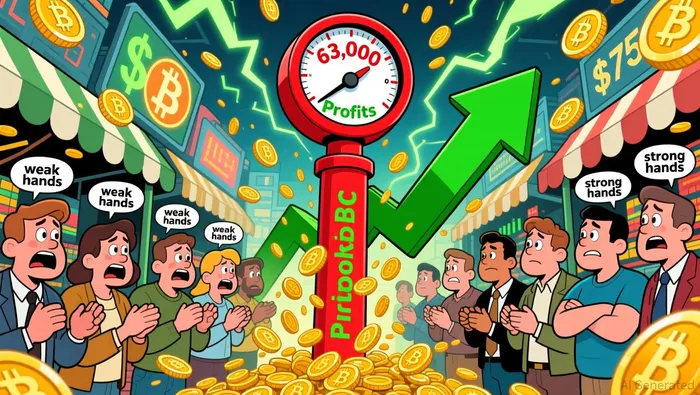
According to CryptoQuant data, on Tuesday alone, investors realized approximately $1.14 billion in profits as prices briefly exceeded $76,000.
A fundamental supply concentration is forming at $76,800, which represents the average cost basis for short-term holders who accumulated during the recent drawdown.
Historically, this level acts as strong resistance as investors who were previously underwater exit at breakeven rather than holding for further gains.
Exchange inflows have spiked to 11,000 BTC per hour at this range, with the average deposit size rising to 2.25 BTC.
The share of large transfers jumped from below 10% to above 40% of total inflows within days, a shift historically associated with increased distribution pressure.
How Do Institutional Flows And Options Impact Market Structure?
U.S.-listed spot Bitcoin ETFs have continued to attract consistent capital, including roughly $240 million in a single session following Middle East geopolitical tensions.
BlackRock's IBIT led the inflows, demonstrating continued interest in the asset class despite macroeconomic uncertainty.
Institutional demand provided the foundation for the recent move, with spot Bitcoin ETFs recording $786 million in net inflows last week.
Additionally, Strategy increased its Bitcoin holdings significantly, buying 13,927 BTC for about $1 billion during the week of April 6–12.
Market analysts monitor a $1.9 billion Bitcoin options contract expiry on the Deribit exchange as a critical liquidity event.
The max pain price of $69,000 represents the strike price that causes the maximum financial loss for option buyers.
Max pain theory suggests that as expiration nears, market makers adjust their spot market trades to hedge positions, inadvertently applying pressure toward this point.
BlackRock and Goldman Sachs are also launching Bitcoin ETFs that use options strategies to reduce volatility.
These income ETFs use covered call options to generate yield while capping potential upside.
The gap between the probability of Bitcoin reaching $100,000 versus $150,000 suggests traders view the lower target as reachable but see the volatility-capping mechanics as a drag on higher targets.
What Are Analysts Watching Next?
According to CryptoQuant reporting, Bitcoin's short-term holder pressure on Binance has decreased significantly.
The 7-day standard deviation of realized profit/loss pressure fell to 217, its lowest reading since February.
This reduction indicates that short-term holders are sending coins to exchanges with less aggressive profit-taking and reduced panic-driven loss realization.
Yield Basis, a liquidity platform built on Curve Finance infrastructure, reported $1.1 billion in trading volume and more than $12 million in fees during the first quarter.
The protocol is designed to capture trading activity during periods of price movement, allowing liquidity providers to earn fees while maintaining exposure to assets such as Bitcoin.
The immediate outlook depends on whether demand can absorb this distribution.
If Bitcoin sustains prices above $78,100, the extra supply will likely be absorbed, potentially leading to a rapid price increase.
However, failure to break this resistance could see a pullback to the $71,000–$72,000 support zone, where the current rally leg began.
Derivatives data supports this consolidation thesis, with negative funding rates and a preference for put options indicating traders are hedging rather than betting on a breakout.