

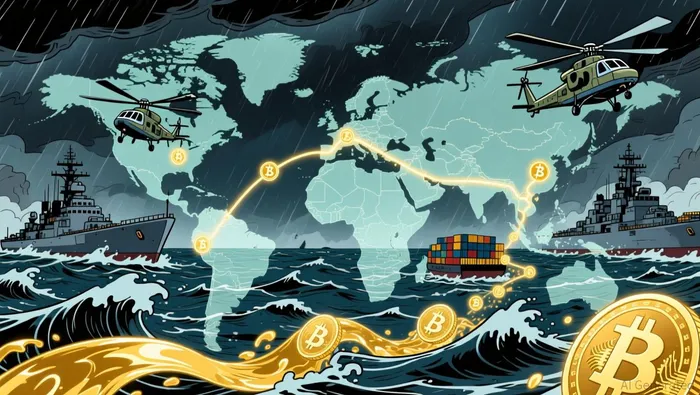
CENTCOM confirmed a fresh wave of US strikes on Iran on Wednesday evening. The trigger was immediate and dramatic: Iran shot down a US military helicopter over the Strait of Hormuz, and Trump promised to hit Iran "hard." The headlines arrived by midnight, and the Bitcoin reaction was predictable - price tumbled.
The narrative that followed was even more predictable. By morning, the same argument that surfaces at every geopolitical shock was circulating: Bitcoin fails as a safe haven again. It's supposed to be digital gold, detached from borders, immune to governments. Instead it fell in lockstep with everything else.
Except the frame is wrong. It has been wrong for years.
The pattern you've seen before
I don't know exactly how far Bitcoin dropped on Wednesday - the timing of reporting made it impossible to pin down a clean intraday number by press time. But I know the pattern well enough that the exact percentage doesn't change the story.
When Russia invaded Ukraine in February 2022, Bitcoin plummeted roughly 8 percent within hours, falling from around $37,000 to $34,413. When Hamas attacked Israel on October 7, 2023, BTC drifted below $27,000 for a cumulative 2 percent decline. The mechanical response is the same every time: shock hits, liquidity evaporates, and Bitcoin gets sold alongside everything else.
Here's the part the headlines skip. Academic research tracking crypto reactions to the Russia-Ukraine war, and a 2026 analysis of Bitcoin's performance across past global conflicts, show the same rhythm. Bitcoin crashes when wars start - then recovers within roughly 50 to 60 days. It's not a thesis break. It's a liquidity event.
Why this keeps happening
The safe-haven label stuck to Bitcoin in its early years, when it was a small network held by people who believed in its detachment from the traditional system. That was a story. The theme is different.
Today, Bitcoin is held by institutions that trade it through the same desks, margin accounts, and risk systems as equities and commodities. When a geopolitical shock hits, those systems trigger across asset classes at once. Correlation doesn't have to be 1.0 to produce the same outcome. What matters is that institutional holders and the platforms they use are embedded in the same liquidity plumbing. When the plumbing tightens, Bitcoin falls with the rest of it.
That doesn't mean Bitcoin is useless. It means the safe-haven question is asking about the wrong identity. Bitcoin isn't the thing you hold to avoid a selloff. It's the thing you hold when you're betting that the post-shock monetary response - more central bank liquidity, more dollar debasement, more inflation - will lift unanchored assets. The recovery pattern of 50 to 60 days is the system re-liquefying, not Bitcoin proving it's gold.
What actually matters here
The headline grabs you with "Bitcoin tumbling," but the real structural force in this story isn't what happens to a price chart. It's what happens to the Strait of Hormuz.
About a fifth of the world's oil passes through that narrow waterway. China, which already watches the US-Iran escalation with what analysts at CSIS describe as "unease", has a direct and immediate interest in whether shipping resumes normally. If the strait gets disrupted - even briefly - oil spikes, and the inflation math for the US, Europe, and Asia all changes at once. That's what drives the Fed's next move, and what eventually feeds back into the dollar and the risk environment Bitcoin lives in.
The transmission chain is: military action → Hormuz risk → oil → inflation expectations → central bank policy → liquidity conditions → asset prices. Bitcoin is at the end of that chain, not the beginning.
The edge case nobody's watching
While the market fixates on whether BTC drops or bounces, there's a quieter layer that matters more to the story of what digital money actually does.
In Iran and the surrounding region, people are already living under sanctions, capital controls, and payment friction that the average US investor can't imagine. For communities in Iran, Lebanon, and parts of the Gulf, a US military escalation doesn't trigger a margin call. It triggers a harder scramble for dollar access and for ways to move value out of a destabilizing local currency. That's where crypto adoption has always shown up first - not in New York, but in places where the dollar suddenly becomes harder to reach.
I've tracked this pattern before. It's the reason I keep looking at frontier adoption and overlooked geographies when the rest of the market is arguing about whether Bitcoin is "digital gold" on a risk-off day. The real test of whether crypto matters isn't how it trades on a US exchange during a headline event. It's what happens to the people whose banking options just got worse.
What to watch next
I'm less interested in Bitcoin's price tomorrow than in three things:
- Whether Hormuz shipping normalizes or stays disrupted. Oil is the bridge between military action and the macro environment that eventually determines Bitcoin's recovery trajectory.
- How the Fed frames the escalation. If officials start talking about supply-driven inflation as a near-term risk, the monetary backdrop shifts in a way that changes the calculus for every unanchored asset, including crypto.
- Dollar liquidity conditions in the broader system. If repo markets tighten or dollar funding strains show up, that's when you'll know whether this is a standard risk-off blip or something with deeper plumbing consequences.
Bitcoin's reaction to the Iran strikes isn't a safe-haven test. It's a reminder that the asset we're holding isn't the same asset people described in 2014. It's bigger now, more connected, and more sensitive to the same system shocks that move everything else. The question going forward isn't whether Bitcoin will fall on bad news. It's whether the monetary system's response to the bad news will be big enough to push it back - and higher - within those 50 to 60 days that seem to mark the recovery window.
That's the pattern. Whether it holds this time depends on how much deeper this goes.