

The headlines today lead with a familiar frame: Iran closed the airspace around Tehran's Imam Khomeini International Airport after Israel launched strikes, and Bitcoin slid toward $63,000. The implied question - the one that gets retweeted and argued about - is whether Bitcoin is a safe haven or just another risk asset that sells off when missiles fly.
It's a reasonable question. It's also not the one that matters.
The more useful story here is quieter and harder to quantify. While the market argues about Bitcoin's price identity during war, a country that is actively under attack has been using cryptocurrency as sanctions-evasion plumbing for months. The rails are doing work even while the chart does the opposite of what bulls hope.
Let me separate the two threads.
The price story is stale
Bitcoin was around $61,928.70 last Wednesday. As of today, it has bounced back up toward $63,224.70. The "$63K" number that keeps appearing in headlines dates back to the February 2026 crash, when the U.S. and Israel first bombed Iran and Bitcoin fell nearly 9%. Gold rose. Bitcoin didn't. The safe-haven test failed, again.
What's happened since is a pattern we've seen before. Bitcoin drops on the shock, then recovers over weeks. In late February it fell to those $63,000 lows, and by mid-April had quietly climbed nearly 20% from there. Today's action - strikes exchanged on Monday, then both Iran and Israel declared a pause - looks like another jolt followed by stabilization.
The price behavior is consistent with a risk asset that happens to carry some liquidity option value. When war breaks out, leveraged positions get unwound and Bitcoin falls alongside equities. When the immediate shock passes, capital flows back. That is the narrative. It's real for people who hold BTC and get margin-called.
The plumbing story is structural
Here's what the price debate obscures. Iran has been turning to cryptocurrency to circumvent sanctions while under active military pressure. According to reporting from late April, Iranian authorities and citizens are increasingly using crypto to evade sanctions, and the U.S. is struggling to keep up.
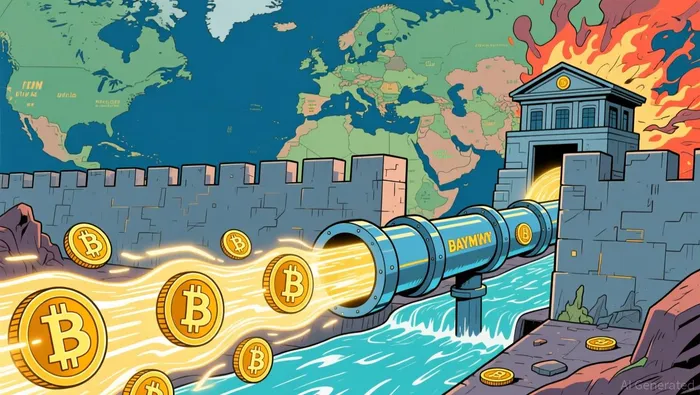
More revealing is what happened at the Strait of Hormuz. During the ceasefire period, Iran's oil exporters' union demanded that ships passing through the strait pay tolls in cryptocurrency. You can read that as a desperate move by a sanctioned regime. Or you can read it as a state actor stress-testing crypto settlement rails under real geopolitical pressure, at a choke point that moves roughly a fifth of the world's oil.
The second reading is more useful, because it tells you something about what crypto actually does in a conflict zone. It isn't a digital gold bar sitting in a vault, appreciating while the world burns. It's a permissionless payment channel that a sanctioned government can actually use - imperfectly, messily, with its own risks - to move value when traditional rails are closed.
I grew up in Zambia, where I watched what happens when a country's ability to move money depends on someone else's permission. What I'm seeing now is that in the places where traditional finance is weaponized - and it increasingly is - crypto fills the gap even when it's ugly and under-resourced.
Narrative versus theme
Here's the distinction I keep coming back to. The market's narrative is: Bitcoin's price tells us its crisis role. If it falls on war, it's not a safe haven. If it rises, it is. Clean, binary, and mostly wrong.
The structural theme is: Bitcoin's utility in conflict is growing even as its price identity remains unsettled. A country under attack can demand crypto payments for maritime passage. Citizens use it to move value when correspondent banking is shut off. That utility doesn't require Bitcoin to rally. In fact, it probably doesn't require Bitcoin to do anything at all - just to keep existing as a network that no single government can freeze.
Several analysts have put this plainly. One recent piece argued that Bitcoin is "not a safe-haven asset, but is gaining crisis utility". That phrase - crisis utility - does more analytical work than the safe-haven debate ever has.
What changes now
The Monday exchange - strikes, airspace closure, then a pause - is the latest episode in a conflict that's been on a fragile truce since February. The Houthis in Yemen also fired at Israel and threatened to disrupt shipping. These aren't isolated flashpoints. They're pressure tests on a system that has been cracked open for four months.
What I'm watching is whether the crypto-plumbing Iran has been building during this conflict survives the ceasefire or collapses back into informal OTC markets. If it persists, it becomes precedent. Other sanctioned or semi-sanctioned regimes watching from Tehran's sidelines will have a reference case for how to use crypto rails under active military pressure. If it collapses, the utility thesis weakens - because it turns out the infrastructure wasn't really there, just the desperation.
For the person in New York or London watching the chart, the takeaway is simpler but less satisfying. Bitcoin's price will continue to flip-flop between risk asset and something more during these episodes. That's not a bug of Bitcoin; it's a feature of an asset that serves two fundamentally different constituencies at once - speculative holders who need it to appreciate, and users in constrained economies who just need it to work.
Those two groups are going to keep arguing about what Bitcoin "is." I think the argument itself is becoming less important than what Bitcoin does when the lights go out.