

Monthly average Bitcoin inflows to major exchanges from holders with one coin or more have plummeted to approximately 27,500 BTC globally. This figure represents a 61% decrease from 2021 levels and one-third of the 2018 peak. Analysts describe this as a structural shift toward self-custody and reduced immediate selling pressure.
On Binance, monthly averages have fallen to roughly 6,000 BTC, down from 15,400 BTC in 2021. The decline suggests a strategic decision by large investors to hold assets offline rather than on trading platforms.
Several factors drive this trend, including the rising nominal price of Bitcoin and the 2024 approval of spot Bitcoin ETFs. These developments have created new avenues for exposure that do not require direct exchange trading.
Why Are Wholecoiners Reducing Exchange Activity?
The rising price of Bitcoin has made whole-coin accumulation a more significant financial hurdle for new investors. This barrier encourages holders to preserve their assets rather than trade them frequently. According to reports, this behavior is a key factor in reduced exchange activity.
The 2024 introduction of spot Bitcoin ETFs in the US has further diverted capital flows away from direct exchange trading. Institutional and retail investors can now gain exposure without moving coins to centralized platforms.
A growing share of the investor base favors long-term strategies that lock assets in cold storage. This behavior aligns with the growth of the long-term holder cohort, defined as addresses holding coins for over 155 days.
How Are Short-Term Holders Reacting to Price Tests?
While long-term holders pull back, short-term holders have moved aggressively in the opposite direction. When Bitcoin tested the $75,000 level, short-term holders sent more than 65,000 BTC to exchanges within 24 hours.
Analysts note that 61,000 of those transfers were locked in profit during the rally. This activity highlights a divergence between long-term accumulation and short-term profit-taking.
Market analyst Michaël van de Poppe observed that the derivatives market is setting up for a potential squeeze. Funding rates have turned negative while open interest has climbed, indicating overleveraged short positions.
What Risks Do Liquidation Clusters Pose to the Market?
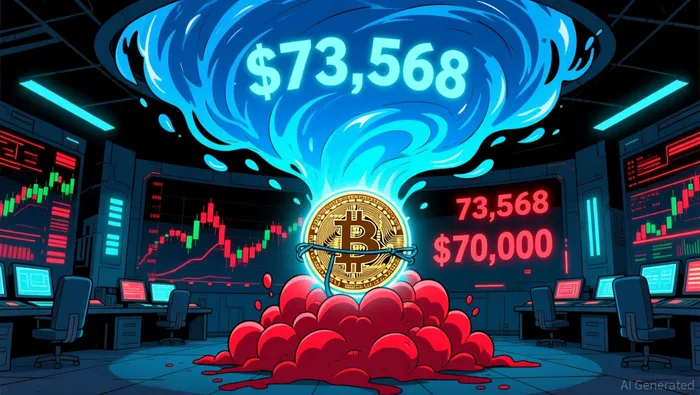
Data from CoinGlass indicates a precarious equilibrium in the Bitcoin derivatives market. $258 million in short positions are at risk if Bitcoin breaks above $73,568.
Conversely, long positions valued at over $514 million are vulnerable to liquidation if the price falls below $70,000. This asymmetry suggests that a breakdown might trigger a larger wave of selling than an upward breakout.
Derivatives data reveals another significant liquidity pool where $159.87 million in short positions face liquidation if the price decisively breaks above $72,034. A drop below $70,000 would trigger the closure of $160.25 million in leveraged long positions.
This creates a volatility sandwich, pinning the price between two massive liquidation clusters. The symmetrical nature of the data suggests a moment of equilibrium that is notoriously unstable.
Recent cryptocurrency derivatives market volatility saw nearly $547 million in liquidations over a 24-hour period. Short positions accounted for over 81% of these liquidations, totaling $446 million.
ETF flow persistence has also shifted, with recent streaks lasting only a few days compared to previous extended periods. Cumulative data shows Bitcoin ETF flows plateauing at $55–$60 billion in 2026.
According to Ecoinometrics, this slowdown is attributed to the Federal Reserve's lack of relief and higher US Treasury yields. These yields now offer competitive returns, reducing the need for Bitcoin exposure.
Market analyst Ardi explains that the BTC range near $74,000 persists because traders show similar behavior at resistance levels. Long positions drop as price tests resistance, while short exposure increases.
On-chain researcher Axel Adler Jr. flagged that Bitcoin's Bull-Bear Index has flipped above zero. This frames the current move as a recovery rather than a new bull regime.