

Bitget introduced its Scan to Pay feature on May 6, 2026, creating a direct path for users to spend USDT at physical merchants by scanning QR codes within the Bitget App. The feature is now live in selected markets across Southeast Asia and Latin America, regions where QR-based payments are widely adopted but access to traditional banking infrastructure remains uneven. This is a targeted liquidity injection, aiming to increase USDT velocity by making it a spendable tool in daily retail.
The core flow is designed for frictionless adoption. Users set a payment PIN, scan a merchant's QR code, review the USDT charge and conversion details, and confirm with their PIN. The system handles the background conversion and settlement in local currency, mirroring familiar local payment flows. For users, this removes the need for manual off-ramping, bank transfers, or currency conversion steps, unlocking their crypto's purchasing power instantly at checkout.
The immediate market context is one of expanding crypto adoption into real-world use cases. The launch targets emerging markets that have seen some of the fastest growth in digital asset usage over the past year. By integrating with existing local payment networks like ThaiQR, Pix QR, and VietQR, Bitget aims to bridge the gap between financial access and usability for the underbanked, positioning USDT as a practical medium of exchange.
The Flow Impact: Volume and Liquidity
The one-step checkout mechanism is designed to directly increase transaction frequency by removing the friction of manual off-ramping. Users can now activate their USDT purchasing power instantly at checkout, mirroring the speed of traditional QR payments. This streamlined flow targets the underbanked in key markets, aiming to convert idle crypto balances into active spending flows and boost USDT's velocity in daily commerce.
Integration with existing local payment rails like ThaiQR and Pix QR is a critical enabler. It drives on-chain volume for USDT without requiring merchants to change their POS systems or bank accounts. This low-friction adoption path leverages established networks, allowing Bitget to tap into billions of existing QR transactions globally. The result is a potential surge in transaction volume that flows directly through the USDT ecosystem.
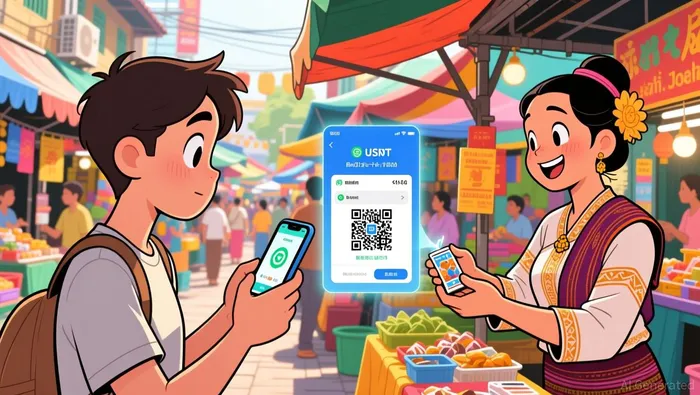
The entire setup hinges on user adoption to convert Bitget's existing USDT balances into active spending. The feature unlocks purchasing power but requires users to hold USDT in their Spot Account to use it. Its success will be measured by how many of Bitget's 125 million users actually spend their stablecoins this way, turning a new payment tool into a significant new source of liquidity and real-world utility.
Catalysts and Risks: Adoption vs. Regulation
The primary catalyst for success is network expansion. The feature's value scales with both user base growth in target markets and the addition of more merchant partners. Bitget's initial launch across Southeast Asia and Latin America taps into regions with fastest growth in digital asset usage and billions of existing QR transactions. For the flow to become significant, Bitget must convert its 125 million users into active spenders and rapidly onboard merchants to create a critical mass of acceptance. Without this dual expansion, the feature risks remaining a niche utility.
The most significant threat is regulatory scrutiny. By enabling direct spending of USDT at physical merchants, the feature blurs the line between a crypto exchange and a payment processor. This could trigger compliance costs and operational friction as regulators assess whether Bitget's technical interface constitutes a payment service. The disclaimer that payment services are provided solely by third-party payment service providers is a legal shield, but enforcement may not follow the letter of the law. Any regulatory pushback could slow expansion or force costly redesigns.
The long-term value depends entirely on whether this creates a sustainable, high-volume payment flow. If adoption is broad and transaction frequency is high, it will boost USDT's velocity and create sticky user engagement. If it remains a low-usage tool for a small segment, it adds minimal liquidity and utility. The setup is a classic test of real-world adoption: does the frictionless flow actually change spending behavior, or does it simply offer a new, unused option?