

Every time BlackRock moves a chunk of Bitcoin to Coinbase Prime, the same story fires off. On-chain watchers see the wallet activity, retail traders panic, and headlines ask whether the world's largest asset manager is finally selling. It is a reflexive read - and it is almost always wrong.
BlackRock deposited 3,580 BTC - roughly $227 million at the time to a Coinbase Prime address, and the familiar cycle repeated. But the question isn't why they moved the coins. The question is what the movement reveals about how the Bitcoin ETF actually works, and who holds the keys when it goes wrong.
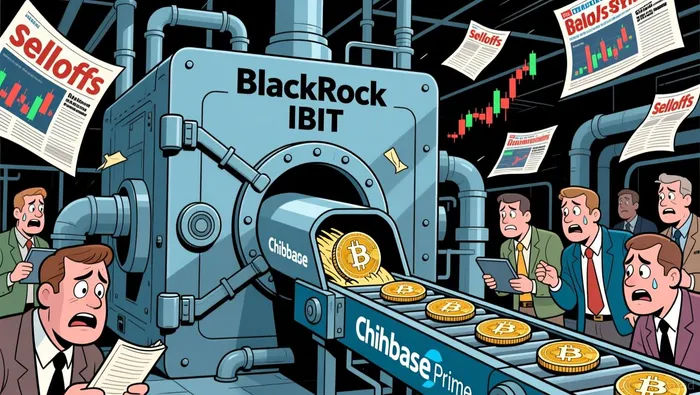
The plumbing nobody is talking about
To understand the transfer, you first need to understand what Coinbase Prime actually is in this context. It is not a trading account. It is BlackRock's prime execution agent - the institutional desk that sits between IBIT's custodial cold storage and the authorized participants (the big banks and dealers that create and redeem ETF shares). When investors redeem IBIT shares, the fund has to deliver the underlying Bitcoin to those participants. The coins move through Coinbase Prime as part of that settlement process.
Think of it as the conveyor belt. You don't stare at the conveyor belt and decide the factory is shutting down.
On-chain tracker Arkham Intelligence has confirmed repeatedly that when BlackRock moves Bitcoin to Coinbase Prime during heavy redemption periods, no sale follows. The coins are being routed for settlement, not dumped on the market. This is the most basic distinction between custody mechanics and trading intent, yet it still gets treated as breaking news every time.
The pattern matters more than the number
Here is what does matter. These transfers are happening with growing regularity because IBIT is experiencing its most severe redemption stress since launch.
In May 2026, IBIT posted $528 million in a single day of redemptions - its second-largest outflow ever. The broader Bitcoin ETF complex saw 13 consecutive days of net outflows, a record streak, with roughly $4.3 billion and nearly 60,000 BTC leaving the 13-fund universe. IBIT alone shed $2.43 billion over a nine-session stretch. BlackRock moved roughly $1 billion in Bitcoin to Coinbase Prime in one week that month to settle those redemptions.
The 3,580-BTC transfer is not an isolated event. It sits inside a chain of institutional plumbing moves that happened because the system is being tested at scale for the first time. When you have a $47 billion fund facing sustained outflows, the custodial and settlement layers become visible. That visibility is the story.
Who sits in the middle
This is where the structure gets interesting, and not in the way crypto advocates like.
Coinbase Prime is the only institution authorized to sit between BlackRock's Bitcoin and the market for creation and redemption purposes. BlackRock filed a surveillance-sharing agreement with Coinbase when IBIT launched, formally tying the exchange to the trust's operations. The SEC filing for the fund explicitly lists reliance on the "Prime Execution Agent" - Coinbase - as a concentrated operational risk.
In other words, the world's largest asset manager put $47 billion of Bitcoin into a structure where a single exchange-affiliated prime broker controls the settlement rail. If you are thinking about the political irony of that - a decentralized asset funneled through the most regulated US exchange, via the largest centralized fund manager - you are thinking about it correctly. It is the exact concentration the early Bitcoin thesis was supposed to eliminate.
What makes this less theoretical right now is that IBIT's outflow pressure is making the dependency visible in real time. The more redemptions flow, the more Bitcoin has to pass through Coinbase Prime. The more that happens, the more Coinbase accrues operational leverage over the biggest institutional channel to Bitcoin.
In-kind changes the calculus
There is a secondary layer to this that most coverage still misses. In mid-2025, the SEC approved in-kind creations and redemptions for crypto ETFs. Before that change, when an investor redeemed IBIT shares, BlackRock had to sell Bitcoin for cash to pay the redemption - meaning every outflow created sell pressure on the open market. Under the new in-kind rules, Bitcoin can be transferred directly to the redeeming party. No sale. No market impact.
This should make redemption-heavy periods less disruptive for Bitcoin price. It also makes the Coinbase Prime rail even more important, because the settlement layer has to handle direct Bitcoin transfers to authorized participants rather than cash. The plumbing becomes more critical precisely when the market is most stressed.
What this is not
I should be clear about what I don't think is happening here. BlackRock is not exiting its Bitcoin position. The fund still holds hundreds of thousands of BTC and remains the dominant spot Bitcoin ETF by assets. The transfers are operational. Repeatedly calling them sell signals is lazy journalism that trains retail traders to misread basic ETF plumbing.
That said, dismissing the transfers as meaningless is its own kind of laziness. The transfers are a window into a structural shift: the institutional Bitcoin stack is becoming more centralized, not less, as the system scales under pressure.
The real question
The question isn't whether BlackRock is selling. The question is whether Coinbase Prime has become too important to fail, at least in the Bitcoin ETF ecosystem. If the next wave of institutional redemptions or market stress hits while all the Bitcoin flows through a single rail, that rail becomes a choke point.
Coinbase's revenue model is already built on custody and institutional services. IBIT's growth has been one of its strongest business tailwinds. The more the fund's operational architecture depends on Coinbase Prime, the more aligned their incentives become - and the harder it would be for BlackRock or the SEC to substitute an alternative without disrupting the entire creation and redemption cycle.
I'm less interested in whether today's transfer will move the price. I'm more interested in whether anyone is tracking the fact that the largest channel to institutional Bitcoin runs through a single exchange-affiliated desk, and what happens to that assumption when the next stress test arrives.