

The headline says interest. The math says crowding.
BlackRock-backed Akaysha Energy is shopping a 50–60% minority stake to pension funds and industry buyers, according to Bloomberg's June 4 reporting. The narrative is clean: institutional validation, demand for clean energy infrastructure, a BlackRock stamp of approval on Australian battery storage. Any astute investor in energy infrastructure would have noticed what the headline skips - the reasons Akaysha needs the capital are the same reasons the buyer needs to be cautious.
BlackRock Acquired a Pipeline. What Shipped Is Different.
BlackRock bought Akaysha in August 2022 with a commitment of over A$1 billion to develop 1GW of battery storage in Australia. Fast-forward four years, and Akaysha claims a 4GWh portfolio backed by over A$3 billion in institutional capital. The headline number has grown. The execution record is harder to defend.
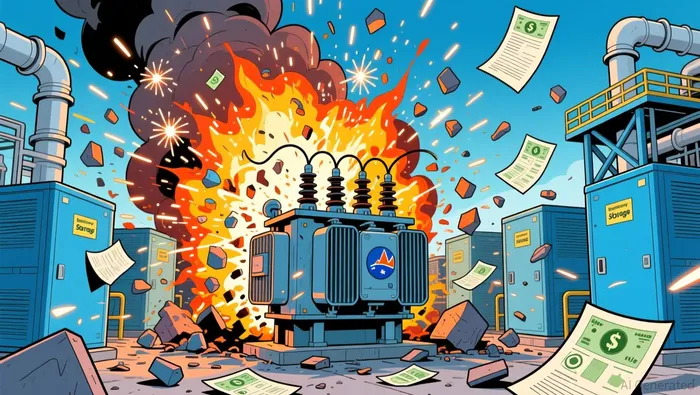
Start with Waratah Super Battery - the 850MW crown jewel at the former Munmorah coal plant north of Sydney, funded by a A$500+ million BlackRock capital raise. Construction started May 2023. Akaysha declared the battery component finished. Then, in October 2025, during energisation - just weeks from final testing - one of three high-voltage transformers suffered what Akaysha's own update called a catastrophic failure. The unit was declared "beyond repair." Full operation was delayed by six months, now pushed to Q4 2026. The replacement transformer alone is scheduled for Q3 2026 delivery.
The Australian Financial Review ran a headline that said it all: "Waratah super battery failure reveals cracks in A$1B contract award."A transformer blowing up during commissioning on a project this size isn't a vendor issue. It's an engineering and project management red flag on the single biggest asset in the portfolio.
Meanwhile, Elaine BESS - a 311MW/1,244MWh project in Victoria that has been in the pipeline for years - only commenced construction in October 2025. That is not a schedule. That is a lag.
Brendale BESS, the 205MW/410MWh unit in Queensland, did commission in January 2026, five months ahead of schedule. That's the good news. It's also the smallest and least complex of their current projects. Size matters in BESS execution - and the bigger the bet, the worse the track record.
The Market Is Crowded. Margins Are Not.
Here is what the stake-sale narrative does not say: Australia's National Electricity Market has 67.3GW of battery storage in its connection pipeline. Only about 5GW was operational as of Q4 2025. Battery projects now account for 46% of the country's record 64GW total energy development pipeline. That is not a growth story. That is a race to connect first before the rest of the pack compresses every participant's economics.
And the economics are already squeezing. Wholesale electricity prices in the NEM nearly halved in the December 2025 quarter, driven by record renewable generation - the very thing batteries are supposed to enable. Research from Modo Energy showed that just a 7% reduction in BESS capacity would increase trading spreads by up to 40% in New South Wales. The reverse is what's happening: capacity is surging, spreads are collapsing.
Negative wholesale prices - where generators literally pay the grid to take their power - are now a regular feature across all NEM states. That is the signal. Battery storage returns follow power-price spreads, not headline renewable capacity numbers. As spreads compress, battery economics follow.
Cell costs are falling too - utility-grade LFP cells traded at $55–75/kWh in early 2026, down 40% from 2024. Lower capex is real, but it does not solve the revenue problem. The per-MWh build cost dropping is not the same as the per-MWh return staying attractive.
The Stake Sale Is Not Validation. It Is A Stress Test.
Why would BlackRock be selling a 50–60% minority stake now? The answer is not that the thesis has changed - it's that the capital story has outpaced the operating story. Akaysha has raised billions in project-level financing ($650M in July 2024, A$300M in September 2025, A$460M for Elaine) and continues to land new tenders. But this is all committed capital on paper. The revenue has not followed.
Akaysha has hedged one project - Brendale - with a revenue swap offtake agreement with Swiss commodity trader Gunvor Group. That is smart. That is also one project in a portfolio that claims to be worth over A$3 billion. One hedged deal does not de-risk a platform.
The cross-currents are clear: battery storage is genuinely needed in Australia, Akaysha has the biggest developer platform in the country, and grid-forming battery technology is real and improving. But the execution risk at Waratah is not a one-off. The margin compression from oversupply is structural. And the 67.3GW pipeline means that every new project Akaysha brings online races toward a thinner revenue pool.
What This Means For Anyone Buying In
The pension funds and industry buyers eyeing a stake in Akaysha are buying a developer pipeline, not an operating platform. The distinction matters. A pipeline is a list of projects that might ship on time, at budget, into a market that might pay what the models assumed. What Akaysha has actually delivered is one mid-size project ahead of schedule and one flagship project that suffered a catastrophic transformer failure during commissioning.
BlackRock entered this deal in 2022 when battery storage looked like the easy infrastructure pick - government-backed, ESG-friendly, and technically simple enough to roll up like solar farms. Four years later, the transformer blew up, the wholesale prices halved, and the pipeline grew to 67.3GW of competition. The story got harder while the pitch stayed the same.
If Akaysha can raise the stake at a price that assumes spreads hold and execution risk has been solved by the Gunvor deal, the buyer is overpaying. If the price reflects the reality - one delivered project, one catastrophe, one hedged revenue stream, and a pipeline racing toward margin compression - then maybe the math works. You decide which was marketing fluff and which one was analysis.
The real question is not whether funds are interested. The real question is what price BlackRock is prepared to accept - because that number will tell you whether the biggest asset manager in the world thinks its Australian battery bet is a long-term hold or a liquidation.