

Bloom's rally has turned a real AI-power bottleneck into a crowded trade
The thesis is still interesting. The stock is now the harder part.
Bloom is up 150% year-to-date after a 23% single-day surge pushed shares to $217 and change. That kind of move often happens when a genuine AI bottleneck meets recency bias: investors stop waiting for proof that profitable scaling is established and start paying as if the next chapter is already here.
Goldman Sachs' stake helped validate the trade
When Goldman Sachs lifted its existing stake by 350% in Q1 and ended the quarter with more than $2.7 billion of Bloom in its portfolio, the market read that as more than one institutional buyer getting interested. Large holders can make other investors more comfortable, even when valuation has already moved well ahead of near-term earnings power.
That is the risk once a stock becomes a symbol. Bulls can focus on time-to-power as the new AI constraint and treat Bloom as a must-have infrastructure name. That may yet prove correct. But once that narrative takes over, it becomes easier to overweight confirming headlines and underweight the gap between story and durable profitability.
The AI power constraint looks real, but Bloom's share of it is still unproven
The market may be right about the bottleneck and too early about the winner.
Rack densities are rising fast
The macro case is no longer abstract. Nvidia's Blackwell roadmap is pushing GB200 racks to 120 kW and GB300 racks to 140 kW, with 300 kW to 600 kW systems expected over the next one to two years. That is a sharp step-change in density, and it forces data centers to rethink power and cooling much sooner than many were built to handle.
Bloom's own report points to the same shift in priorities. Its survey found one-third of data centers to be fully off-grid by 2030, while Texas' data center load is expected to account for nearly 30% of U.S. demand by 2028. That does not prove Bloom wins, but it does suggest power availability is becoming a bigger project driver.
A real market does not mean immediate Bloom upside
This is where investors can slip into confirmation bias. They see a real constraint, place Bloom in the solution set, and assume linear upside. But "AI needs power" and "Bloom monetizes that demand immediately" are different claims.
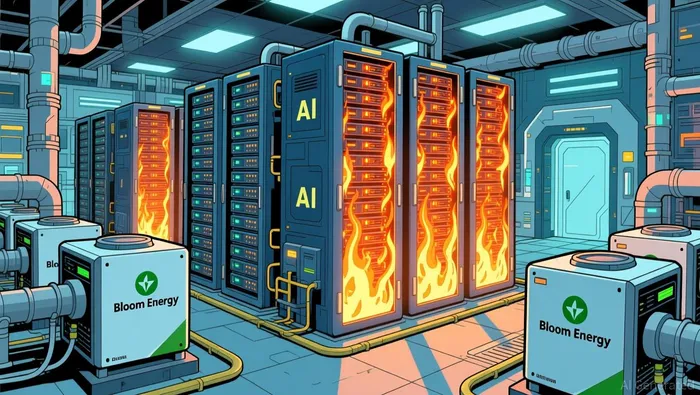
Bloom has lived this gap before. Long before the AI rerating, it was a startup darling funded by Silicon Valley's initial push into renewable energy with early customers such as Google and Walmart. After its 2018 IPO at $15 a share, the stock remained near that level for years. That history matters. It shows Bloom had a long runway to validate the technology, build references, and scale operations before the market rewarded it.
What investors need to see next
The bull case is that higher rack densities compress the adoption window. The bear case is that incumbents, alternative generators, and utility-backed solutions may still capture the easiest wins first. That makes the next few quarters important.
What to watch: - customer wins tied to higher-density deployments - evidence that onsite power is speeding up project starts - proof that demand is turning into revenue, deployments, and clearer visibility
Valuation now leaves little room for execution misses
After a huge run that attracted strong Goldman Sachs support, Bloom no longer needs another reason to stay interesting. It needs proof that the AI-power narrative is becoming financial proof. Right now, the stock is trading near $217 and change. That is the real tension: the story can be right and the timing can still be wrong.
What a credible next update must show
For the stock to stay justified from here, the next earnings update needs to do more than reinforce the macro theme. Investors should look for four things:
- Backlog-to-revenue conversion: Are orders becoming recognized revenue, or are they still mostly promises?
- Deployment speed: Is power-advantaged demand turning into faster installations and customer progress?
- Guidance stability: Can management hold or raise expectations without a wobble?
- Operating discipline: Is growth coming with better cost and execution control?
Why caution still makes sense
If results fail to validate the AI-power story in hard numbers, the market may decide Bloom is still a compelling technology with an immature earnings profile. That would matter more after a 150% year-to-date move.
The same logic applies after the surge to $217 and change. A weak reaction would not necessarily mean the long-term thesis is broken. It would mean investors got there too early.
That is why the cleaner posture is selective caution. The AI-power bottleneck looks real, and Bloom is part of the solution set. But once valuation gets this ambitious, execution stops being optional and becomes the main test.