

Ceasefire eased headline fear, but not the supply squeeze
Brent's move below $93 per barrel reflected relief after Iran and Israel agreed to halt attacks. But this still looks more like a ceasefire trade than a resolved market. Brent remains 38.30% higher than a year ago, which suggests the war premium has been trimmed, not erased.
Two signals are pulling the market in opposite directions
The bullish case is straightforward: if de-escalation holds, the conflict premium can unwind quickly and prices can keep drifting lower.
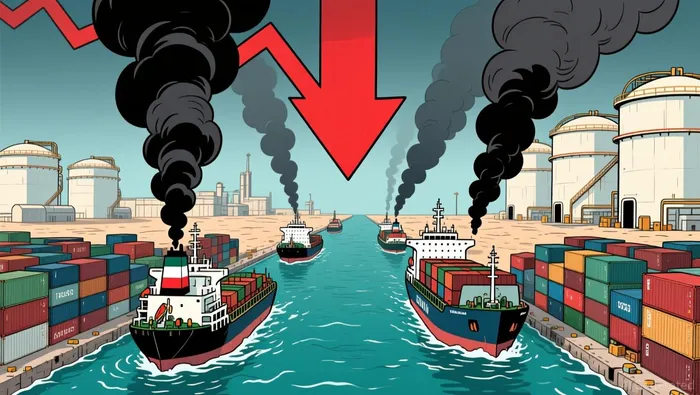
The bearish case is still stronger in the near term. Even with the ceasefire holding, the Strait of Hormuz is still effectively closed, and last week's spike to $110.94 for Brent and $97.01 for WTI showed how fast the market can reprice a Hormuz threat.
That is why this still looks like a dangerous middle zone. The market has already absorbed a major disruption, and a delay in reopening the strait could push prices back above $100 quickly.
Why oil can still spike back above $100
The headline relief is real, but the flow problem is not fixed. The Strait of Hormuz is still effectively closed, and supply concerns remain the main driver of price sensitivity. As long as exports and shipping remain constrained, another scare can quickly force traders to bid for scarce cargo again.
Shut-in production and inventory draws keep the market tight
A ceasefire can calm nerves faster than it restores barrel movement. The physical gap is still large: 10.5 million barrels per day of Middle East production was shut in during April, while total losses since February to 12.8 mb/d show how much Gulf output has already disappeared from the market.
The inventory backdrop adds to the sensitivity. Large oil inventory draws in May and June will keep supporting the market, and global oil inventories will decrease by 2.6 million b/d this year. When stocks are being drawn down, there is less cushion to absorb another disruption.
SPR releases help, but they are not an instant fix
The DOE has already released 17.5 million barrels of crude oil from the U.S. Strategic Petroleum Reserve, and reports say the U.S. has become the supplier of last resort. That provides some relief, but it does not instantly erase the shortage.
There is also an execution limit. The U.S. SPR release is structured as an exchange, so the market gets relief gradually rather than all at once.
The near-term debate: still-tight flows versus gradual normalization
Near-term bulls can point to a closed Hormuz, millions of barrels per day of shut-in production, and drawing inventories. Bears are trading the recovery path, leaning on shipping traffic beginning to pick up in June and the possibility that flows improve gradually even if production takes longer to recover.
What would actually validate a lower-oil move
The ceasefire bought calm, but traders still need proof that physical pressure is easing.
China's weaker demand is the clearest near-term offset
The cleanest bull-to-bear signal is demand relief from Asia. China's crude imports in May is tracking around 6.6 million barrels a day, the lowest level since 2016, and China's sharp drop in crude imports is freeing up supplies for the rest of Asia. If that trend holds, the market can start to feel less contestable on every Gulf barrel.
Price needs firmer follow-through
Brent has already slipped below $93 per barrel, but a more durable shift in tone will need stronger follow-through in price. Until then, a quick dip followed by a rebound may simply reflect traders testing whether relief has enough demand support behind it.
What matters most from here
Do not trust a lower-oil story on headlines alone. The better signal is a combination of calmer geopolitics, improved Hormuz flows, and sustained demand relief from China. If those pieces do not line up, one Hormuz delay could still send oil back toward $100.