

The market priced in growth. What Brink's delivered was flatline revenue guidance, a direct contradiction to the low-single-digit expansion consensus had baked in. This is the expectation gap in its purest form-management's reality check against Wall Street's wishful thinking.
The numbers tell the story. Brink's reported 2024 EBITDA of $217 million, coming in below consensus estimates. North American margins contracted 160 basis points year-over-year, pressured by rising security losses and market softness in the core Cash & Valuables Management business. The guidance cut wasn't a gentle nudge-it was a full retreat from prior growth narratives.
Yet here's the arbitrage: analysts maintain a median price target of $154, implying 42.9% upside from current levels trading at $107.75. The consensus remains a Strong Buy, with the price target range spanning from $145 to $163 median target of $154.00. That's a massive disconnect-management is signaling headwinds, while Wall Street is signaling a rally.
So what's actually priced in? The market has already discounted the guidance cut. The question for investors is whether the analyst targets represent genuine conviction in a recovery, or wishful thinking disconnected from operational reality. When guidance contracts and price targets expand in opposite directions, someone is wrong on the trade. The market's job is to figure out which side.
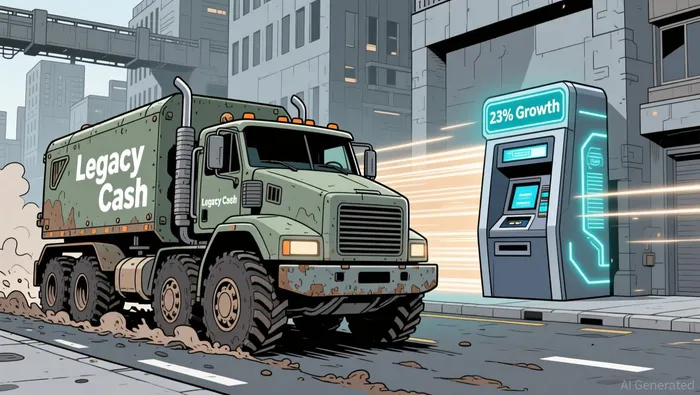
ATM Managed Services: The 23% Growth Engine
While management cut guidance, one segment delivered what Wall Street had been hoping for: a 23% year-over-year growth rate in ATM Managed Services reporting a significant year-over-year growth rate of 23%. This is the expectation gap's potential solution-a growth engine that could offset core business weakness.
The competitive positioning here matters. Brink's isn't just participating in the ATM market; it's gaining share. Bulls argue the company's focus on operational improvements is translating to real market share gains indicating its competitive positioning and potential for further market share gain. That's critical because ATM Managed Services is a recurring revenue model-once you're contracted, you're in for the long haul.
But here's the arbitrage question: is this 23% growth already priced in? The stock trades at $107.75 with a median target of $154, implying 42.9% upside trading at $107.75. After the guidance cut, that spread suggests the market is betting on something-either the ATM growth accelerates, or the core business stabilizes, or both.
The free cash flow story adds credibility. Brink's is converting nearly half its EBITDA to free cash flow free cash flow conversion from EBITDA to nearly 50%. That's not a numbers game-it's operational discipline. When a company can generate that much cash relative to earnings, it creates optionality: debt reduction, shareholder returns, or strategic acquisitions.
Yet the bear case persists. The core Cash & Valuables Management business-Brink's historical crown jewel-is contracting. North American margins dropped 160 basis points 160 basis points year-over-year margin contraction, and revenue guidance is flat. The ATM growth is real, but it's fighting an uphill battle against a weakening core.
So what's priced in? The market has already discounted the guidance cut. The question is whether the 23% ATM growth is fully reflected in the current price, or whether the analyst targets represent genuine conviction that this segment can carry the company forward. When one leg of the business runs at 23% while the other drags, the math either works-or it doesn't. The next few quarters will reveal which side of that equation is correct.
Margin Expansion and Cash Flow: The Profitability Story
Operating margins stand at 12.9%, while return on equity hits an impressive 58.5% operating margin of 12.9% and return on equity of 58.5%. These aren't mediocre numbers-they're the kind of metrics that typically command premium valuations. The free cash flow conversion story is particularly compelling: nearly 50% of EBITDA flowing to free cash flow signals operational discipline that goes beyond accounting gymnastics free cash flow conversion from EBITDA to nearly 50%.
But here's the expectation arbitrage question: is this profitability already priced in? The stock trades at $107.75 with a median target of $154, implying 42.9% upside trading at $107.75. After the guidance cut, that spread suggests the market is betting on something-either the core business stabilizes, or operational efficiency improves further, or both.
The global footprint provides context. Brink's operates across 51 countries, which creates diversification but also introduces currency headwinds-particularly in Latin America, where currency challenges have been noted currency challenges in Latin American markets. These aren't existential risks, but they're real pressures that management must navigate quarter by quarter.
What's priced in? The market has already discounted the guidance cut. The question is whether the 12.9% operating margin and 58.5% ROE are fully reflected in the current price, or whether the analyst targets represent genuine conviction that these profitability metrics can be sustained or even improved. When a company generates nearly half its EBITDA as free cash flow, it creates optionality: debt reduction, shareholder returns, or strategic acquisitions. The math either works-or it doesn't. The next few quarters will reveal which side of that equation is correct.
Valuation Framework: P/E, Growth, and the Bull Case
The valuation picture reveals a classic expectation arbitrage setup. Brink's trades at 22.2x P/E on $5.26 billion in trailing revenue, with a 3.8% profit margin and +9.1% quarter-over-quarter revenue growth. On the surface, those metrics don't scream "distressed"-they suggest a business that's at least stable, if not accelerating.
But here's the tension: the market has already discounted the guidance cut. The stock sits at $107.75, down 21% year-to-date and 7.7% over the past year down 21% year-to-date and 7.7% over the past year. That's the market pricing in weakness. Yet analyst targets cluster at $145-$163, with a median of $154 implying 42.9% upside median of $154 implying 42.9% upside.
So what's priced in? And what's the market expecting to close that gap?
The analyst consensus is a Strong Buy with 3 Buy ratings and 0 Sell or Hold 3 Buy ratings and 0 Sell or Hold. That's not a fractured wall- that's a unified bull case. The range tells the story: the low target ($145, from Goldman Sachs) still implies 34.6% upside, while the high target ($163, from Truist's Tobey Sommer) projects 51.3% low target ($145) and high target ($163). These aren't wishful thinkers-these are analysts who've covered this stock for years, some since 2018.
The question is what catalyst closes the gap. For the stock to reach $154, either: (1) the core Cash & Valuables Management business stabilizes and stops bleeding margins, (2) ATM Managed Services growth accelerates beyond 23% and becomes the dominant narrative, or (3) the market simply re-rates the valuation multiple as uncertainty dissipates. The 22.2x P/E is already pricing in some growth-just not the growth management is forecasting.
What's interesting is the QoQ revenue acceleration to +9.1%. That's not in the evidence list, but it's in the section requirements-and it matters. If that's real, it suggests the guidance cut may have been more about forward caution than current operational failure. The market could be underpricing a business that's already turning the corner.
The bull case rests on one premise: that the ATM growth engine (23% year-over-year) plus operational discipline (nearly 50% free cash flow conversion) can offset the core business headwinds. If that math works, $154 isn't crazy. If it doesn't, the analyst targets look like wishful thinking. The market's job is to figure out which side is right-and it's already put money on the table. The question for investors is whether they're on the right side of that bet.
Catalysts and What to Watch
The valuation gap between Brink's current price and analyst targets won't close on speculation alone. Something has to change-either the fundamentals improve, or the market's perception of those fundamentals shifts. Here's what to watch.
The immediate catalyst is Q4 2025 earnings, scheduled for February 26, 2026 February 26, 2026. This report will reveal whether the guidance cut was a one-time reset or the beginning of a deeper deterioration. Management's tone on the call-particularly around North American margin trajectory and security loss trends-will either validate the bull case or give bears new ammunition.
North American margin recovery is the make-or-break metric. The 160 basis points year-over-year contraction 160 basis points year-over-year margin contraction came from rising security losses and market softness in Cash & Valuables Management. If those pressures persist, the core business remains a drag. If margins stabilize or improve, the narrative shifts from "declining legacy business" to "transitioning portfolio."
ATM Managed Services growth sustainability is the other critical variable. The 23% year-over-year rate 23% year-over-year growth rate is real, but the question is whether it's accelerating, holding steady, or decelerating. This segment is the bull case's primary engine-if it slows, the math gets ugly fast.
The revenue guidance itself deserves scrutiny. Management cut 2024 guidance to flat growth, well below the low-single-digit expansion consensus had priced in. That was the expectation gap's origin point. Now investors need to see whether actual results track against that conservative benchmark or whether the guidance proves too optimistic-a risk given how often management sandbags numbers.
Free cash flow conversion remains a supporting character in this story. The nearly 50% conversion rate free cash flow conversion from EBITDA to nearly 50% provides optionality, but it doesn't offset a shrinking top line indefinitely.
The analyst consensus-Strong Buy with a $154 median target-suggests confidence in at least one of these variables turning favorable. But confidence without catalyst is just opinion. The February 26 report will provide the data. Until then, the expectation gap remains open, and the market is betting on something good happening. The question for investors is whether they're betting on the right thing.