

Broadcom guided to consolidated revenue of 29.4 billion in Q3 - semiconductor revenue from AI to grow over 200 percent year-over-year to 16.0 billion dollars - and Broadcom falls 3% anyway.
The market is reading the wrong lesson from that reaction. This isn't a story about whether Broadcom's AI demand is real. It is a story about whether the Broadcom business model - and the VMware software engine supposed to justify its multiples - can sustain what the market is now pricing in.
The AI number is real. The architecture is different.
Broadcom's AI semiconductor revenue hit $10.8 billion in Q2, up 143% YoY. Q3 is expected AI semiconductor revenue to accelerate to $16 billion, up over 200% year-on-year - growth that would make even Nvidia blink. The AI backlog expanded from $10 billion in Q3 to $73 billion. CEO Hock Tan has now publicly stated the company has "line of sight" to over $100 billion in AI chip revenue alone in 2027.
That is not a narrative. That is an earnings trajectory.
But here is what the headline skips: Broadcom does not sell GPUs. It sells custom ASIC design and manufacturing services - ASICs are optimized for specific tasks, unlike GPUs, built for individual customers from the ground up. Google's TPUs. Meta's custom chips. OpenAI has announced a partnership with Broadcom Inc. to design and manufacture its first proprietary AI processors in a $10 billion deal. Anthropic placed an additional $11 billion order in the fourth quarter.
This is a services model wrapped in a semiconductor revenue line. Broadcom designs, partners, and ships chips that nobody else can use. There is no CUDA moat. There is no shelf product a data center can walk in and buy. The moat is the relationships and the engineering bandwidth - and those are not the same thing as a product platform.
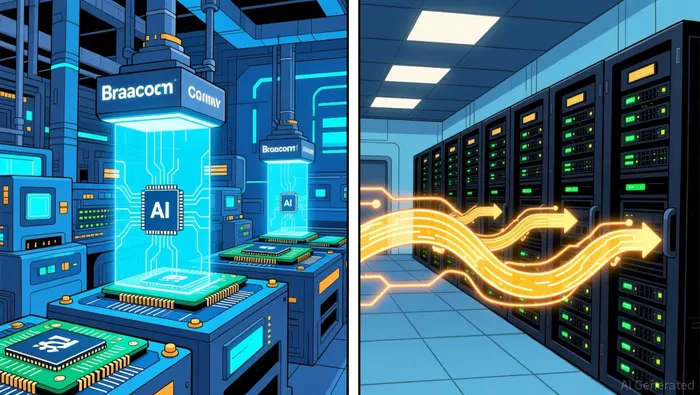
This matters because the custom ASIC business is exactly what Nvidia fears in the inference era. As hyperscalers optimize for cost-per-token rather than raw training throughput, the incentive to customize grows. Broadcom is the enabler of that shift. But being the enabler means Broadcom's revenue is someone else's architecture decision - not its own.
The VMware slowdown is the part the market actually priced
While the AI story grabs headlines, the Q2 results carried a quieter signal that moved the stock: Revenue for infrastructure software of 7.2 billion was up 9% year on year. Q3 guidance puts it at approximately $9 billion, which implies a seasonal lift rather than an acceleration in the underlying trend.
Compare that to where this story started. VMware's infrastructure software business generated $27 billion in revenue in fiscal 2025, growing 26% year-over-year. In Q1 FY2026, VMware grew 13%. By Q2, the infrastructure software segment as a whole was at 9%. The deceleration is real.
This is the architecture question the persona always comes back to: hardware sets the ceiling; software sets the multiple. Broadcom bought VMware for $61 billion because the plan was to become a software-recurring-revenue company that could justify a higher valuation multiple on top of its semiconductor cash flow. The VMware transition to subscription pricing drove initial growth, but the low-double-digit growth rate is now normalizing toward the mid-single digits that the broader enterprise software market produces.
Put plainly: Broadcom's semiconductor business is growing at 143% to 200%+ year-over-year, and its software business is growing at 9%. The company has $2.2 trillion in current market cap partly because it believed VMware would converge toward a higher-multiple software story. If software growth is settling into 9-12%, that convergence looks slower than the price assumes.
Supply commitments are the dual signal
The $73 billion AI backlog looks like a fortress. It is. But supply commitments of this scale are a dual indicator - demand strength and leverage risk at the same time.
Confirmed XPU customers include Google, Meta, OpenAI, Anthropic, and - new in 2026 - represent a concentration that would make a portfolio manager nervous. These are the same customers who also buy Nvidia GPUs, AWS capacity, and Google Cloud compute. They set the budget. They decide whether custom chips beat GPUs on total cost of ownership. And they can change their minds.
The OpenAI deal - $10 billion for custom AI processors - and Anthropic's expanding Google-Broadcom partnership are headline-grabbing. They also mean Broadcom's AI revenue is now tracking the capital allocation decisions of two pre-profit AI labs. That is not a risk I'm highlighting to dismiss Broadcom. It is a risk that changes how I think about allocation.
Demand is not the issue. The issue is whether a $73 billion concentrated backlog, a 9% software growth rate, and a $2.2 trillion market cap represent a risk/reward profile that still justifies a large position.
The investment question is not whether Broadcom wins
Broadcom is on the right side of the training-to-inference transition. Custom ASICs are the inference-era answer to GPU homogenization. Broadcom's engineering capability and customer relationships are not going anywhere. The $100 billion AI chip revenue target by 2027 is mathematically reachable on the current trajectory - $10.8B in Q2, $16B guided for Q3, implies an annualized AI run rate approaching $60-70 billion this fiscal year.
But here is what separates the long-term thesis from the current allocation decision: Broadcom is no longer a stock with asymmetric upside at this market cap. The returns are real, but they are likely back-half weighted. Much of the inference transition is already baked into the price.
The debate is not whether Broadcom remains essential to the AI infrastructure buildout. It is whether a company with 200% AI growth and 9% software growth deserves a $2.2 trillion valuation when the software multiple engine is decelerating, and whether the concentrated customer risk in a $73 billion backlog is appropriately priced.
In my opinion, Broadcom deserves a position in a portfolio tracking the AI infrastructure trade - not because it is the cheapest way to get AI exposure, but because the ASIC transition is a structural shift that will take years to play out. But the allocation should reflect the changed risk profile: smaller than it was a year ago, managed with attention to VMware growth prints and customer concentration signals, and always weighed against what else the capital could do elsewhere in the AI trade.
The break condition is clear: if VMware software growth falls to mid-single digits for two consecutive quarters while AI semiconductor growth decelerates below 100% year-over-year, the dual-engine thesis cracks. Until then, the trend is intact - just no longer asymmetric.