

Broadcom shares fell more than 13% in extended trading on June 3 after the chipmaker's fiscal second-quarter revenue landed at $22.19 billion, just below the $22.27 billion Wall Street estimate cited by Reuters, even though its own release showed 48% revenue growth and record free cash flow.
The reaction turns a strong AI print into a higher-bar story. Broadcom reported $10.8 billion of AI semiconductor revenue and guided that line to $16.0 billion in the current quarter, yet Reuters said the guide was slightly below Visible Alpha's $16.36 billion estimate and the long-range $100 billion AI chip sales target for 2027 was left unchanged.
A narrow revenue miss mattered because the bar had moved
A shortfall of about $80 million would not usually define a company growing sales by nearly half, but AVGO had already become one of the public-market proxies for hyperscaler custom silicon. Reuters said the stock sold off after the $22.19 billion revenue print missed expectations and after the 2027 AI sales forecast stayed at $100 billion.
Official figures still argue against a demand break. Broadcom posted $9.31 billion of GAAP net income, $15.24 billion of adjusted EBITDA and $10.26 billion of free cash flow, while third-quarter consolidated revenue guidance of $29.4 billion sat above the $28.54 billion LSEG average estimate reported by Reuters.
AI revenue accelerated, but the guide did not clear the hurdle
AI semiconductor revenue increased to $10.8 billion in fiscal Q2 from $8.4 billion in fiscal Q1, and the company says the current-quarter AI line should reach $16.0 billion. That sequence is steep enough to keep Broadcom in the AI infrastructure conversation, but the comparison that moved the stock was the $16.36 billion Visible Alpha estimate, not the year-over-year growth rate.
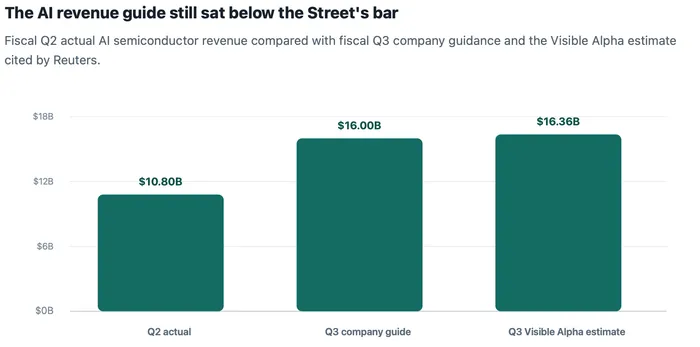
Source note. Provider and source are Broadcom Q1 release and Broadcom Q2 release for Q1 and Q2 AI semiconductor revenue plus Q3 company guidance, and Reuters via CNA for the Visible Alpha Q3 estimate. Symbol is AVGO. Date range is fiscal Q1 FY2026 through fiscal Q3 FY2026 guidance and estimate. Interval is quarterly.
The chart compresses the tension. Broadcom's company guide implies another large step-up from Q2, while the market-source estimate was already above that guide. A small gap can matter when the share price has been rewarding the company for custom-chip scarcity rather than only reported revenue.
Custom silicon now needs role discipline
Broadcom's role is not the same as Nvidia's. Reuters framed Nvidia's GPUs as the industry standard for AI workloads, while Broadcom sits in custom AI accelerators and AI networking for large cloud customers that want lower-cost and workload-specific silicon.
That distinction cuts both ways. Reuters said Meta and Alphabet's Google are among Broadcom's hyperscale customers, but it also noted that Marvell is making inroads and expects its custom chip business to surpass $10 billion of revenue in 2029. The economic link for AVGO is design-win durability, networking attach and supply availability, not a generic AI spending headline.
Software makes the consolidated story less explosive
Semiconductor solutions supplied $15.01 billion of Q2 revenue and grew 79%, while infrastructure software produced $7.18 billion and grew 9%. The VMware software base still supports cash generation, but the segment mix means consolidated growth does not look as dramatic as the AI semiconductor line.
That mix matters for the earnings multiple because Broadcom is no longer priced only as a cyclical chip supplier. The market has to decide how much value to assign to AI accelerators and networking when a slower software unit and a 67% non-GAAP operating income outlook sit inside the same company result.
The next quarter has to turn a bigger guide into a better surprise
Fiscal Q3 now carries three measurable hurdles. Consolidated revenue has to land near or above the $29.4 billion guide, AI semiconductor revenue has to clear the $16.0 billion company target rather than only meet it, and the non-GAAP operating income ratio has to stay near the 67% outlook rather than slide as capacity is secured.
Broadcom's quarter does not point to an AI demand break. It points to a higher standard for surprise. A company can report $10.8 billion of Q2 AI semiconductor revenue and still lose the argument if the next guide does not sit above the market's estimate. That is why the Reuters-cited $16.36 billion Visible Alpha estimate matters more to the stock story than the absolute growth rate.
A practical reading of the next report separates growth from repricing power. Growth is still visible if custom accelerators and networking keep rising. Repricing power comes back only if the company shows that customer demand is pulling shipments faster than the Street modeled, that supply remains available through 2026 and 2027, and that the 2027 AI target has room to move higher.
A weaker follow-through would leave the opposite message. If fiscal Q3 merely lands around the company guide, if the 67% operating-income outlook does not hold, or if Marvell's custom-chip progress makes hyperscaler design wins look less scarce, the stock can keep carrying a lower AI premium even while Broadcom's business keeps expanding. The selloff therefore reads less like a rejection of Broadcom's AI position and more like a warning that the market has stopped paying for growth that was already expected.