

If you are trying to build a portfolio that covers expenses without selling shares, Warren Buffett's name shows up everywhere. And honestly, that is a good place to start looking. But the "two Buffett stocks that pay passive income" angle you see floating around needs one correction right away: his biggest position does not count for income.
Apple is roughly 22% of Berkshire's public equity portfolio. It just raised its quarterly dividend to $0.27 per share in April 2026, which annualizes to $1.08. On today's stock price, that yields about 0.4%. You would need to hold a lot of shares to make Apple's dividend fund anything but a nice cup of coffee. That is a growth story with a dividend check on the side, not an income engine. Own Apple if you like its business. Do not own it for the cash flow.
So the actual income question is: among Buffett's real holdings, which ones pay a check you can plan your life around? Two stand out - and they are the ones that have been doing this for decades, not quarters.
American Express: the 16% raise that tells you what the business thinks about itself
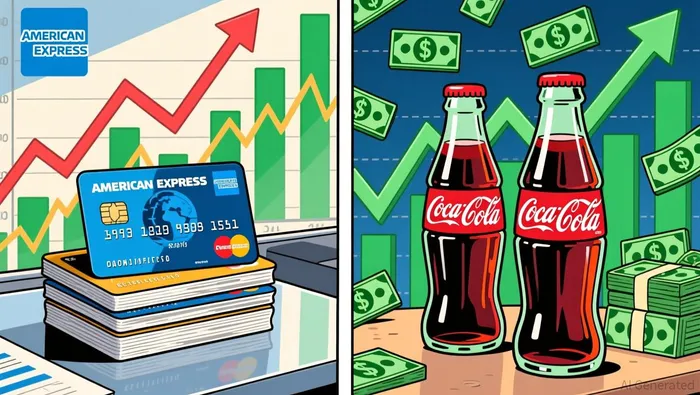
American Express holds about 17% of Berkshire's public portfolio and just handed shareholders something to pay attention to. In early 2026, the company raised its quarterly dividend 16% - from $0.82 to $0.95 per share. That annualizes to $3.80 a share. On current pricing, that works out to roughly a 1.2% yield. The headline yield won't fund a retirement check by itself, but the movement matters more than the static number.
A 16% jump is not something a board does when it is worried about the future of the payout. They do it when earnings are running hot and they want shareholders to feel it. American Express reported 2025 revenue of roughly $72 billion, up 10% year over year. Earnings per share grew alongside it. The machine is generating more than enough to cover the check.
Even better for the income question: the payout ratio - the percentage of earnings paid out as dividends - sits around 21%. That means for every dollar the company pays you, it keeps about four to five dollars in earnings. The cushion is enormous. If card spending softens, there is a wide gap before the dividend even needs to be defended. That is the kind of margin that lets you sleep when the stock wobbles.
The cash-flow engine here is straightforward. American Express earns from merchant fees when you swipe the card, interest on revolving balances when you carry a balance, and annual fees from its co-branded partnerships. It is a premium brand with sticky customer behavior. People with a Green or Gold card don't abandon it in a downturn. They swipe less often, maybe - but the relationship and the fee structure hold.
Coca-Cola: 64 years of raises and the kind of yield that actually shows up
Now we get to the one that most readers came here for.
Coca-Cola pays $0.53 per share per quarter, or $2.12 annualized, for a current yield of about 2.7%. That is a number you can actually build a monthly budget around. If you hold $37,000 of Coca-Cola, the dividend puts $1,000 in your account every year, before you even touch price appreciation. Not heroic, but real.
The track record is what makes this different from a high-yield trap that looks attractive until it cuts. Coca-Cola has raised its dividend for 64 consecutive years. That is 64 years of management sitting at the table and choosing to pass more cash to shareholders, through recessions, pandemics, currency shocks, and commodity price spikes. The company survived every one of those and increased the check anyway.
What funds this? A global beverage distribution network with pricing power. Coca-Cola concentrates on its high-margin syrups and concentrates, then bottlers handle the expensive part of moving liquid around. The company can raise prices by a dollar or two on a 20-ounce bottle and the consumer barely notices. That pricing power, combined with brand penetration in markets from Nigeria to Indonesia, generates free cash flow that grows steadily even when unit volumes are flat.
There are risks, of course. Sugar taxes, shifting consumer preferences toward water and energy drinks, and currency headwinds when the dollar is strong all pressure the business. But 64 years of increases is not the track record of a company that is about to break. The payout comes from operating cash flow, not from borrowing or return of capital tricks.
So what should you actually do?
Here is the plain-English version. If your goal is income that keeps paying while you stop working, you are looking for two things: a check that arrives and a business that is unlikely to stop writing it. By both measures, American Express and Coca-Cola pass. AXP gives you dividend growth with a massive payout cushion - the 21% ratio means the check is deeply buried in earnings. KO gives you the yield, the history, and the kind of boring cash generation that income investors should respect, not dismiss.
Apple, for all its brilliance, belongs in a different bucket. It is a compounding growth position that happens to pay a rounding error of a dividend. Do not force it into your income architecture.
If AXP dips on a broad market selloff and the income engine looks unchanged - and at a 21% payout ratio, it almost certainly will - that is your reinvestment signal. Lower prices on intact dividends let you buy more future income for the same dollars. That is how the portfolio yield machine works.
The Buffett name is useful bait for clicks. The actual work is checking whether the cash-flow engine can keep writing the check. On that test, these two pass. The rest is noise.