

GCP Infrastructure Investments has repurchased roughly 51 million of its own shares since December 2024. The shares are held in treasury - meaning they exist on the company's books but carry no voting rights and represent no claim on future distributions. As of mid-May, that leaves about 833 million voting shares outstanding from a total issued base of 884.8 million.
That is not just a buyback programme. It is a closed-end fund quietly running a structural arbitrage on its own discount to net asset value.
The basic mechanics are simple. GCP Infra is a Jersey-incorporated investment trust listed on the London Stock Exchange, managed by Gravis Capital, and invested primarily in UK infrastructure debt - long-dated, public-sector-backed loans that sit somewhere between a corporate bond and a loan to the government. The last published diluted NAV per share was around 100 pence. The stock has been trading closer to 74 pence. That is a discount of roughly 27%.
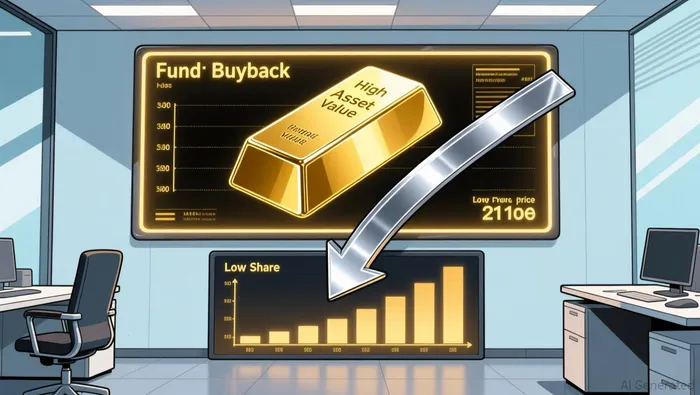
When a closed-end fund trades at a 26% discount to NAV, it means the market is pricing each share of the fund as if the underlying assets were worth significantly less than they actually are. This is a well-known feature of investment trusts, not a bug. The discount reflects liquidity concerns, management fees, and the fact that you can't redeem your share directly against the fund's assets the way you could in an open-ended fund.
But GCP Infra is using that discount as raw material.
Every share the company buys back at 74p represents approximately 100p of underlying assets. The treasury shares are then cancelled from the voting and distribution base. So the remaining shareholders own a proportionally larger slice of the portfolio. If the NAV stays flat, NAV per share goes up anyway. It is mechanical, and it is real.
The odd thing is not that the fund is buying back shares. The odd thing is how persistently it has been doing it and how large the discount has stayed.
The current programme was announced on 12 December 2024 with a target of returning at least £50 million to shareholders. As of the latest filing on 18 May 2026, the fund has repurchased 51,182,127 shares. At average prices in the mid-70s pence range, that is well north of £37 million and heading toward the £50 million target.
Meanwhile, the 12-month average discount has hovered around 27%. The latest quoted premium/discount figure is roughly -26.7%. That number has not collapsed despite months of aggressive buying. In a market where supply shrinking should mechanically bid up the price, the discount has proven sticky.
This creates a situation worth sitting with for a moment. The fund is buying back shares because the market keeps mispricing them. But the market keeps mispricing them despite the fund buying back shares. Something about the structure of GCP Infra - the illiquidity of the underlying infrastructure debt, the closed-end format, the investor base - means the discount does not close easily, even as the company keeps printing money on the spread.
Here is the plumbing in smaller detail.
GCP Infra has 884,797,669 ordinary shares in issue. Roughly 51.2 million are now held in treasury. Treasury shares do not vote. Treasury shares do not receive dividends. The voting base is therefore about 833.6 million shares. The fund files periodic "total voting rights" announcements under FCA disclosure rules, partly because shrinking the voting base can trigger additional disclosure obligations as shareholding concentrations shift.
Why does the voting base matter? Because in a closed-end trust with a persistent discount, the buyback programme is not just a return-of-capital mechanism. It is a concentration mechanism. As the float tightens, remaining shareholders - and in particular any large holders - gain proportionally more influence over board decisions, including decisions about future buybacks, distribution policy, and capital allocation.
The fund's shareholders' meeting in January 2025 authorized directors to issue or sell from treasury up to 88,479,766 shares - which is essentially the full remaining headroom on the buyback authorization if the limit is the standard 10% of issued share capital. They have used about 5.8% of that total base so far. There is room to go further.
This is basically the same old trick that UK investment trusts have played for decades, just with more disciplined frequency and a better asset base. The classic trust-arbitrage model is: find a quality portfolio, get the market to underprice the wrapper, buy back shares at the discount, compound NAV per share, and repeat. The trick is that it only works if the underlying assets are genuine and the NAV is real - not a mark-to-model fiction. GCP Infra's infrastructure debt portfolio is backed by long-dated contractual cash flows from UK public infrastructure, which is as close to real as the infrastructure credit space gets.
The fund also pays an annual dividend of roughly 7 pence per share, which at the current price is a yield of around 9-10%. That is the income layer. The buyback is the capital layer. Together they make the holding proposition look different than the price alone suggests.
The counterargument is straightforward. The discount persists for a reason. Investors know they are locked into a closed structure with illiquid underlying assets. They are not paying NAV because they cannot exit on demand. The buyback programme helps, but it is discretionary - the fund does not have to keep buying, and it cannot buy its way out of structural illiquidity. If the portfolio underperforms or interest-rate risk crystallizes in the infrastructure debt book, the NAV itself can fall, and then the buyback math stops working.
That is fair. The buyback is not a substitute for good underlying economics. It is an amplifier of them. If NAV falls, buying back shares at 74p against a 90p NAV is less generous than buying at 74p against 100p. The spread narrows. The programme still helps, just less dramatically.
The structural point is this: GCP Infra is a fund that generates yield from UK infrastructure debt, trades at a stubborn 26-27% discount, and has been systematically exploiting that discount by buying back shares with cash it does not need to deploy elsewhere. The voting rights filings are the plumbing detail that reveals how much of the float has already been absorbed and how concentrated the remaining base is becoming.
For the investor, the question is not whether the buyback programme is "good." It is whether the discount is permanent enough to make the arbitrage repeatable and whether the underlying infrastructure debt portfolio can hold its NAV over the next few years. If both conditions are true, the buyback is not a temporary gimmick. It is a structural feature that makes the stock cheaper than the business implies - every time you look at it.
If the discount closes, the programme loses its edge. If the NAV erodes, it loses its foundation. The machine works best when the market stays wrong about the wrapper while the assets inside do their job.