

The 3% rally in the CSI SWS Electronics Index isn't a short-term bounce-it's the market catching its first breath as China's AI chip sector hits the steep part of the S-curve. The numbers tell the story: Huawei alone projects AI chip revenue surging to $12bn this year, up from $7.5bn in 2025-a 60% jump driven by existing orders for its 950PR chip. That's not a forecast; it's a trajectory already locked in.
What makes this different from previous cycles is the acceleration. Industry executives are explicit: growth in China's chip sector is coming faster than expected. The AI infrastructure buildout is creating an explosion in demand that's outpacing even optimistic models. Huawei's $12bn target rests on orders already in the pipeline, and the company is backing it with capacity-planning to add two dedicated fabrication plants this year to ramp production of chips manufactured by SMIC.
The structural forces behind this are undeniable. U.S. export restrictions have acted as "rocket fuel" for domestic substitution, while Beijing's directive for Chinese tech companies to limit Nvidia chips to overseas operations has opened a massive void. Huawei is stepping in, and the market is responding. SMIC's revenue already hit a record $9.3bn in 2025, with analysts projecting it could top $11bn in 2026. Moore Threads, a Nvidia rival, guided for 231% to 247% year-on-year growth in 2025.
This is the S-curve inflection point-the moment when adoption shifts from gradual to exponential. The 3% rally is the market's first recognition that China's AI chip sector isn't just catching up; it's accelerating up the curve faster than anyone modeled.
The Infrastructure Layer: Capacity Expansion as Competitive Moat
The 3% rally reflects the market's dawning realization that China is building something far more substantial than temporary substitution-it's constructing the fundamental rails for exponential AI growth. The numbers reveal a strategic transformation: China's manufacturing capacity for chips made on mature 22nm to 40nm process nodes is projected to reach 42% of global output by 2028, up from 37% in 2026. That's not incremental-it's a structural reordering of the global semiconductor map.
But capacity alone doesn't create a moat. The real competitive advantage lies in vertical integration. China is aiming for more than 70% of silicon wafers-the foundational material for all chips-by this year. This target cuts across the entire supply chain, reducing dependency on imported substrates and insulating production from external shocks. When you combine dominant mature-node capacity with aggressive wafer localization, you get something rare: an infrastructure layer that can scale independently of foreign supply constraints.
The catalyst for this buildout is as important as the buildout itself. U.S. export restrictions have acted as "rocket fuel", amplifying growth from AI data centers and electric vehicles while forcing self-sufficiency. The mechanism is straightforward: restrictions cut off access to advanced tools and materials, which in turn triggers massive domestic capital spending to fill the gap. SMIC's revenue already reflects this dynamic-rising 16% to $9.3bn in 2025, with analysts projecting it could top $11bn in 2026.
What makes this different from previous import-substitution cycles is the scale and urgency. Order backlogs for critical equipment are "booked out into next year," signaling that capacity expansion isn't speculative-it's already committed. The AI boom has intensified this pressure, with chips becoming more complex and performance-intensive, raising requirements for testing, packaging, and high-speed interconnects. China is positioned to respond precisely because its manufacturing base is so large.
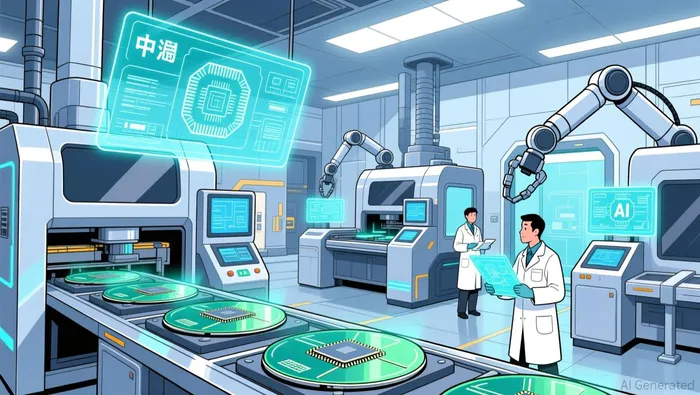
For investors, the implication is clear: the companies building this infrastructure layer-foundries, materials suppliers, equipment manufacturers-are capturing the structural upside of the AI S-curve. They're not waiting for demand to arrive; they're building the capacity that will define the next decade of growth.
Valuation Implications and Catalysts
The 3% opening gain in the CSI SWS Electronics Index set to open up 3% isn't just a technical bounce-it's early positioning by investors recognizing that the infrastructure story we've outlined translates directly to exponential valuation potential. When a sector hits the steep part of the S-curve, traditional PE multiples become irrelevant. What matters is trajectory: order backlogs, capacity expansion commitments, and the speed of adoption.
Huawei's AI chip revenue surging to $12bn-up 60% from $7.5bn in 2025-provides a concrete revenue anchor. But the real valuation driver is what comes next. The company's plan to launch an upgraded 950DT chip in Q4 2026 represents a critical inflection point. If the 950PR has already secured massive orders, the 950DT-positioned as a higher-performance variant-could unlock enterprise and cloud customers still migrating away from Nvidia. That's the kind of product cycle acceleration that defines S-curve leaders.
Yet the sector faces a real asymmetry. While domestic players dominate the hardware buildout, foreign companies retain an edge in after-sales support and technical services-the invisible infrastructure that keeps data centers running at scale. This is where the rubber meets the road: Chinese chipmakers can produce silicon, but can they match the ecosystem depth that Nvidia has spent decades building? The answer will determine whether the 3% rally evolves into a sustained re-rating or stalls at the curve's knee.
The ultimate catalyst-and risk-lies in tooling. China's push for 70% of silicon wafers domestically is impressive, but advanced chipmaking ultimately depends on lithography equipment. Whether domestic alternatives to ASML can scale to meet the volume and precision requirements of AI chip production remains the sector's defining uncertainty. If they can, the infrastructure layer becomes truly self-sustaining, and the exponential curve extends further. If not, capacity expansion hits a wall.
For investors, the setup is clear: the 3% rally is the market's first nod to a structural shift. The companies building capacity now-SMIC, Huawei, materials suppliers-are positioning to capture the steepest part of the adoption curve. But the magnitude of the move depends on whether tooling constraints ease. Watch for announcements on domestic lithography scale-up; that's the signal that will determine whether this is a 2x or a 10x story.