

Summary
- China is building coal-to-chemicals and coal-to-liquids capacity at a scale that has no global parallel - turning 276 million tons of coal into synthetic fuels and petrochemicals last year.
- The official justification is energy security: China imports roughly 70% of its oil and wants to reduce its exposure to Middle Eastern chokepoints and sanctions risk.
- The economics work only one way: coal-to-liquids breaks even above roughly $47-58 per barrel of oil. Below that, every plant is a subsidy-dependent money loser.
- The carbon cost is staggering - coal chemicals emit... 607 million tonnes... accounting for approximately 5.71% of China's total CO 2 emission.
- For global oil markets, the structural implication matters more than the politics: if Chinese coal chemicals scale as planned, they act as a long-term ceiling on oil demand growth, not the supply diversification the narrative promises.
I've been watching a quiet but aggressive push across China's coal-rich provinces that deserves far more attention than it has received. Regional governments in Inner Mongolia, Shaanxi, and Ningxia are fast-tracking coal-to-chemicals projects - converting domestic coal into synthetic fuels, plastics, and petrochemical feedstocks - and selling it as an energy security imperative. The pitch sounds rational on its surface: China imports roughly 70% of its oil, much of it from the Middle East, so why not burn domestic coal to make synthetic replacements?
Except the numbers don't work the way the narrative claims.
The false narrative here is that coal chemicals meaningfully solve China's energy security problem. The reality is that this expansion is a political project masquerading as an economic one. It generates provincial GDP, employs miners in dying coal basins, and gives Beijing a rhetorical shield against Western criticism about fossil fuel dependence. But as a structural hedge on China's oil import risk? In my opinion, it's far more theater than substance - and for global oil markets, the long-term implication runs in the opposite direction from what Beijing claims.
The scale is enormous, but so is the waste.
China consumed approximately 380 million metric tons of coal as feedstock for chemical and liquid fuel production last year, representing roughly 8% of the country's total coal consumption. The sector turned 276 million tons of coal - equivalent to nearly a full year of European coal use - into synthetic chemicals, oil, and gas. Coal-to-chemicals is now likely the only major coal-consuming sector in China still authorized for substantial capacity expansion, even as coal-fired power generation faces its first structural peak.
The investment is staggering. Four major coal chemical bases in Shaanxi and Inner Mongolia carry total investments exceeding 600 billion yuan. China's broader coal investment is expected to exceed $54 billion in 2025 alone. The country is simultaneously building 36 coal-to-olefins projects representing over 24 million tonnes of annual olefin capacity, including the world's largest single-site coal-to-olefins plant, which produces 3 million tons annually.
That scale should impress. It does - until you ask what it actually accomplishes.
The economics only work one way.
Here's the number that breaks the energy security pitch: coal-to-liquids technology breaks even only when oil prices sit above roughly $47 to $58 per barrel. That means these plants are fundamentally vulnerable to any sustained oil price decline. When crude drops to $60 - which it has spent extended periods at throughout the 2010s and 2020s - every barrel of synthetic oil produced is a margin-negative proposition.
China's coal chemical plants are not free cash flow machines. They are capital-intensive operations that require sustained high oil prices and, implicitly, government support to survive. That's not energy security. That's fiscal risk relocated from the balance sheet of an importing nation to the balance sheets of state-owned enterprises that can absorb losses Western producers cannot.
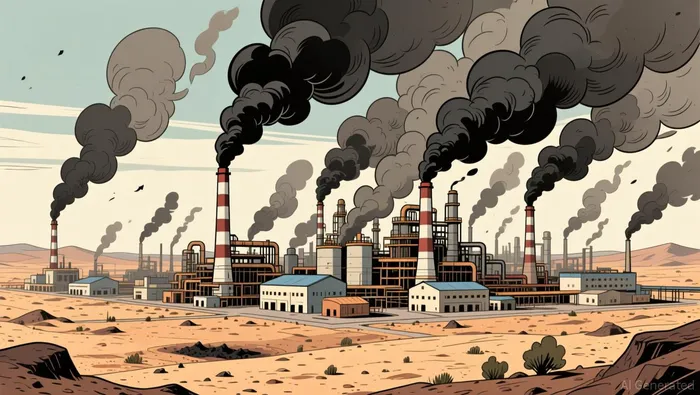
Carbon and water are the hidden costs.
The coal chemical industry in China generated approximately 607 million tonnes of CO₂ emissions in the last decade, accounting for roughly 5.7% of the country's total. Coal-fed production of methanol, ammonia, and PVCs alone contributes about 0.27 gigatonnes of CO₂ - roughly 3% of China's total emissions. That's from a single subsector of a single country.
Put it another way: coal-to-liquids produces roughly 2-3 times more CO₂ per barrel of output than conventional oil extraction. China is trying to solve an oil import problem by dramatically worsening its carbon problem. Given the country's stated net-zero by 2060 target, this trajectory is arguably self-defeating.
The water constraint is equally structural. China's coal chemical capacity is concentrated in Inner Mongolia and western Shaanxi - arid regions that are already experiencing severe water stress from coal mining alone. Producing one barrel of synthetic oil from coal requires roughly 3-5 times more water than conventional oil production. These are projects building water-intensive infrastructure in water-scarce basins, which creates an operating risk that no amount of political will can overcome.
The real implication for oil markets runs the other way.
This is where the false narrative inverts into something investors should actually care about. China's crude oil imports dropped sharply in April 2026 to 9.4 million barrels per day, down by more than 2 million barrels per day from 2025 averages, according to S&P Global Energy data. The country is also expanding its strategic petroleum stockpiles by roughly 1 million barrels per day in 2026.
The combination matters. Coal chemicals, even if economically marginal, represent a structural demand ceiling for Chinese oil imports. They don't replace enough volume to make China oil-independent - oil import dependency is projected to remain at roughly 70% through 2026 - but they create a persistent drag on oil demand growth in the world's largest crude-importing nation.
For global oil producers, that's a secular headwind. For investors overweight in Big-3 American oil majors, it's a structural demand-side counterweight to any geopolitical supply spike thesis. China isn't becoming energy independent. It's building a parallel synthetic capacity that limits how much oil it needs to buy at high prices, which caps the upside of oil as a trade during Middle Eastern disruptions.
What this means for the portfolio.
The Chinese coal chemical boom is not an energy security solution. It's a geopolitical project with terrible economics, enormous carbon costs, and water constraints that will only worsen. It won't make China oil-independent. Oil import dependency will remain at roughly 70% for the foreseeable future.
But the side effect is real and structurally important: China is building capacity that acts as a demand substitute for imported oil, one that grows precisely when oil prices are high enough to make it marginally economical. That creates a non-trivial long-term ceiling on Chinese oil demand growth.
For investors, this reinforces my longstanding view that the New Age of Energy Abundance thesis applies on the demand side as much as the supply side. China's coal chemical expansion, combined with its aggressive EV adoption and renewable buildout, means that oil demand growth from the world's largest importer is structurally capped - not eliminated, but capped.
That being the case, I remain cautious on broad Big-3 oil stock enthusiasm despite near-term geopolitical premiums. The China coal chemical story is the kind of slow-moving, structural headwind that consensus oil bulls consistently underweight. When oil spikes on a Middle Eastern headline, the market prices in supply disruption and ignores the fact that Beijing just activated another synthetic substitute. The disconnect is where the trade lives - and it favors sellers, not buyers, on sustained oil rallies.