

Beijing officially announced President Donald Trump’s state visit from May 13 to 15 for a summit with Chinese President Xi Jinping. While geopolitical tensions like the Iran war loom, Wall Street's focus remains resolutely commercial. Market participants are prioritizing potential frameworks for Boeing aircraft orders, AI semiconductor exports, and a broader trade truce over ceremonial handshakes. Reports indicate a high-profile business delegation, including chief executives from Nvidia, Apple, and Boeing, will accompany the president. This summit presents a net-positive catalyst for U.S. equities; the inclusion of heavyweight corporate leaders signals a high probability of actionable trade agreements rather than mere political posturing.
The $250 Billion Spectacle of 2017: Headlines Versus Financial Realities
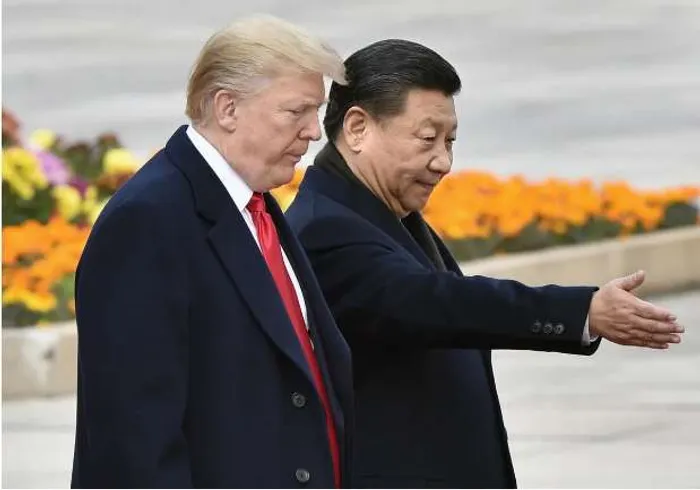
To gauge the potential market trajectory of the upcoming summit, investors must examine the precedent set by Trump's November 2017 state visit to China. During that trip, the two nations unveiled a sweeping package of commercial agreements touted at approximately $250 billion. The most visually striking component was Boeing's purported $37 billion agreement for 300 aircraft. However, capital markets quickly distinguished between diplomatic optics and binding financial contracts. Many of the announced deals were culminations of multi-year negotiations repackaged for political display rather than entirely new revenue streams.
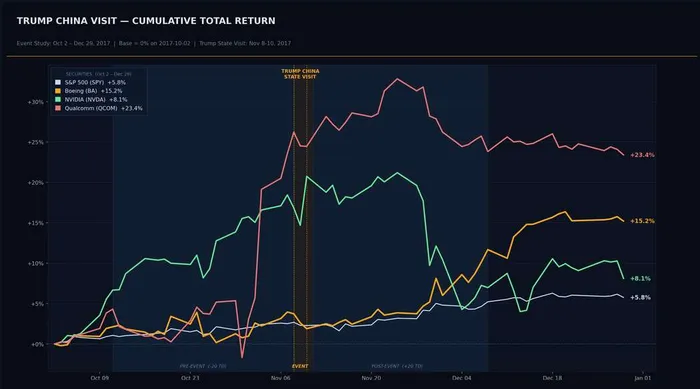
Consequently, the broader U.S. equity market exhibited a muted response, while specific stocks experienced distinct divergence. According to Ainvest analysis, the historical cumulative returns during the 2017 visit highlight this exact trend. The S&P 500 (SPY) maintained a calm upward trajectory from October to December 2017, advancing merely 5.8%. In contrast, individual corporate participants saw amplified, news-driven volatility. Boeing (BA) registered a steady 15.2% gain driven by aviation order expectations, while semiconductor players like Qualcomm (QCOM) surged 23.4%. Nvidia (NVDA) experienced notable post-event fluctuations before eventually settling at an 8.1% gain. The 2017 playbook demonstrates that the broader market index did not undergo a massive upward revaluation; instead, trading action concentrated on specific equities driven by short-term news flow and sector-specific policy shifts.
The 2026 Trading Lines: Aerospace Orders, AI Semiconductors, and Tariff Policies
Transitioning to the present, the May 2026 summit offers three distinct trading narratives. Boeing stands as the most direct fundamental proxy. Boeing CEO Kelly Ortberg previously stated that the manufacturer was explicitly counting on the current administration to help unlock a long-awaited major order. Industry sources suggest ongoing negotiations could yield an order for up to 500 737 MAX narrowbody jets alongside dozens of widebody aircraft. If finalized, this would represent the first major Chinese commitment to the U.S. planemaker since 2017, injecting immediate revenue visibility into Boeing and its broader aerospace supply chain.
Simultaneously, Nvidia represents the critical axis of technology and trade policy. CEO Jensen Huang's anticipated presence in Beijing inherently acts as a market signal regarding potential marginal easing in AI chip export constraints. Nvidia's access to the Chinese data center market remains a closely scrutinized metric under current export regimes. Moreover, Nvidia is executing a highly strategic dual-sided geopolitical approach. While seeking market access in Beijing, the chipmaker is concurrently executing a multi-billion-dollar prepayment to fund new domestic fiber-optic factories with Corning (GLW). This specific expansion is sized to grow U.S. production capacity by a factor of ten, addressing one of the most severe bottlenecks in the AI hardware build-out. This secures critical U.S.-based AI infrastructure supply, reinforcing Nvidia's strategic moat regardless of the immediate diplomatic outcome.
Furthermore, overall market sentiment will hinge on broader tariff discussions. The inclusion of executives from Apple (AAPL), Exxon Mobil (XOM), and Visa (V) on the invitation list indicates that the administration aims to secure comprehensive access for large-cap U.S. multinationals. For these corporations, White House willingness to broker direct deals with Beijing serves as a structural tailwind. A diplomatic pause or tariff rollback would reduce macroeconomic friction, broadly supporting the industrial and consumer sectors. However, as the 2017 data proved, sweeping political declarations are insufficient. Wall Street portfolio managers will demand execution details and clear paths to profit realization before committing to long-term valuation premiums.
Beyond the Handshakes: Execution Dictates Equity Valuations
Ultimately, the core focus for financial markets is not the occurrence of the Beijing visit, but the tangible contracts executed upon departure. A confirmed mega-order for Boeing will serve as a definitive bullish catalyst for the aviation manufacturing chain. Establishing predictable rules for AI semiconductor exports will trigger a fundamental repricing of chipmakers' forward earnings multiples. In addition, extending a tariff ceasefire will effectively establish a floor under prevailing market risk appetites. Wall Street is poised to meticulously separate political narratives from verifiable corporate profitability. Investors should maintain strict caution regarding broad index exposure; trading purely on diplomatic anticipation carries execution risk, as tentative memorandums of understanding frequently fail to translate into recognized quarterly revenue.