

USA Rare Earth's France expansion targets the weakest link in the Western rare-earth chain
USA Rare Earth says it will make an additional investment in France that could exceed €175 million ($204 million) to expand metal, alloy, and magnet-making capacity. The goal is not to add another mine. It is to strengthen the part of the Western rare-earth chain where the gap is widest: converting separated material into metals, alloys, and magnets before China, which controls almost all rare earth ore separated into oxides and nearly all rare-earth magnets, retains command of the processing rail.
Why the timing matters
The strategic logic became harder to ignore after China's April 2025 export restrictions on heavy rare earths and permanent magnets disrupted allied defense and industrial supply flows. Once policymakers see how quickly dependency can translate into real disruption, capital tends to move toward the most constrained step in the chain rather than the most obvious one.
The main bull and bear points
Bulls argue that USA Rare Earth is targeting the actual bottleneck with assets that are already taking shape: a Less Common Metals production facility at Lacq, a strategic investment in Carester, and announced plans to expand into higher-value metal, alloy, and magnet output. If execution lands, France could become a real processing node rather than just a strategic headline.
Bears will note that announced ambition is not the same as delivered supply. France could provide financial support and debt guarantees, and the government is also evaluating further support mechanisms, including a potential direct equity investment. If the build-out slips, the thesis remains strategically relevant but loses much of its near-term investment appeal.
France matters because the bottleneck is chemical, not geological
France matters because this bet is focused on separation, refining, and conversion - not on digging more ore out of the ground.
Separation is the real choke point
The key choke point is separation. Today, almost all rare earth ore is separated into oxides in China using solvent extraction, and Chinese firms also produce nearly all rare-earth magnets. That is why mining alone does not solve the problem. If purified oxides, metals, and alloys still have to pass through China, the bottleneck has not been broken; it has simply been shifted upstream.
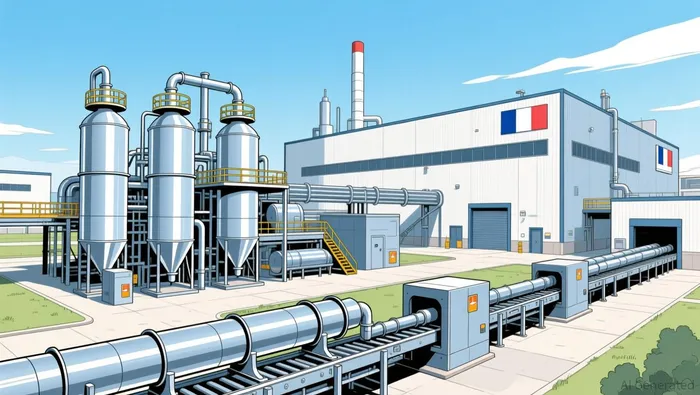
USA Rare Earth is aiming at that constraint. It holds a 12.5% stake in Carester, which is described as a specialist in complex rare earth separation techniques. Carester is set to open a commercial-scale rare-earth separation plant in southern France later this year, while a USA Rare Earth subsidiary is building a facility in the same region to turn Carester's oxides into pure metals. That is the operational link worth watching: creating a local bridge from separation to metal production.
This is an infrastructure story, not a finished-output story
This is not a claim that Western rare-earth independence already exists. The EU still imports 98% of rare earths from China, and Europe's ambition to reach 15% to 20% processing capacity by 2030 remains a target, not a reality. But France already has some of the pieces needed to build a processing cluster, including industrial infrastructure, a re-emerging rare-earth processing base, skilled labor, and policy support for critical-minerals capability.
That policy layer could help shorten the path from pilot chemistry to commercial scale. USA Rare Earth said France could provide financial support and debt guarantees, with the government also evaluating a potential direct equity investment into its European subsidiary. Separation and metal production require more than standard capex; they also require time, yield improvement, and patient funding.
What to watch next
The clearest near-term signposts are operational:
- Whether Carester's separation plant opens on schedule
- Whether the local metal-production facility begins converting oxides as planned
- Whether announced magnet activity moves from evaluation to a concrete build-out
- Whether public support moves from discussion to formal commitment
If those steps become visible and repeatable, France has a stronger case for becoming a functional node in the Western rare-earth chain. If they slip, the story stays strategically interesting but loses commercial momentum.
How USA Rare Earth compares with MP Materials
The broader backdrop is clear: Washington is trying to rebuild non-Chinese rare-earth capacity, and it is using both company-specific funding and broader industrial-policy tools to do it. MP Materials is the more developed public benchmark because the U.S. government has committed a multibillion-dollar public-private partnership to support an end-to-end domestic rare-earth chain. At the same time, the government has taken stakes in both companies to secure processing capacity.
That makes MP the stronger benchmark for a nationally funded, end-to-end rebuild. USA Rare Earth's France project is different in structure. It is more of a cross-border processing-platform attempt: can it link Carester, a specialist in complex rare earth separation techniques, French metal production, and eventual magnet output into one functioning chain?
For investors, that distinction matters. The strategic case is easier to understand than the execution case. The real question is whether USA Rare Earth can turn strategic relevance into visible throughput, customer adoption, and durable operating capability.