

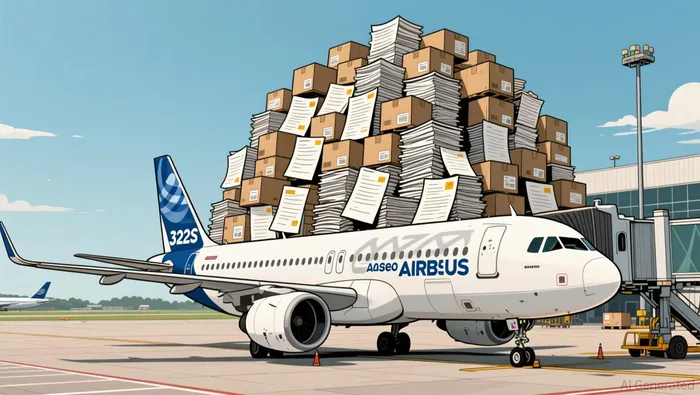
The headlines say China is stalling Airbus deliveries to pressure Europe over COMAC jets. The reality is a supply chain that can't keep up with a backlog of 9,031 aircraft - and Chinese airlines just ordered 137 more A320neos.
Let me reconstruct what actually happened. Airbus reported Q1 2026 earnings in late April. Profit more than halved. Revenue fell 7% year over year. CEO Guillaume Faury cited an "administrative delay" that held up deliveries of nearly 20 aircraft destined for Chinese customers. The European press ran with the geopolitics. The market sold the stock. EPS came in roughly 29% below consensus.
But here's what that story leaves out: Airbus itself said the administrative issue is now resolved, confirmed on its earnings call in early May. Twenty aircraft out of a quarterly delivery run of 108. A blip, not a blockade.
Meanwhile, China Southern Airlines - one of the biggest buyers in the world - confirmed an order for 137 A320neos in April. Airbus confirmed it in its own order reporting. If China were weaponizing aircraft deliveries as leverage, you wouldn't see its largest carrier writing a six-figure purchase order in the same month.
This isn't about geopolitical excitement. It's about what happens when a company with a nine-year backlog can't ramp fast enough to feed it.
The real bottleneck: supply chain, not geopolitics
Airbus delivered 793 commercial aircraft in 2025 against a target of roughly 820. The company has set a 2026 delivery target of 870. But the constraint isn't demand or Chinese bureaucracy. It's engines. Pratt & Whitney's Geared Turbofan engines - which power much of the A320neo family - remain a single-point bottleneck. Seating suppliers and composite material vendors are still playing catch-up. Airbus's own management has said supply chains are a "major constraint across 2026."
That matters because it means the pain is temporary and operational, not structural. When the supply chain heals, those 9,031 backlogged aircraft don't vanish. They convert into deliveries, revenue, and cash flow. A backlog nearly 10.4 years long at the current delivery rate is not the profile of a company in structural decline. It's the profile of a company that's been supply-constrained and is inching its way out.
COMAC: the distraction that isn't
The competitor narrative assumes COMAC is the wedge. The numbers say otherwise. COMAC has delivered 32 C919 aircraft total - all to Chinese carriers. Zero have gone outside China. EASA, Europe's aviation safety regulator, said in May 2025 that C919 European certification would take "between three and six years". That puts real European market entry no sooner than 2028, and more likely 2029 or beyond. EASA began flight evaluations in January 2026, which is progress, but certification timelines for a first-time manufacturer are historically long and rarely compressed by geopolitics.
COMAC's share of the 125-240 seat single-aisle order backlog sits around 7%. That means Airbus and Boeing still control roughly 93% of the pipeline in this segment. China needs 9,570 new passenger aircraft between 2025 and 2044, according to Airbus's own Global Market Forecast. The C919 is a drop in that ocean.
The financial bridge
This is where the story matters. Airbus generated €73.4 billion in revenue in 2025. Free cash flow reached €4.75 billion. The board raised the dividend to €3.20 per share. At a market cap of roughly €137 billion and a forward P/E of 24x, the stock isn't cheap. But the question isn't whether the multiple is low - it's whether the denominator is about to grow faster than investors expect.
Think about the math. Airbus plans 870 deliveries in 2026, up from 793 in 2025. That's an 87-aircraft increment, roughly 11% more. If the average selling price holds in the €100-130 million range per aircraft, that additional 87 planes translates into €8-11 billion of incremental revenue. At Airbus's historical operating margins on commercial aircraft (roughly 11-12%), that's €900 million to €1.3 billion of added operating profit. A meaningful share of that margin expansion flows through to free cash flow.
If 2027 sees the supply chain ease further and deliveries reach the 900-950 range, you're looking at another €1-1.5 billion of revenue on top of 2026. The FCF compounding machine starts showing up on the tape.
The market is still pricing the Q1 miss and the delivery pain. But the operating setup is already getting cleaner. The administrative delay is resolved. The backlog is intact. Chinese orders are growing. The constraint is production, not demand - and production constraints, by definition, resolve when suppliers catch up.
What would break the thesis
The Pratt & Whitney engine situation could worsen rather than improve. A prolonged GTF crisis would push the delivery ramp into 2028 or beyond, and at 24x forward earnings, the stock doesn't have much room for extended disappointment. If Airbus misses its 2026 delivery target by a wide margin - say, falls short of 850 - the multiple compresses.
A broader trade war escalation that leads to actual import bans on Airbus aircraft in China would change the risk profile materially. But as of today, the evidence points the other way: Chinese carriers are still ordering, and the "administrative delay" language suggests regulatory friction, not a policy weapon.
My tripwire: if Airbus reports a Q2 delivery count that's materially worse than Q1 - fewer than 108 aircraft - and the guidance for the full year is cut below 850, the supply chain story has turned structural and the setup breaks. Cut without ego.
If deliveries hold or improve through mid-year and the backlog stays above 8,500, the inflection is playing out. The stock trades at 24x forward earnings for a company that may deliver €5 billion plus in free cash flow within 18 months if the ramp executes. I'd rather own that rerating than bet against it.