

A Hangzhou court recently awarded roughly $38,000 to a worker whose job was replaced by a large language model. The company, which employed Zhou in what was described as a tech role paying 25,000 yuan a month, first offered him a demotion to a lower-level position at 15,000 yuan after an LLM took over his tasks. When he refused, they fired him. The court called it illegal.
The headlines called it a precedent. Some called it a signal that China is drawing a line in the sand against AI-driven layoffs. And it is a signal. Just not the one the headlines think.
The more interesting question isn't whether AI will displace Chinese workers. It's whether the government is using AI as the convenient new explanation for a labor market that was already cracking before generative models caught up.
China's youth unemployment rate - ages 16 to 24 - hit 16.3% in January 2026. It was higher before that. It peaked at 21.3% in mid-2023, which is when the government suspended the statistic entirely for a while because the number was politically inconvenient. The official urban unemployment target for 2026 sits at 5.5%. The gap between the target and the youth reality is not a data error. It's a structural problem.
Alibaba cut its headcount by more than half over three years. Tencent and Baidu have done similar things. These are not AI-driven layoffs. They are the result of a growth model that ran out of growth. When you can no longer hire your way to revenue expansion, you stop hiring. Then you start cutting. The AI part comes later, as justification, not cause.
The Zhou case matters because it forces a contradiction onto the surface. China has made AI a national strategic priority. The government wants its companies to build models, deploy systems, and close the gap with American leaders. But it also needs 12 million new urban jobs this year to keep the social peace. Those two goals are pulling in opposite directions. The court ruling is the state trying to control the speed of a disruption it itself ordered.
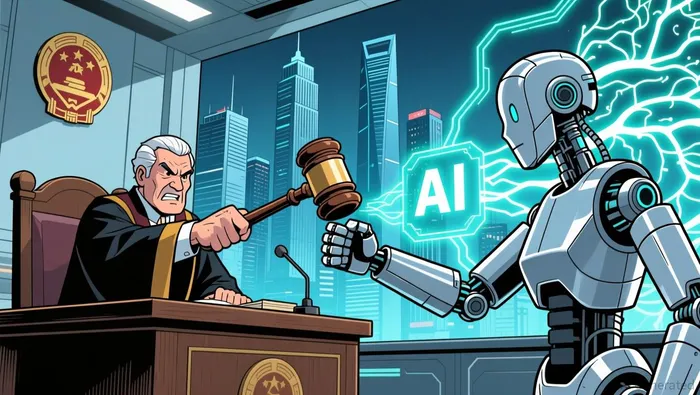
Here's the mechanism. The government cannot afford a universal safety net for displaced workers. Only about 18% of unemployed workers in middle-income economies receive unemployment-related benefits, and China's system is stretched thin after years of property-sector stress. So the tool it reaches for isn't social insurance. It's litigation. It uses courts to slow down the worst excesses of employer-side automation, because it doesn't have the fiscal capacity to cushion the landing.
That's not the same thing as protecting workers. It's damage control dressed up as worker protection.
The speed at which the narrative has shifted makes this clearer. In 2024, Chinese respondents ranked AI's impact on jobs sixth out of seven categories of concern. By 2026, it jumped to second. The technology didn't improve that fast. The labor market got worse, and people started looking for something to blame.
Most people think the court ruling is about whether AI should replace workers. But look at what the ruling actually says. It says companies can't fire workers just to replace them with AI - implying that firing for other reasons, like restructuring or redundancy, remains legal. The distinction is narrower than the headlines suggest. This isn't a ban on AI displacement. It's a requirement that companies follow existing labor procedures before automating a position. The substantive question - whether the job should exist at all - is not addressed.
I suspect the real pressure point comes later. If AI adoption accelerates and companies learn to restructure around it - reorganizing, redefining roles, making the displacement look like normal evolution rather than direct replacement - the court precedent will have very little to grip. You don't fire the worker and hire an LLM. You reorganize the department and the worker becomes surplus. The same outcome, different paperwork.
The contradiction is uncomfortable because it's familiar. Every major automation wave starts with the government wanting the technology and ending up managing the fallout. The difference this time may be the speed. Generative AI can be deployed in weeks, not years. The Zhou case took from January 2025 through April 2026 to resolve. By the time a ruling lands, three more companies may have found the loophole.
What to watch: whether the number of similar cases rises, or whether companies quietly adapt by restructuring instead of replacing. If the former, the courts will be overwhelmed and the precedent becomes noise. If the latter, the ruling achieves nothing except making displacement less visible.
The test is simple. Check whether AI-related litigation in Chinese labor courts continues to increase, or whether layoff language in company communications shifts away from AI and back to the old words - optimization, restructuring, right-sizing. If companies switch back to the old language, the AI story is a wrapper, not the engine. And the engine is the same one that was already running: a growth model that can't create enough jobs to absorb a young population the government desperately needs to keep employed.