

The headline you may have seen last month - China's producer inflation at its highest in nearly four years - is right about the number and wrong about the story. What happened is not that China is re-inflating on demand. What happened is that the floor under wholesale prices collapsed out from under deflation, and something new moved in.
China's producer price index (PPI), which tracks the prices manufacturers and mines charge for their output, jumped to +2.8% year-on-year in April. Just the month before, it was +0.5%. Before that, February: −0.9%. January: −1.4%. Before that - 37 more months of the same. China's industrial producers had been in a deflationary squeeze so long it stopped being a headline and became background noise. Until April.
The consumer price index (CPI) was less dramatic but still telling: 1.2% year-on-year in April, with core inflation (stripping out volatile food and energy) also at 1.2%. The economy isn't overheating. But the deflationary gravity that held China's producer prices hostage since 2023 has broken. That matters because China is the world's largest manufacturer, its pricing trends flow through every supply chain on earth, and deflation there is inflationary ballast for the rest of the globe.
The Iran shock - the trigger, not the thesis
Here's what everyone attributes the PPI rebound to: the war in Iran, which began in late February 2026 and effectively closed the Strait of Hormuz to most global shipping. Brent crude surged more than 55%, hitting nearly $120 a barrel at its peak. Global shipping rerouted around the Cape of Good Hope, sending freight costs through the roof. The OECD warned in early June that higher energy prices from the conflict will slow global growth and raise inflation through 2027.
This is real. It is also incomplete.
An energy supply shock is a classic transitory inflation driver. Oil prices spike, flow through input costs, then - if nothing else changes - normalize when supply adjusts or demand weakens. If the Iran conflict were the only force at work, the rational call would be: wait for the spike to fade, then look for the next cyclical bottom.
What everyone is missing: China broke its own deflation machine
Here is the variable that changes the time horizon. China didn't wait for the Iran shock to fix its producer deflation. It has been fixing it for months - by forcing its own industrial producers to stop killing each other.
In 2025, 24% of Chinese firms reported losses. The cause was vicious price wars fueled by years of government-driven overcapacity - excess production flooding markets and driving wholesale prices into a self-reinforcing downward spiral. China's response, starting in 2025 and intensifying into 2026, was an "anti-involution" campaign: production curbs, output restrictions, and policy pressure on companies to stop competing purely on price. The central government is telling manufacturers to produce less and charge more.
This is not a stimulus program. This is supply discipline. And it is structural.
Why this matters for your portfolio
I believe this is the running-it-hot thesis playing out in real time. I have argued for months that policymakers across the world are increasingly willing to tolerate structurally higher inflation because debt service, deglobalization, energy transition costs, and supply-chain fragility make the old 2% regime unsustainable. What China is demonstrating is that this isn't just about central banks losing control. It's about governments choosing price floors over price competition.
Two forces are now working in the same direction. The Iran conflict lifted energy costs - the immediate trigger. China's own supply discipline removed the deflationary pressure - the structural floor. Even if oil prices eventually retreat from their peak, the production curbs won't reverse. China's industrial policy has shifted from "produce everything at any price" to "protect margins and prices." That is a regime change, not a cycle.
The real-economy implication
This is where the portfolio construction gets concrete. If the global inflation floor is higher than the market's pricing models assume, then the companies that win are the ones with pricing power and tangible assets. The ones that lose are the ones whose business models depend on cheap Chinese input costs collapsing over time.
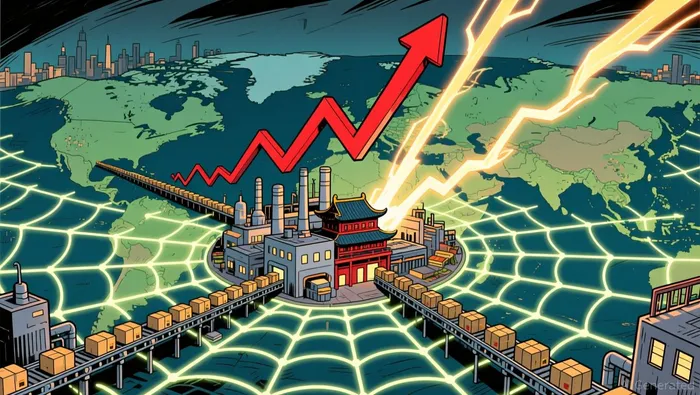
Energy companies sit at the top of this food chain. The Iran shock was a geopolitical event, but the underlying story is energy supply fragility - a structural condition that is not going away. Underinvestment in upstream capacity, deglobalization pressures on supply chains, and the energy transition itself all tighten the margin between supply and demand. Energy companies with toll-road infrastructure models - pipelines, terminals, midstream assets - are particularly well-positioned because their revenue is volume-based and contract-locked, insulated from commodity price swings while still benefiting from the higher price environment.
Industrials and defense are the second tier. Reshoring trends, infrastructure spending, and defense budget increases are all supply-constrained by definition. These are sectors where pricing power is embedded in mission-critical contracts with long durations and oligopolistic market structures. If Chinese industrial prices are no longer falling, the cost of competing with Chinese exports rises. That supports the pricing power of Western industrials that serve domestic reshoring demand.
What to watch today and tomorrow
China's May CPI data drops today and the May PPI tomorrow. 10 June: China to report May Consumer Price Index (CPI); 10 June: China to report May Industrial Producer Price Index (PPI). The May numbers will tell us whether the April rebound is a single-month anomaly or the start of a sustained reversal. If PPI holds above 2%, the structural thesis gains credibility. If it drops back toward zero, the Iran shock was dominant and the time horizon shortens.
I don't think the answer is clear-cut. What I do think is that the 38-month deflationary trend is over. The question is no longer whether China's producer prices can fall further. The question is how high the new floor sits - and whether you're positioned for an economy where the old assumptions about cheap global manufacturing no longer hold.
From an income and risk/reward point of view, the implication is straightforward. Companies that provide what the real economy cannot function without, that can raise prices without losing customers, and that generate cash flows growing faster than a higher inflation floor - those are the names that compound through this regime. Not FANG. TOLL. The distinction isn't about style. It's about whether your income stream survives when the price gravity that held the global economy together for two decades stops pulling downward and starts pushing up.