

The headline says AI. The data says something else entirely.
China's May trade data beat forecasts, and the story machines have already assigned the cause: Chinese exporters are riding the AI wave. This is the kind of headline that sounds convincing until you look at what's actually inside the containers.
Because the answer is not AI chips. The answer is a 90-day tariff truce and mature-node semiconductors that have nothing to do with artificial intelligence.
The primary driver: tariff front-loading, not demand
Here is what actually happened. Trump imposed sweeping tariffs on April 9, 2025. On May 12, 2025, the United States and China announced a 90-day reduction in bilateral tariffs. Between those two dates, and in the months leading up to the April hit, Chinese exporters did something they always do when the tariff hammer swings: they rushed every shippable unit out the door.
This is mechanical behavior, not a demand story. Front-loading is the single largest distortion in Chinese export data during any tariff cycle. When the window opens, volume surges. When it closes, volume collapses. Barclays noted as much at the time, writing that shipment could be front-loaded, boosting exports in the first half of 2025 before dampening them in the second half. That's what the data shows - a spike, then a fade. Anyone treating the spike as structural growth is misreading the plumbing.
China's full-year 2025 trade surplus hit a record $1.19 trillion - up 20% from 2024. Impressive on the surface. But a surplus driven by timing windows and volume compression tells you nothing about competitiveness. It is not as good as it looks.
The secondary amplifier: China's $47.6 billion in semiconductor exports - and what the number hides
China was the world's top semiconductor exporting country in 2025, shipping $47.62 billion worth of chips - 33.5% of global semiconductor exports. This number is cited by every analyst who wants to build the "China wins" narrative.
The problem is what those chips actually are.
China's semiconductor export dominance is built on mature nodes, memory packaging, and legacy logic - not advanced AI processors.China's mature-node capacity has grown more than four times faster than global demand since 2015, according to the USCC. The country is flooding the market with chips made on 28nm, 40nm, and older processes - processors for appliances, cars, industrial equipment, consumer electronics. These are commodities. They face their own structural overcapacity and pricing pressure.
No one is buying Chinese mature-node chips as a substitute for Nvidia H200s. A 28nm microcontroller is not a pathway to the AI infrastructure market. It's a pathway to margin erosion.
The headline doesn't tell you that the $47.6 billion is weighted heavily toward products that are becoming cheaper, not more valuable. Per-unit economics are going the wrong direction, even as volume goes up. That is the difference between an AI wave and a race to the bottom.
The AI claim: Huawei Ascend, measured against engineering reality
If China were genuinely riding an AI export wave, you would need evidence that Chinese AI accelerators are competitive enough to win orders outside the domestic walled garden, and that they're shipping in volume that shows up in export data. Neither condition is met.
Let's look at the engineering:
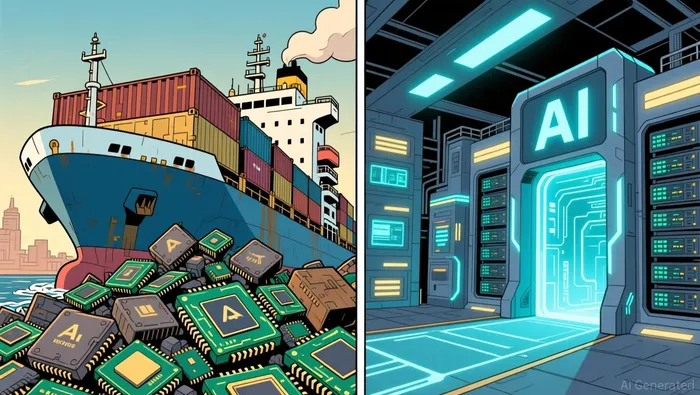
- Ascend 910B (the current deployed workhorse): matches Nvidia's A100 - a chip that Nvidia released in 2020. That's already a generation behind. At 310W power, it delivers 320 TFLOPS in FP16, which is adequate but not competitive with anything Nvidia ships today.
- Ascend 910C: the chip Huawei is ramping. DeepSeek's own internal benchmarks put it at 60% of Nvidia's H100 inference performance. Independent analysis puts it at approximately 3× less computational throughput than Nvidia's B200. That is not an AI wave. That's a two-generation gap.
Huawei plans to produce roughly 1.4 million Ascend 910C dies in 2025, scaling toward 1.6 million total across the Ascend product line in 2026. But these chips are consumed entirely within China. They cannot be exported in any meaningful way. More critically, they are not good enough to replace Nvidia even domestically. Baidu and ByteDance test them, evaluate them, and continue planning around Nvidia architecture for everything that matters.
The "AI wave" in export data is a narrative built on a product that exists on paper but not in competitive reality.
What the data actually tells investors
The cross-currents are straightforward:
- Tariff timing drove the May export surge. When the truce expires, the surge reverses. This is a mechanical swing, not a growth trend.
- Semiconductor export leadership is real but irrelevant to the AI thesis. Mature-node volume with declining per-unit economics is not a bullish signal for the companies riding it.
- China's AI chip gap is real and widening in TCO terms. Even Huawei's best effort lags Nvidia by two generations. The domestic market absorbs the shortfall; the export market ignores it.
- **China's $51.1 billion in semiconductor equipment imports in 2025 - a fivefold increase over the past decade - tells a different story. China is still a massive net importer of the tools needed to build advanced chips. That number should make anyone who believes in the self-sufficiency narrative stop and reconsider.
Directionally, the implication is that the "AI wave" thesis for China's export data is inverted. The trade data tells you about tariff arbitrage and mature-node overproduction. Neither is an AI story. Investors who anchor on this headline are buying a narrative the numbers don't support.
The real question isn't whether China's exports are growing. It's whether the growth is in products that are gaining value or losing it. On that metric, the answer is clear.
You decide which was marketing fluff and which one was analysis.