

A +0.5% monthly PPI rise would sharpen the portfolio question
A fresh monthly PPI gain would not be a victory lap for Chinese manufacturing. It would force investors to decide whether rising factory-gate prices reflect real pricing power or simply a cost pass-through test. The setup is already visible: March PPI rose 0.5%, and April PPI then accelerated to 2.8% year on year, above market expectations. That points less to a clean recovery than to an inflation mix investors still need to interpret.
Why the source of the rise matters
The key detail is where the momentum is coming from. Gasoline prices jumped 11.1% month over month in March, and the April surge was tied to global energy price shocks stemming from the Middle East war. That matters because energy-led PPI is not the same as broad demand recovery. It tends to hit transport, chemicals, packaging, and logistics first.
If downstream demand and consumer pricing stay soft, manufacturers may face higher costs without durable pricing power. That makes this primarily a margin-risk story, not a straightforward reflation trade.
The core issue is pass-through, not the headline rise
The key question is not whether PPI is rising. It is whether demand is strong enough to absorb higher input costs without squeezing profits.
March showed softness beneath the surface
Consumer prices climbed 1% in March, below the 1.2% consensus forecast. The inflation backdrop was also helped by transport and communication costs, which rose 0.9% year on year, driven by fuels for transport, which rose 3.4%. That looks more like supply-shock inflation than a broad demand rebound.
April improved the headline print, but not necessarily the profit picture. April CPI rose 1.2% year on year versus 0.9% expected, and CPI rose 0.3% month over month versus an expected 0.1% dip. That helps rule out a full demand collapse, but it still falls short of confirming a durable consumer-led recovery strong enough to support broad and repeated repricing by manufacturers.
Why margins can still compress
When PPI is pulled higher by oil, chemicals, and transport costs while CPI remains modest, the spread between input inflation and output pricing can stay tight. In plain terms, companies may be able to charge a little more, but not enough to fully offset rising fuel, logistics, and raw-material bills.
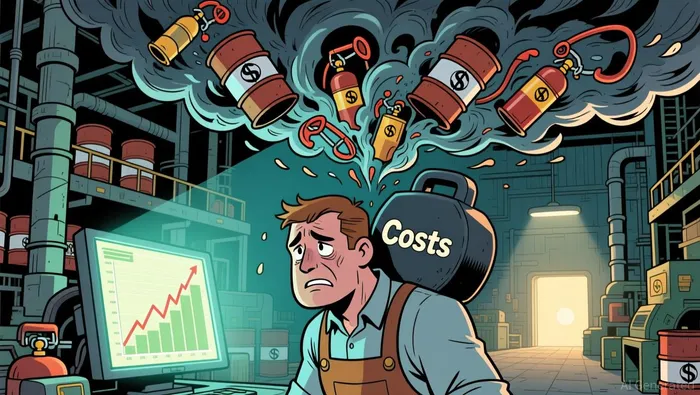
A better-than-expected CPI print does show the economy can absorb some imported inflation without breaking. But a single stronger print does not prove sector-wide pricing power. For margins, that is a boundary condition, not a green light.
Portfolio implication: favor dispersion over broad cyclical beta
That favors stock-picking over broad industrial exposure. If the inflation regime is still cost-driven, the edge comes from identifying companies with actual pass-through ability, lower energy sensitivity, or stronger balance-sheet resilience. It does not come from owning every cyclical name that moves with a higher PPI headline.
What to watch next
- If CPI stays above consensus while PPI keeps accelerating, the pass-through story strengthens.
- If CPI fades back toward or below expectations, margin pressure is more likely to reassert itself.
- If transport and fuel components keep leading while consumer goods and services remain muted, treat this as another round of supply-shock inflation.
Positioning should stay tactical until the inflation mix broadens
The allocation call is tactical. After a second straight month of increase in PPI, driven in large part by global energy price shocks stemming from the Middle East war, investors should treat this as a regime-ambiguity trade rather than a mandate to chase broad industrial beta.
How to build for ambiguity
Favor low-correlation quality: businesses with steadier cash flows, less direct fuel and chemical exposure, and more balance-sheet room to absorb input-cost volatility. That is the cleaner way to protect risk-adjusted returns if another hot PPI print still turns into margin compression rather than durable revaluation.
At the same time, size pro-cyclical China exposure more like a satellite position than a default benchmark weight until the inflation mix changes. If the next leg higher remains tied to energy-led cost pressure, sector correlations can compress quickly and turn a diversified cyclical basket into one big factor trade.
What would justify adding risk
Do not add exposure on headline strength alone. Add only if the signal broadens downstream.
Clean invalidation signal
This defensive positioning weakens if downstream demand broadens, CPI holds up, and PPI leadership moves from energy toward machinery, metals, and consumer goods. Until that happens, the disciplined move is to stay selective, favor quality, and wait for confirmation.