

The $810 million note issue is the catalyst, but execution is the real test
Cipher's latest headline is straightforward: its subsidiary has priced $810 million of 6.000% senior secured notes due 2031. The bigger question is whether Cipher can turn that capital into energized, leased data-center capacity quickly enough to outgrow the leverage before execution risk starts driving the stock.
That is a meaningful capital load for a company still proving its AI infrastructure story. The deal also reimburses roughly approximately $63.6 million of prior equity put into the project, while setting aside money for debt service reserves, leaving less room for error if timelines slip.
Why the financing structure matters more than the coupon
This is not simple corporate leverage. The notes carry first-priority liens on substantially all assets of the issuer and guarantor, and Cipher has provided a completion guarantee for the Stingray Facility. If construction takes longer or costs more than expected, the pressure is not confined to a standalone bond issue; it can feed back into the parent and keep equity volatility elevated.
Why the next few weeks matter
The offering is expected to close on June 15, 2026, and investors are already scrutinizing execution closely. Heading into the pivot, 19% of the float had been sold short, a sign that the market wants cleaner proof of delivery before rewarding the story. Bulls can argue the debt is acceptable if it accelerates leased capacity. Bears will argue the risk is financing the transition before the market sees more durable proof points.
Cipher's upside case depends on scale turning into contracted cash flow
The market is not paying for today's income statement. It is paying for the possibility that installed power becomes tenant-backed revenue over time.
The 100MW Stingray site matters because scale is the asset
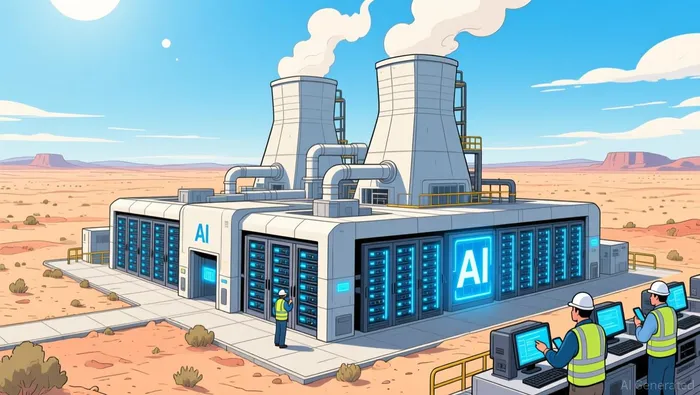
A current loss profile is not the central issue. The more important issue is whether Cipher can convert megawatts into durable revenue fast enough to deserve an infrastructure-style multiple rather than a turnaround multiple. That is why the 100MW development in West Texas matters more than a single weak quarter. So does the site's land and front-of-the-meter positioning, because those are the constraints that matter most in AI data-center supply.
This is a capacity-first business model. In mature infrastructure, investors tolerate weak current earnings if they believe committed demand and limited power will support longer-duration cash flows. Cipher's bull case rests on the same logic: secure the power, secure the tenant, then let leases improve earnings quality over time.
Pre-leased projects are the bridge from capex to revenue
Cipher is not just assembling sites in the abstract. Its Barber Lake campus is pre-leased to Fluidstack and Google, and Black Pearl is pre-leased to Amazon Web Services. That changes the risk profile. Unleased capacity is a vision; pre-leased capacity is a more direct path from capex into revenue recognition and lower vacancy risk.
The broader pipeline matters too. Cipher says it has a pipeline of projects with up to 3.4GW of capacity across seven sites. If even a fraction of that pipeline becomes energized and leased, the valuation starts to look less like a single-facility bet and more like an early wager on platform scale.
Why the bear case still has weight
The counterargument is straightforward. The market can forgive weak earnings, but it usually does not forgive poor conversion. First-quarter expectations still point to $33.71 million in revenue, down 31.15% year over year, with a loss of 27 cents per share. That tells you the current financial picture still reflects a company in transition, not a mature asset base collecting contracted rents.
Skeptics will also note that pre-leasing is not the same as operating cash flow, and that a large megawatt pipeline can become more narrative than substance if timing slips or financing becomes harder at each subsequent project. That is the real debate: whether Cipher's leases and capacity pipeline are strong enough to offset execution risk, or whether the multiple compresses back toward the quality of the income statement.
Positioning around Cipher depends on what gets confirmed next
Cipher still fits best as a watchlist name with a tactical posture, not as core AI infrastructure exposure. The key signal is not today's earnings base, but how cleanly financing converts into energized, leased capacity.
The market is still reacting sharply to milestones rather than steady compounding, as shown by the 8.2% move on the pricing headline. That argues for satellite sizing rather than anchor exposure.
What would confirm the thesis
- The notes close on schedule.
- Stingray advances toward energization without obvious delays.
- Pre-leased projects move closer to revenue contribution and clearer cash-flow visibility.
What would weaken it
- Construction or energization timelines slip.
- Leverage rises before leased capacity becomes operating cash flow.
- The story stays anchored to pipeline scale rather than delivered results.
For now, the cleaner approach is to start small and add only if closing, build progress, and customer commitment line up. If execution improves, the scale story can hold. If it does not, the debt structure will likely keep the downside sticky.