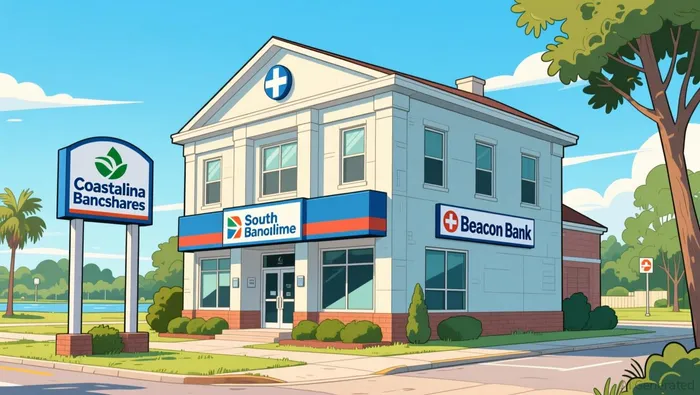
The "merger of equals" label vs. the ownership math
The deal is marketed as a merger of equals, but the ownership outcome is not 50/50. Under the agreement, each Beacon share converts into 0.736 shares of Coastal common stock, and after closing Beacon holders will own about 43.9% of the combined company versus 56.1% for existing Coastal holders. That is meaningfully off-equity, so the headline says collaboration while the mechanics say Coastal is the surviving vehicle.
Control stays with the Coastal entity
The surviving legal structure reinforces that point. The combined holding company will keep the name Coastal Carolina Bancshares, Inc., continue trading under the ticker CCNB, and sit on a fifteen-member board with eight will come from Coastal and seven from Beacon. Laurence S. Bolchoz will continue as president and CEO of both the holding company and the bank. Even though the bank will eventually operate under the Beacon Bank, N.A. brand, the surviving entity, ticker, and board majority make clear where the dominant control lies.
Why the scale story has merit, and why the exchange ratio still matters
For CCNB holders, the real question is not branding: does this combination create enough earnings, book value, and strategic flexibility to make the exchange ratio feel fair after the fact?
The bull case starts with geography and scale
The strategic logic is easy to understand. The merger creates a platform with approximately $2.2 billion in consolidated assets and roughly $200 million in market capitalization, along with sixteen branches and a loan production office stretching from Wilmington, NC, to Charleston, SC, and inland to the upstate. That is a more meaningful regional footprint than either franchise had on its own, with better potential for deposit diversification, broader lending reach, and fixed-cost absorption.
That also fits the stated rationale for the deal. The companies say the combination reflects a broader trend of banks seeking greater scale to absorb regulatory costs, invest in technology and improve operating efficiency. If that premise holds, the size increase is not just cosmetic; it can improve capital flexibility and make the franchise more resilient than either company was alone.
Value still depends on price in an all-stock deal
Size alone does not create shareholder value. In an all-stock transaction, what matters is whether earnings and book value per surviving share rise fast enough to justify the dilution. The combined company will remain Coastal Carolina Bancshares, Inc. and continue trading as CCNB, while Beacon shareholders will receive 0.736 Coastal shares and own 43.9% of the post-close franchise. That means Coastal holders are already financing most of the expansion through the surviving stock.
So the bull case has a strict test: the merger needs to show measurable accretion to book and earnings, plus enough operating leverage, without forcing management into weaker credits just to fill out a larger branch footprint.
Where the debate splits
Bulls can argue the combined franchise will be more competitive, with better cross-selling and cost-control potential. Bears can argue the roughly $200 million market capitalization suggests investors still want near-term proof rather than a long integration narrative.
Timing matters, too. The transaction is expected to close in the third or fourth quarter, with the bank operating under the Beacon Bank, N.A. brand after the early 2027 system conversion. That leaves a limited window to demonstrate early synergy wins before integration complexity takes over.
What CCNB shareholders should watch before calling this a winner
This is less a pure valuation debate than a proof test on terms, execution, and asset quality.
Fair-value estimates are too split to settle the case
Current valuation signals are mixed. One model says CCNB trades 37.9% below fair value, while another shows it as 237.6% overvalued on an intrinsic-value basis. That disagreement matters. It suggests the upside case is not settled and that investors should wait for the proxy materials and fairness opinion to see whether the exchange ratio actually protects the surviving shareholder.
Dilution history raises the bar
Valuation discussion on CCNB also notes that Shareholders have been diluted in the past year. If that is still fresh in investors' minds, this deal cannot be judged on scale alone. Existing CCNB holders need evidence that the combined franchise can earn back any additional dilution quickly.
That backdrop makes the operating trend relevant. Earnings grew by 28.1% over the past year, which is a positive signal. But strong trailing earnings do not excuse a poor exchange price in an all-stock deal; they only matter if they help lift future per-share value.
The proof points that matter most
Watch these items in the coming disclosure materials:
- Accretion timing: Are book value and earnings per share accretive by the first full post-close year?
- Integration costs: Are one-time expenses capped and clearly disclosed?
- Loan growth and deposit pricing: Does the larger footprint produce cheaper funding and cleaner demand, or just more branches to support?
- Beacon asset quality: Are Beacon's loans and reserves adding durable value, or are Coastal shareholders taking on weaker credits?
The next catalyst is the proxy and fairness package before the expected third or fourth quarter close. If those documents do not show fair value, manageable integration drag, and solid Beacon assets, the market is likely to treat this as another stock-funded expansion in which existing holders end up with less control and a larger pool of shares sharing the same upside.