

The market's mood has shifted. After years of chasing growth, investors are now seeking stability. As geopolitical tensions and AI-driven volatility have unsettled the waters, a defensive rotation has taken hold. The S&P 500 Dividend Aristocrats Index, comprising companies with decades of consecutive dividend increases, has delivered roughly 7% total returns year-to-date in 2026. This marks a dramatic reversal from the tech-dominated rally of recent years, with investors fleeing to the perceived safety of consumer staples.
Coca-Cola has been a key beneficiary of this flight to quality. The beverage giant's stock has surged about 11% so far in 2026, significantly outperforming the S&P 500's decline. This strong performance is driven by two factors: the powerful defensive narrative and solid underlying results. The company's strong fourth-quarter and full-year 2025 earnings provided a tangible foundation for the rally, showing steady organic growth and robust cash flow even amid persistent consumer pressure.
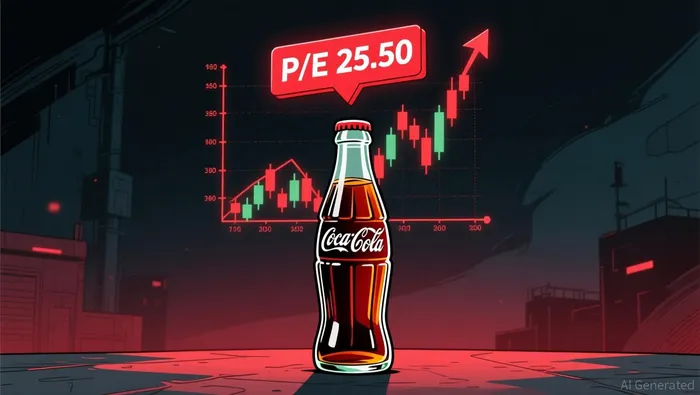
Yet the core investment question is whether the price paid reflects the business's intrinsic value. As of early April 2026, Coca-Cola trades at a P/E ratio of 25.50. While this is a slight discount to its own 5-year average of 26.65, it remains a significant multiple to its historical range. The stock's premium valuation leaves little margin of safety for a long-term investor. The thesis is that while the defensive rotation justifies the outperformance, the high price tag demands flawless execution and sustained growth to justify it.
The Durability of the Moat for Long-Term Compounding
The investment case for Coca-Cola rests on the durability of its competitive advantages. The company's ability to compound shareholder value over decades depends on whether its current growth drivers are rooted in a wide, sustainable moat or are more vulnerable to cyclical shifts and portfolio changes.
The evidence points to a business demonstrating remarkable resilience. For 18 consecutive quarters, Coca-Cola has gained value share, a powerful signal of pricing power and distribution strength. This isn't just about selling more soda; it's about maintaining brand relevance and market leadership even in a dynamic macro environment. Management's confidence for 2026 is built on a flexible lever: the ability to rebalance between pricing, affordability, and premiumization as consumer elasticity evolves. This adaptability is a hallmark of a durable business, allowing it to navigate inflation fatigue and uneven spending without losing ground.
A key pillar of this durability is the company's strategic pivot. The "Total Beverage" expansion is diversifying its mix, with Hydration, Sports, Coffee, and Tea now contributing nearly a third of total revenue. This reduces reliance on any single category and taps into higher-growth, higher-margin segments. The asset-light model, which focuses resources on brand building while outsourcing bottling, further protects margins and capital efficiency. These are structural advantages that compound over time.
Yet, the quality of earnings power must be scrutinized. The company's 2026 guidance calls for 4% to 5% organic revenue growth, driven by a 4-point contribution from price/mix and a 1-point volume gain. This suggests that volume growth is modest, and much of the top-line expansion relies on pricing and portfolio shifts. While this is a disciplined approach, it also means the business is highly sensitive to consumer spending power. The "flexible" pricing lever is a strength, but it is consumer-elasticity-dependent-a vulnerability in a prolonged downturn.
The bottom line is one of quality versus vulnerability. Coca-Cola possesses a wide moat, evidenced by its sustained value share gains and strategic diversification. However, the path to compounding in the near term appears to hinge on a delicate balancing act between premiumization and affordability. For a value investor, the question is whether this balance can be maintained for the long cycle, or if the business is merely executing a sophisticated portfolio shift that may not be as durable as its iconic brand suggests.
Dividend Sustainability and the Compounding Engine
The dividend is the ultimate test of a business's cash-generating power. For a company like Coca-Cola, which has paid a dividend for over a century and extended its streak of annual increases to 64 consecutive years, the sustainability of that payout is paramount. The forward annual rate of $2.12 per share yields 2.7% at current prices, a figure that looks modest but is backed by a powerful compounding engine.
The critical metric for a value investor is the payout ratio relative to free cash flow. The historical pattern has been one of a gap. In fiscal 2025, the company paid $8.779 billion in dividends while its reported free cash flow was $5.296 billion. This meant the dividend exceeded free cash flow, a dynamic that has persisted in recent years. Management has acknowledged this, noting that the dividend payout as a percentage of adjusted free cash flow was 73%, which aligns with its long-term target of 75%. The adjustment excludes one-time items like the Fairlife acquisition payment, which artificially compressed reported FCF. On a straight operating cash flow basis, the payout ratio has run above 100%, a situation that requires cash reserves or financing to bridge.
This is where the forward view becomes the key. Management has guided for free cash flow of approximately $12.2 billion in 2026, driven by expected operating cash flow of $14.4 billion against capital expenditures of $2.2 billion. If this target is met, it would restore a healthy cushion for the dividend. The company's 2026 guidance for comparable EPS growth of 7% to 8% and organic revenue growth of 4% to 5% provides the earnings strength to support this cash flow trajectory. The CFO has reinforced the commitment, stating that free cash flow generation drives the unwavering commitment to reinvest and grow the dividend.
The bottom line is one of transition. The dividend has been funded by a mix of earnings, operating cash flow, and balance sheet management in recent years. The 2026 outlook, however, appears to return to a more traditional model where free cash flow comfortably covers the payout. This is a necessary evolution for the compounding engine to run efficiently. For now, the streak remains intact, but the path to sustainability hinges on delivering on that $12.2 billion FCF target. It is a manageable hurdle for a business with Coca-Cola's scale and pricing power, but it is a hurdle nonetheless.
Risks to the Margin of Safety
The high price paid for Coca-Cola's quality demands a clear-eyed assessment of the risks that could erode its intrinsic value. While the business possesses a wide moat, several threats could challenge its durable compounding and narrow the margin of safety at current levels.
The most profound long-term risk is a potential shift in consumption patterns. The rise of GLP-1 weight-loss medications represents a structural headwind for sugary beverages. As these drugs become more prevalent, they could alter consumer habits in a way that is difficult to offset with portfolio diversification alone. This is not a near-term volatility but a potential multi-decade trend that could pressure the core business, even as the company expands into coffee and sports drinks.
A significant, unresolved financial risk looms from a multi-billion dollar U.S. tax dispute. The company has made a $6.1 billion deposit related to this matter, which has directly impacted its free cash flow. This is a concrete liability that, if resolved unfavorably, could impose a substantial cash cost or require a material adjustment to earnings. The uncertainty surrounding this dispute introduces a tangible element of operational and financial risk that is not reflected in the company's otherwise steady guidance.
Execution risk is heightened by the leadership transition. The departure of CEO James Quincey after nearly a decade of steady stewardship coincides with the company's preparation for a new era under incoming CEO Henrique Braun. While the new leader is expected to focus on digital transformation and emerging markets, any misstep in navigating the complex portfolio or in maintaining the delicate balance between premiumization and affordability could disrupt the growth trajectory. The market's premium valuation leaves little room for a stumble during this sensitive period.
Finally, the company's own financial engineering introduces a layer of complexity. The dividend has been funded by a mix of earnings and operating cash flow, with the payout ratio on a straight FCF basis historically running above 100%. The 2026 guidance for $12.2 billion in free cash flow is a critical target to restore a more traditional funding model. Failure to meet this target would force a return to the same cash flow management that has supported the dividend in recent years, potentially straining the balance sheet and raising questions about the sustainability of the payout at a time when the stock trades at a premium.
The bottom line is that the margin of safety is not just about the business's quality, but about the clarity of its path. The risks here-structural consumption shifts, a large unresolved tax liability, a leadership handoff, and a critical cash flow target-collectively create a setup where the high price paid leaves investors exposed to a combination of long-term trends and near-term execution hurdles. For a value investor, these are the vulnerabilities that must be weighed against the company's durable advantages.
Conclusion: The Margin of Safety at Current Prices
The analysis converges on a clear, persona-aligned answer. For a value investor, Coca-Cola at its current price offers a minimal margin of safety. The premium valuation-trading at a P/E ratio of 25.50-demands near-perfect execution of a complex transition, leaving little room for error.
The core question is whether this multiple is justified by the durability of the moat and the growth trajectory, especially with a new CEO in place. The evidence shows a business with a wide, resilient moat, as demonstrated by 18 consecutive quarters of value share gains and a strategic pivot to a "Total Beverage" mix that now contributes nearly a third of revenue. Yet the growth path is not one of effortless compounding. It relies on a delicate, consumer-elasticity-dependent balancing act between pricing, affordability, and premiumization. The stock's price appears to assume this balance will be maintained flawlessly for the long cycle.
The watchpoints for a long-term investor are now more critical than ever. Success hinges on three fronts: the seamless execution of the beverage diversification strategy, the continued discipline in volume and pricing, and the resolution of the $6.1 billion U.S. tax dispute. Any stumble in these areas could quickly erode the high price paid. The leadership transition adds a layer of execution risk, as the company prepares for a new era under incoming CEO Henrique Braun.
For the dividend, the path to sustainability is clearer. The 2026 guidance for approximately $12.2 billion in free cash flow is a critical target to restore a more traditional funding model. Meeting it would provide the necessary cushion for the unwavering commitment to the 64-year dividend streak.
The bottom line is one of quality priced for perfection. Coca-Cola possesses the hallmarks of a durable compounding engine. But at a premium multiple, the market is paying for a future where all the pieces fall into place. For a disciplined investor, the current setup suggests the price of admission is too high to accept a wide margin of safety. The business may be great, but the stock is not cheap.