

The core of Colombia's energy crisis is a steep, irreversible decline in its domestic gas supply. Production has fallen to a record low, creating a structural deficit that will only widen without new sources. In February 2026, commercial gas output hit 695 million cubic feet per day, the weakest February reading on record. That figure represents a 15.7% year-on-year decline, following a 17.1% drop for the full year 2025. This collapse is driven by the mechanical decline of the country's three dominant mature fields-Cusiana, Clarinete, and Cupiagua-which account for a disproportionate share of the 80% of national production concentrated in just 12 fields.
The result is a complete break from self-sufficiency. Colombia lost gas self-sufficiency in December 2024. Since then, the country has become reliant on imports, a shift that has accelerated sharply. Through the SPEC regasification terminal in Cartagena, imports have surged from less than 3% of total supply between 2015 and 2023 to more than 23% in Q1 2026. This is not a temporary fix but the start of a new supply reality.
The deficit trajectory is severe and projected to worsen. Without new domestic production, Corficolombiana projects the supply gap will reach 20% in 2026, rising to 41% by 2028 and a staggering 57% by 2030. This is a steep, irreversible decline creating a structural deficit. The only project with the scale to address it, the offshore Sirius field, faces a 122 prior-consultation process and will not produce before 2029-2030 at the earliest. For now, the country is left choosing between importing more expensive LNG, seeking gas from a post-Maduro Venezuela that requires an OFAC license, or waiting for a solution that is years away.
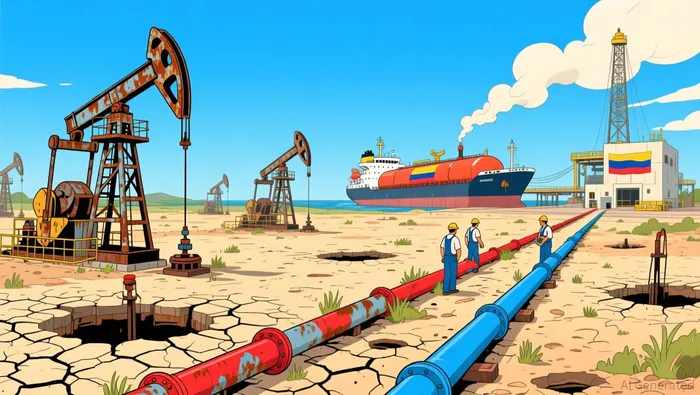
Demand Pressures and Economic Vulnerability
The supply deficit is not just a technical energy problem; it is a direct source of fiscal stress and economic vulnerability.
The 2025 gas crunch laid bare this risk, when a domestic supply tightness coincided with an outage at the country's only LNG import terminal in Cartagena. To avoid rationing factories, the state oil firm Ecopetrol was forced to cut its own gas consumption and push extra supply into the market. For households and industry, it was a stark lesson in scarcity: higher prices and fragile supply with little room for error. That shock reopened a political fight over fracking, as the government grappled with the immediate trade-off between energy security and environmental goals.
This vulnerability is amplified by a parallel collapse in Colombia's oil sector, which undermines the very export revenue and fiscal stability the country needs to manage its energy transition. The oil and gas output has fallen sharply, with February 2026 crude production at 734,924 barrels per day, the lowest monthly average since 2021 and down 23% from a decade ago. This is a major blow to a budget that never fully recovered from the pandemic, as oil remains Colombia's single largest export and a key fiscal contributor. The dual decline in both oil and gas production creates a dangerous feedback loop: less domestic hydrocarbon revenue forces the government to rely more on expensive imports, which in turn increases economic exposure to global price shocks.
The country's increasing reliance on imported gas, now accounting for a fifth of consumption, is the linchpin of this amplified risk. This dependence turns global energy disruptions into direct domestic fiscal pressures. Recent tensions in the Middle East, including Iran's closure of the Strait of Hormuz, caused a major spike in global oil and gas prices. Such events threaten to spiral Colombia's budget deficit higher, as the state must pay more for essential fuel imports while its own hydrocarbon earnings shrink. In essence, the supply deficit has turned Colombia's economy into a more sensitive barometer for global energy market turbulence, worsening its financial fragility at a critical time.
The Fracking Option: A Supply-Side Trade-Off
The political discourse around fracking in Colombia has shifted from abstract environmental slogans to a tangible trade-off between energy security and economic cost. This pivot is exemplified by presidential candidate Paloma Valencia, who has openly stated that investments in oil, natural gas, and mining can lift people out of poverty. Her running mate echoed that call, advocating for the use of fracking. This marks a clear move away from the previous administration's stance, which halted fracking pilots and championed a fossil-fuel "non-proliferation" push. The 2025 gas crunch, which forced the state oil firm Ecopetrol to cut its own consumption to avoid factory rationing, reopened this debate with a stark lesson in scarcity.
Yet the legal and regulatory path forward is not a simple green light. There is no nationwide legal ban on fracking, but the country also lacks a clear, enabling framework. The reality is one of suspended pilots, reintroduced bills, and an international partner that walked away. For fracking to be considered, it would require strict oversight, credible community benefits, and an honest accounting of its costs and risks. The debate is no longer about whether to do it, but how to do it responsibly if at all.
This discussion happens against a backdrop of a severe and worsening supply gap. The offshore Sirius project, the only field with the scale to structurally close the deficit, faces a 122 prior-consultation process and will not produce before 2029-2030 at the earliest. This leaves a critical four-year window where the country must find other sources. The near-term fix of piping gas from Venezuela requires only a pipeline repair and an OFAC license, but it is a political and logistical hurdle. In this tight supply window, fracking emerges not as a guaranteed solution, but as a potential, highly constrained option. It is a trade-off that must be weighed against the immediate need for reliable gas and the long-term fiscal and environmental costs.
Catalysts and What to Watch
The coming months will test whether Colombia's energy crisis forces a pragmatic policy shift or entrenches political paralysis. Three concrete signals will determine the path forward on domestic production, particularly fracking.
First, the resolution of the Venezuelan gas pipeline repair and the required OFAC license is the fastest potential fix. The physical work to reconnect the Gasoducto Antonio Ricaurte is minimal-a 5-kilometer repair on the Colombian side that could be done in months. The real bottleneck is regulatory. The incoming administration and state firm Ecopetrol are actively negotiating an OFAC waiver with Washington. A successful license would provide a near-term supply boost for 2026, directly easing the projected 20% deficit and reducing immediate pressure to approve other domestic options. Its absence would leave the country reliant on more expensive LNG imports, amplifying the fiscal and price pressures that could make any domestic production look more attractive.
Second, the progress of the Sirius project's lengthy prior-consultation processes will signal the government's long-term commitment. This offshore field is the only project with the scale to address the structural deficit, but it faces a 122 prior-consultation process and will not produce before 2029-2030. The incoming administration's regulatory signals on this process will be a key indicator. A clear, accelerated path forward would reinforce the long-term strategy, while delays or new hurdles could undermine investor confidence and leave a gap that must be filled by other means in the interim.
Finally, tracking gas prices and import volumes is the most direct economic pressure gauge. The shift to imported LNG has already reshaped costs, with industrial gas prices rising 69% year-on-year in 2025. Sustained high prices, especially if driven by global volatility or a demand surge from an El Niño event, will increase the economic imperative to find any domestic source. Monitoring import volumes through the SPEC terminal and the new Puerto Bahía facility will show how much the country is relying on external supply. If these volumes remain high or grow, it will keep the fiscal and energy security risks front and center, making the trade-offs of fracking or other domestic options harder to ignore.