

Oil prices have surged, but will crude quickly pull back or stay elevated? Gold and silver are consolidating after a huge rally—could the next breakout be forming? Meanwhile, rising yields and stretched valuations are forcing investors to rethink risk in US stocks.
Iran said a US proposal to end the war is “still being considered ” after reports suggested both sides may be moving closer to an agreement.
US media outlet Axios reported Wednesday that the White House believes it may be nearing a 14-point memorandum of understanding with Iran.
However, a senior member of Iran’s parliament dismissed the proposal as merely a “wish list,” while a foreign ministry spokesperson said Tehran would communicate its response to the US proposal through Pakistani mediators.
Brent crude plunged 7% on Wednesday, still drop in Thursday trading as investors reassessed the prospects of a Middle East peace deal.
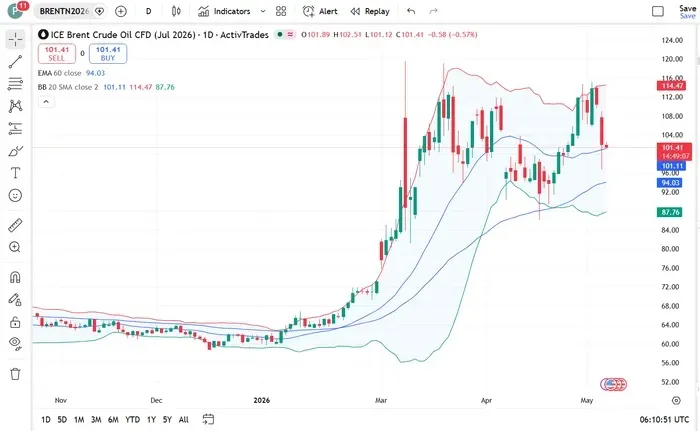
Yet beneath the short-term volatility lies a much larger structural issue for the global oil market.
Strait of Hormuz Disruption Has Drained Global Oil Inventories
The earlier disruption around the Strait of Hormuz severely depleted global crude inventories.
In April alone, global oil inventories reportedly fell at a record pace of 11-12 million barrels per day. Before the market entered a stressed operational state, globally available usable inventories were estimated at only around 800 million barrels. By late April, approximately 280 million barrels had already been consumed.
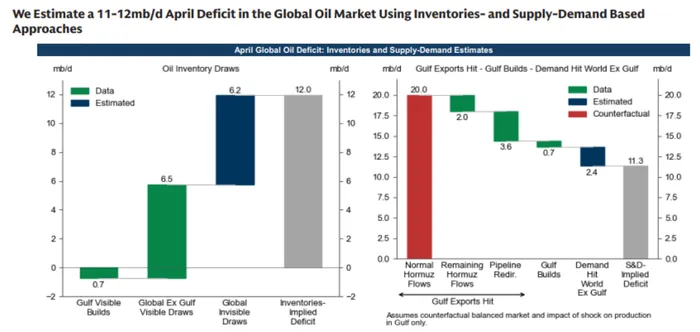
Under traditional geopolitical disruptions, major oil producers would normally deploy spare production capacity to stabilize prices. But this crisis is different.
Most of the world’s spare production capacity is concentrated in Saudi Arabia and the UAE, and much of that capacity is physically trapped inside the Strait of Hormuz. As a result, the oil market’s traditional shock absorber has effectively failed, forcing the world to rely on existing inventories to absorb the supply-demand imbalance.
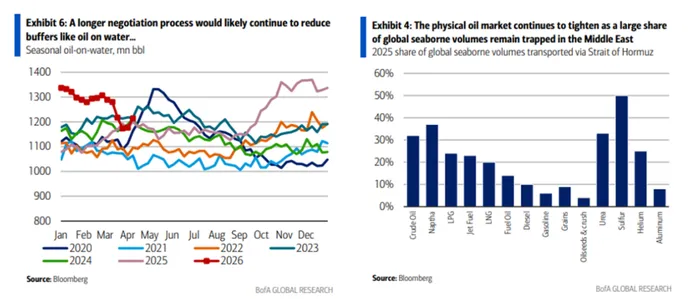
Even if the strait reopens in May, restoring crude supply could still take more than a month. If supply normalization does not occur until late July, global inventories could remain significantly below normal levels throughout the year, potentially pushing international oil prices even higher.
Moreover, even after shipping routes normalize, oil-importing nations are likely to systematically raise their strategic reserve targets, creating additional precautionary demand. This could establish a new long-term floor for crude prices.
High Oil Prices Are Repricing Inflation and Interest Rates
As oil prices remain elevated, markets are beginning to reprice the possibility of inflation staying higher for longer.
The yield on the 30-year US Treasury has climbed back above the critical 5% level, forcing investors to reconsider current US equity valuations.
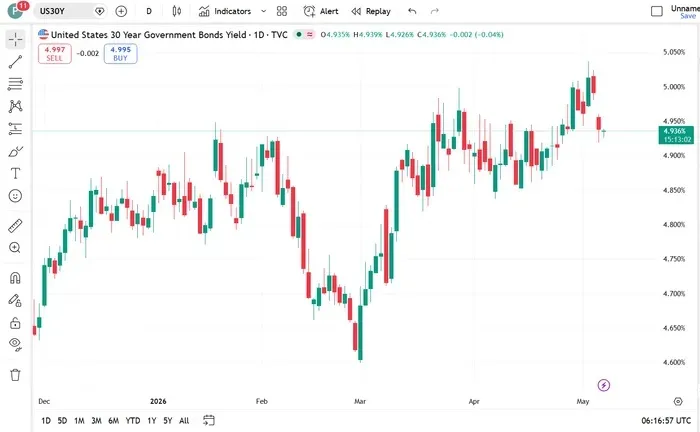
Goldman Sachs partner Richard Privorotsky recently expressed caution, noting that historically, interest rates have imposed far greater constraints on stock market performance than oil prices themselves.
Warren Buffett’s Berkshire Hathaway holding a record level of cash reserves is also increasingly viewed as evidence of concern over today’s speculative environment in US equities.
The market is now confronting a difficult reality: if oil prices stay high while rates continue rising, richly valued technology stocks may face mounting valuation pressure.
At the same time, many mega-cap technology companies are approaching the limits of capital expenditure spending and may increasingly rely on debt financing to sustain AI infrastructure investment.
Could Gold and Silver Be Preparing for Another Major Rally?
After an explosive rally earlier this year, gold and silver experienced a meaningful correction and are now consolidating. Market attention has largely shifted toward oil and semiconductor stocks.
But beneath the calm surface, the next major move may already be forming.
Legendary precious metals expert Bill Holter recently appeared in an in-depth interview on USA Watchdog with host Greg Hunter. Holter argued that precious metals could be preparing for another powerful breakout.
According to Holter, the United States is increasingly becoming a “banana republic.” Including official debt and unfunded liabilities, total obligations could eventually approach an astonishing $200 trillion. As the issuer of the world’s reserve currency, the credibility of the US dollar is becoming increasingly fragile.
Central Banks Continue Buying Gold
Recent pullbacks in gold prices sparked concerns that central bank demand may be fading. Holter strongly rejected that view.
He stated that central banks around the world continue to accumulate gold. India reportedly recorded its largest gold import month in history in March, while BRICS central banks continue purchasing aggressively.
Holter acknowledged that some central banks have temporarily sold gold reserves to raise liquidity, but he described these moves as isolated events rather than a structural shift. The long-term sovereign accumulation trend remains intact.
Silver Fundamentals Remain Exceptionally Tight
Silver previously surged above $120 during a short squeeze before retreating toward the $80 range.
Holter argued that silver market liquidity is increasingly shifting away from COMEX paper trading and toward physical ownership. Open interest in COMEX silver futures has reportedly fallen below 100,000 contracts, the lowest level in 15 years, suggesting speculative traders are exiting the market.
Fundamentally, silver remains in a structurally bullish position.
The global silver market has been in deficit for more than five consecutive years, with annual supply shortages estimated between 300 million and 400 million ounces.
The rise of AI infrastructure may further strengthen demand. Data centers, electrical systems, and AI hardware all require significant quantities of silver.
Holter cited forecasts suggesting silver could eventually reach between $100 and $300 by the end of 2026. He stated that the market may be preparing for a move even larger than the rally seen between last November and January.
Buffett’s Warning on the Stock Market
Holter also warned investors about US equities, pointing to Buffett as a key signal.
Berkshire Hathaway is sitting on roughly $400 billion in cash and has struggled to find attractive acquisition opportunities. Holter described this as a major message for investors.
The implication is increasingly clear: even one of history’s greatest long-term investors appears reluctant to aggressively deploy capital into today’s market.
Conclusion
Although Iran and the US may be moving toward a temporary ceasefire arrangement, a durable peace agreement remains fragile, and the path toward full normalization of the Strait of Hormuz is still long.
Global oil inventories are likely to remain significantly below normal levels this year, while countries may increase strategic reserve targets, potentially keeping oil prices elevated for an extended period.
In precious metals, massive US debt burdens continue to undermine confidence in the dollar, while central banks remain committed buyers of gold. Silver fundamentals remain exceptionally strong, supported by annual supply deficits of 300-400 million ounces and rising AI-related demand.
For US equities, the rise in 30-year Treasury yields above 5% may force investors to reassess valuation assumptions. If oil prices remain high, elevated rates could increasingly pressure stock multiples. At the same time, major technology companies may be approaching the limits of AI-related capital spending.
At Berkshire Hathaway’s shareholder meeting, Buffett clearly signaled that this is not an ideal time for aggressive stock buying. The market may want to listen carefully.