

Innio priced its IPO today at $27 per share - the top of its range - and upsized the deal to 90 million shares, raising $2.43 billion. The stock opens on Nasdaq under INIO. The valuation implied is around $20 billion.
Here's the thing nobody is leading with: the company gets none of it. Every one of those 90 million shares is secondary. Advent International and ADIA - the Abu Dhabi sovereign wealth fund - are selling their stakes. This is not growth capital. It's an exit.
Advent bought General Electric's distributed power business for $3.25 billion in 2018, rebranded it Innio, and spent eight years turning it around. Fitch upgraded the credit rating to B+ last year, projecting EBITDA margins approaching 24% by 2027. The financials are clean: $2.81 billion in trailing revenue, about $98 million in net income. Solid for an industrial company. Solid enough, apparently, to justify a $20 billion asking price.
But the valuation requires you to believe something more specific than "gas engines are profitable." It requires you to believe the current demand spike is structural, not cyclical.
Innio's investor filing reveals the number that matters. New orders from data center customers jumped from $27 million in 2023 to $2.3 billion in 2025. That's an 85-fold increase in two years. The VoltaGrid deal alone - 1.5 gigawatts of behind-the-meter power, 300 gas engines, delivery by 2028 - is bigger than Innio's entire data center book of business two years ago. Another framework agreement with Rehlko for 1.25 GW sits in the pipeline.
The story is simple to tell and hard to bet on. AI data centers need power. A lot of it. Grid connections take years to build. Gas engines can be deployed fast, they burn cheaper than diesel, and they emit less than alternatives. For a company trying to power a 5-gigawatt campus by 2028, a gas engine backup today is better than nothing today.
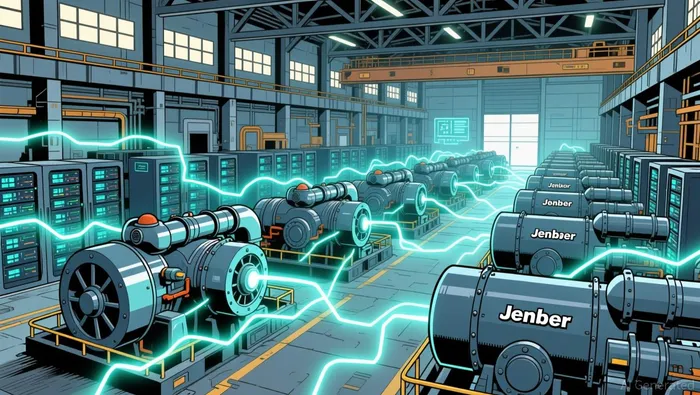
But here's the contradiction that carries the risk. Innio is pitching itself as an energy transition company - its own materials talk about empowering "the transition to net zero." In April, they announced a 3 MW demonstration of 100% hydrogen backup power for data centers. The language is carefully calibrated: we sell gas now, hydrogen later, the engines are flexible enough for both.
I suspect this is more PR architecture than revenue architecture. The $2.3 billion in data center orders is for natural gas engines. The hydrogen demo is 3 megawatts. For context, the VoltaGrid deal is 1,500 megawatts. There's a scale problem between the story and the product.
Which brings us back to the structure of the deal itself. A 100% secondary IPO sends a specific signal. The owners believe the stock can sustain a price above what they paid in 2018. ADIA came in around 2023, so their cost basis is higher and less clear. But both want liquidity now, while the data center power frenzy is at its peak and investors are connecting dots between AI capex and anything that sells infrastructure to it.
If the data center power boom moderates - if grid connections catch up, if battery costs fall further, if regulators restrict natural gas permits - those 300 Jenbacher engines ordered by VoltaGrid become a different conversation. The orders are real, but they're also long-dated. A gas engine sold today for delivery in 2028 is not the same as revenue recognized in 2027.
The competition is real too. Caterpillar and Cummins both make gas engines for the same applications. Wartsila has the marine and power generation pedigree. Innio has Jenbacher as a brand, but in an industry where the customer is buying capacity more than technology, brand differentiation fades.
What to test. The question isn't whether Innio makes good engines. It's whether the market for them will exist at the same margins three years from now. Watch two things. First: does Innio actually convert those data center orders into booked revenue at the margins the market expects? The S-1 shows where the order book is, but execution is always the hard part in heavy manufacturing. Second: does the hydrogen narrative ever move past demonstrations and into commercial orders, or does it remain a slide in the presentation deck?
The way Advent made money here isn't by building a permanent platform. It's by buying a neglected industrial asset, fixing its margins, and selling it while the narrative is hottest. That's how private equity works. The question for public shareholders is whether what's left after the exit is a business that compounds or one that slowly reveals itself as a cycle.