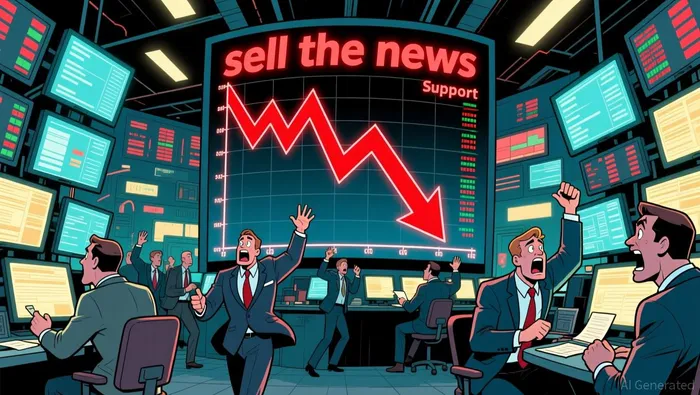
The market's verdict on CoreWeave's latest update was swift and severe. Shares sank 11% on Friday, a classic "sell the news" reaction that highlights a stark expectation gap. The company's own guidance reset had clearly fallen short of what was priced in. For the current quarter, CoreWeave expects revenue of $2.45 billion to $2.6 billion, a miss against the Street's $2.7 billion expectation. Even more telling was the operating income forecast, which projects $30 million–$90 million-a wide miss against the $154 million analysts had penciled in.
This isn't just a one-off stumble. The pattern is clear: CoreWeave shares have sold off after every earnings report since its IPO. The stock had been on a powerful run, surging 78% in 2026 and more than 200% since its March 2025 listing. That rally priced in relentless AI demand and recent high-profile deals. The guidance cut, however, forces a reset on the path to profitability, revealing that the capital intensity required to fund that growth was not fully discounted by investors.
This setup aligns with a broader, more cautious view from the Street. Société Générale's Chief US Equity Strategist, Manish Kabra, has issued a 'Not So Fast' warning for tech, pointing to a potential inflection point. He sees hyperscalers, a category that includes CoreWeave, facing a cash flow trough. Free cash flow for this group is expected to turn negative this year before finally turning positive in early 2027. The implication is a potential sector-wide reset, where the current surge in valuations may be premature. For CoreWeave, the guidance miss is a concrete example of that reality check in action.
The Drivers: Strong Demand vs. Heavy Capital Burden
The earnings report laid bare a classic tension in high-growth tech: overwhelming demand versus the brutal economics of building the infrastructure to serve it. On one side, the numbers are staggering. CoreWeave's total backlog of signed contracts reached $99.4 billion, a figure that signals long-term demand far outstripping current capacity. The company is essentially sold out for years, with active power now above 1 gigawatt and contracted power at 3.5 gigawatts. This is the "buy the rumor" thesis in full force, where the market had priced in this massive, pre-sold future.
On the other side, the capital burden is becoming impossible to ignore. Bank of America's analyst highlighted the looming pressure, noting that heavy capital spending and execution risks could keep the stock volatile. The firm projects that despite the growth, operating margins will only reach roughly 8% for the full year. This is a stark contrast to the Street's earlier, more optimistic expectations for operating income. The guidance reset shows the market is now pricing in this heavy capex ramp, which has already increased by $500 million at the midpoint due to rising component costs.
This conflict explains the stock's violent reaction. The $99.4 billion backlog is real, long-term demand. But the market had already run ahead, with shares surging 78% in 2026 and more than 200% since its IPO. That rally priced in a smooth, profitable path to that future. The guidance cut, however, forces a reset. It confirms that the capital intensity required to fund that growth is a near-term drag on profits, making the path to the promised $30 billion in annual recurring revenue by 2027 look more expensive and uncertain. The expectation gap is not about demand-it's about the cost of delivering it.
Valuation and Catalysts: The Path to a "Safer Entry"
The valuation landscape for CoreWeave has shifted from a "buy the rumor" rally to a "wait for the cash flow" reality check. The stock's recent selloff, including a 6% intraday drop after HSBC initiated coverage with a $32 price target, underscores the market's growing unease. That target implies a staggering 75% decline from current levels, making it the Street's lowest. For now, the bearish case is clear: the capital-intensive business model, lack of earnings, and high valuation multiples are priced for perfection. The guidance reset has forced a reassessment of that perfection.
For investors seeking a "safer entry," the path forward may be tied to a sector-wide inflection. Société Générale's Manish Kabra suggests the best buying opportunities for tech stocks, including hyperscalers like CoreWeave, are likely to come in early 2027. His rationale hinges on two key metrics. First, he expects the aggregate free cash flow for this group to turn positive in early 2027, a critical signal that the massive capex buildout is finally starting to pay off. Second, he advises monitoring the capex-to-sales ratio of these firms, a direct measure of how efficiently they are converting investment into revenue.
This sets a clear watchlist for CoreWeave. The company must demonstrate it can manage its heavy spending. The Bank of America analyst projects operating margins will only reach roughly 8% for the full year, a figure that will be under constant scrutiny. The key near-term catalyst is execution on its infrastructure plan. Management has set a target to reach 1.7 gigawatts of active power by the end of 2026. Hitting that mark is essential to converting its $99.4 billion backlog into revenue and, eventually, cash flow. Any delay or cost overrun here would confirm the "heavy capital spending" risks that have spooked the market.
The bottom line is that the stock's volatility is now a function of this execution race. The $32 price target from HSBC is a stark reminder of the valuation risk if the company falters. Conversely, a successful ramp to 1.7GW and a clear path to positive free cash flow could begin to bridge the expectation gap. For now, the market consensus is to wait. The safer entry point, according to the Street's most cautious strategist, is likely still over a year away.