

The Corning-NVIDIA partnership isn't just a supply deal-it's a market signal about where AI scaling hits its next hard constraint. When the world's dominant AI chip company partners with the world's leading optical fiber innovator to build three new factories, investors should listen: the bottleneck is moving downstream from GPUs to physical infrastructure.
The headline numbers tell the story. Corning will expand U.S. optical connectivity manufacturing capacity by 10x and increase fiber production by more than 50%. These aren't incremental capacity additions-they're exponential-scale commitments that signal NVIDIA expects demand for optical connectivity to grow tenfold as AI factories scale. The partnership also includes $500 million in warrants to NVIDIA and will create more than 3,000 new high-paying American jobs across North Carolina and Texas.
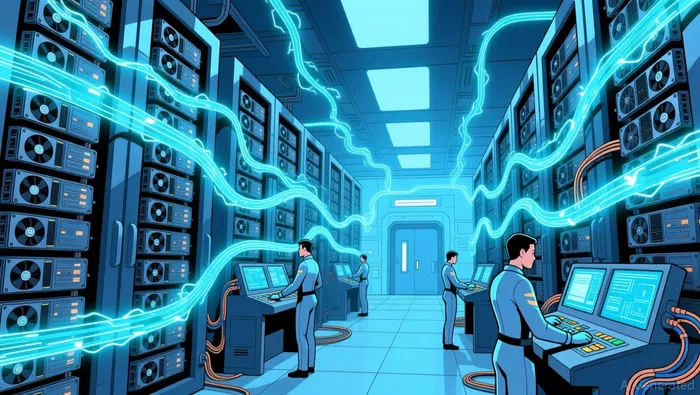
What's being built matters more than the scale, though. Modern AI workloads require thousands of NVIDIA GPUs operating in concert, and copper interconnects can't move data fast enough at that scale. The partnership is widely understood to be preparing for co-packaged optics integration-a paradigm shift where optical glass fibers replace copper in rack-scale systems, enabling intelligence to move at the speed of light. This isn't an upgrade; it's a fundamental rearchitecture of how AI compute infrastructure connects.
The market already recognizes this as a structural inflection point. Corning shares jumped 14% on the news, adding to gains that have put the stock up over 250% in the past year. NVIDIA rose nearly 3%. But the real signal is in what Jensen Huang's partnership validates: the next S-curve of AI scaling depends on physical infrastructure layers, not just compute density.
For investors tracking the AI infrastructure thesis, this confirms the playbook. GPUs get the headlines, but power, cooling, networking and physical data-center components decide how fast the AI factory can actually scale. The Corning-NVIDIA deal marks the moment optics moves from background component to core infrastructure layer-exactly the kind of first-principles shift that defines exponential adoption phases.
Market Reaction & Valuation Context
Corning's 14% surge on the deal announcement-and its 250% gain over the past year-stands in stark contrast to NVIDIA's modest ~3% advance on the news. That divergence tells you everything you need to know about how investors are pricing this partnership.
For Corning, this is the latest leg up in an exponential adoption story. The market is treating the NVIDIA deal as validation that optical infrastructure has moved from niche component to core AI factory requirement. With capacity expanding 10-fold and a $6 billion Meta deal already in the pipeline, investors see a company riding a structural S-curve. The 14% jump reflects that trajectory accelerating.
NVIDIA's reaction tells a different story. The stock's ~3% gain isn't disappointment-it's pricing that reflects an already-dominant position. NVIDIA trades at a 42x trailing PE and carries a $5.05 trillion market cap, with shares up 84% over the past year. At these levels, the market has already priced in the company's pricing power and its ability to scale without needing explicit infrastructure partnerships to validate demand.
The 5-day change tells an even more telling story: NVIDIA is down 0.68% over the past week, even as it trades near its 52-week high of $216.82. This isn't a stock that needs a supply-chain partnership to justify its valuation. The market views NVIDIA as the orchestrator of the AI factory, not a beneficiary of it.
For NVDA investors, the takeaway is straightforward: this deal confirms the infrastructure thesis but doesn't change the investment thesis. NVIDIA's dominance in AI compute is already priced at levels that assume exponential scaling. The Corning partnership validates that scaling will happen-but it also highlights a subtle risk. When your stock has run up 84% in a year and trades at 42x earnings, the bar for incremental positive catalysts rises dramatically. Infrastructure deals like this are table stakes, not upside catalysts.
The real question for NVDA investors isn't whether the deal is good-it's whether the market has already priced the entire AI infrastructure buildout into the current valuation. At 84% annual returns and near 52-week highs, the answer appears to be yes.
What This Means for NVDA Investors: Action or Hold?
The Corning-NVIDIA partnership confirms what savvy investors already suspect: the AI infrastructure S-curve is accelerating, and NVIDIA sits at its center. But confirmation isn't catalyst-and that distinction matters when you're managing a position that's already delivered 84% annual returns and trades near its 52-week high.
Here's the reality. This deal validates NVIDIA's position as the orchestrator of the AI factory buildout. When the chip dominant player partners with the world's leading optical fiber innovator to expand capacity 10-fold, it's a structural endorsement of the entire AI infrastructure thesis. The demand trajectory Jensen Huang is betting on is real. Three new manufacturing facilities and more than 3,000 new high-paying American jobs aren't speculative future states-they're committed capacity that signals NVIDIA's confidence in sustained exponential scaling.
But confidence isn't a catalyst. NVIDIA already trades at a 42x trailing PE with a $5.05 trillion market cap. The market has already priced the entire AI infrastructure buildout into the current valuation. When a stock has run up that far, that fast, incremental positive news-no matter how structurally significant-becomes table stakes rather than upside fuel.
The 5-day chart tells the story: NVIDIA is essentially flat to slightly down over the past week, even as it trades near all-time highs. That's the market's way of saying this deal was expected. It was always going to happen. The question isn't whether NVDA benefits from the infrastructure buildout-it's whether the current valuation leaves room for additional upside beyond what's already priced.
The recommendation is straightforward: Hold current positions. Add on pullbacks.
For investors already positioned in NVDA, this partnership reinforces the core thesis without changing the risk profile. You're already exposed to the AI scaling story. The Corning deal simply confirms the infrastructure layer is catching up to the compute layer-which is exactly what the S-curve model predicts.
For investors on the sidelines, the entry bar is high. At these levels, you're paying for perfection. The market expects NVIDIA to deliver exponential growth quarter after quarter. Any deviation-whether from competition, execution slippage, or macro headwinds-could create meaningful downside. Waiting for a pullback gives you margin of safety without missing the structural story.
The real insight here isn't about NVDA at all. It's about understanding where you are on the S-curve. The Corning partnership marks the moment infrastructure moves from constraint to enabler. For NVDA investors, that's bullish context-not a buy signal. The trade has already happened. The question now is whether you're positioned to ride the next leg, or whether you need to wait for a better entry.