

South Crofty is being positioned as a high-grade, low-cost entry into a tight global tin market. The project's scale is defined by a measured and indicated resource of 2.5 million tonnes at 0.7% tin grade, located in the historically productive Central Mining District of Cornwall. This isn't just a new discovery; it's a reactivation of one of the world's highest-grade tin resources, leveraging existing infrastructure to potentially become a new, low-cost producer.
The economics are compelling. The project's estimated all-in sustaining cost is about $14,500 per tonne, a figure that contrasts sharply with the current global price hovering around $35,000 per tonne. This creates a substantial operating margin, which is a critical advantage in a market where supply struggles to meet demand. The project's updated pre-feasibility study supports this, showing a robust after-tax net present value and an internal rate of return that confirms its potential to be a long-life, modern operation.
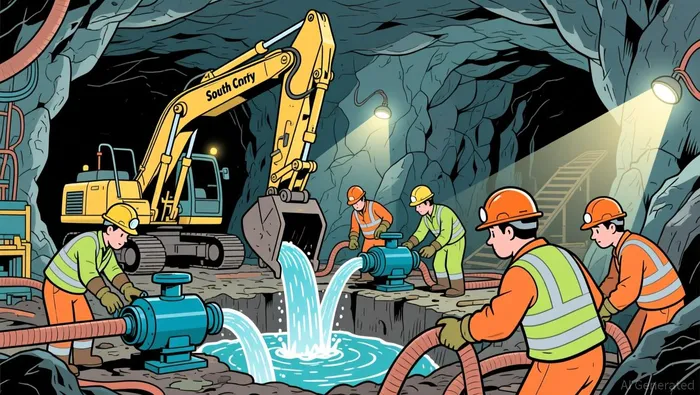
Currently, the work is in a critical early phase. Engineers have successfully pumped water out of the flooded mine and accessed tunnels 1,148ft (350m) below ground. With 80 people working on site, the focus is on de-watering and accessing the ore bodies. The company remains optimistic about beginning commercial extraction by mid-2028.
The bottom line is that South Crofty represents a significant, low-cost supply option in a constrained market. Its high-grade resource and favorable economics place it well within the global supply mix, but it's still early in development. The project's success hinges on the completion of the de-watering and access work, followed by the capital-intensive build-out to production.
Funding the Path to Production
The financial roadmap to production is now in motion, but it remains a complex, multi-step process. On May 6, 2026, Cornish Metals successfully completed an oversubscribed placement of US$210 million in six-year senior secured bonds with a 13.5% annual coupon rate. This debt financing is a crucial pillar, but its settlement is conditional. The company must first complete an equity raise of at least US$161 million before the bond proceeds can be drawn down from escrow, likely around May 21.
This two-part funding strategy-debt plus equity-is designed to secure the total capital needed. The project's pre-production capital is pegged at £198 million, and the combined bond and equity raise would cover that cost. The company has also secured strategic support that could ease future financing. The UK government's designation of tin as a critical mineral has opened doors, and the company recently announced a potential $225 million letter of interest from the US EXIM Bank. While that funding is not yet secured, it underscores the project's perceived strategic value in diversifying Western supply.
The timeline for this funding to translate into production is tight. The company expects to announce a final investment decision this summer, which would lock in the capital and kick off the construction phase. From that point, the target remains commercial extraction by mid-2028. The progress on the de-watering and access work is creating the necessary development momentum to support these financial milestones.
The bottom line is that the funding path is progressing, but it is not yet complete. The successful bond placement demonstrates investor confidence, but the project's viability hinges on closing the concurrent equity raise and securing the strategic support from bodies like the EXIM Bank. With the final investment decision looming, the company is navigating a critical window to lock in the capital required to advance from a flooded mine to a functioning producer.
Supply Context and Market Implications
The global tin market is a story of concentrated supply and rising strategic importance. Around two-thirds of the world's tin comes from just three countries: China, Myanmar, and Indonesia. This heavy reliance creates a clear vulnerability for major importers like the United States, making them susceptible to supply shocks from geopolitical instability or policy changes in those regions. In this context, Cornish Metals' South Crofty project is being positioned not just as a new producer, but as a source of "responsible supply" that aligns with critical mineral security goals.
The project's potential output, however, is a diversification play, not a market-transforming one. The updated preliminary economic assessment outlines an average production of 4,700 tonnes annually over a 14-year mine life, with peak output reaching 5,000 tonnes. To put that in perspective, global tin production is measured in hundreds of thousands of tonnes per year. South Crofty would add a meaningful, low-cost stream to the Western supply mix, but it would not be enough to shift the global balance on its own.
The strategic framing is key. The project's appeal to the US Export-Import Bank, which has expressed interest in a $225 million letter of interest, hinges on its ability to provide a secure, Western alternative. This isn't just about economics; it's about supply chain resilience. For the US, funding a project that can deliver tin-in-concentrate from a high-grade, low-cost source in Cornwall supports a broader goal of reducing dependence on a handful of Asian producers.
The bottom line is that South Crofty fits a specific market need. It adds a new, responsible supply option in a concentrated market, which is valuable for geopolitical risk management. Yet its scale means it will remain a niche player in the global tin picture. Its real impact may be more symbolic and strategic-demonstrating that new Western production is possible-while its financial success will depend on the project's ability to deliver its promised output at its low cost, all while navigating the tight timeline to production.
Catalysts, Execution Risks, and What to Watch
The path from a flooded mine to a producing asset is now defined by a clear, high-stakes timeline. The immediate catalyst is the final investment decision, which the company expects to announce this summer. This decision will formally commit the capital and launch the construction phase, turning the project from a development story into a build-out. The successful completion of the oversubscribed US$210 million bond placement provides a major funding pillar, but it is not the final step. The primary execution risk is the concurrent equity raise. The bond's settlement, expected around May 21, is conditional on completing an equity fundraising of at least US$161 million. Failure to secure this capital would stall the entire project, as the bond proceeds cannot be drawn down from escrow.
The key watchpoint is the timeline to production. The target remains commercial extraction by mid-2028. This is a complex, multi-year plan that depends entirely on executing the financial and operational steps in sequence. The company has made progress on the ground, with engineers accessing tunnels deep below the surface, but the real work of building a modern mine and processing plant lies ahead. The project's success hinges on deploying the secured capital efficiently and navigating any permitting or logistical hurdles.
In essence, the critical path is now set. The company must first close the equity raise to unlock the bond funding, then make the final investment decision, and finally deliver on the construction schedule. Each milestone is a gate that must be passed. The project's low-cost economics and strategic positioning provide a strong foundation, but the ultimate outcome will be determined by the team's ability to manage this intricate financial and operational plan to meet the mid-2028 target.