

The partnership is real. The implication is not.
On June 9, Databricks announced its 2026 Customer Awards, naming 10 organizations and leaders across industries for pushing data and AI. Cotality - the real estate and property data company that rebranded from CoreLogic in March 2025 - has been deepening its integration with Databricks through a data connector and marketplace listing. The real story is about distribution, not recognition.
That doesn't mean Cotality isn't doing anything worth examining. It means you shouldn't confuse a platform vendor's partnership announcement with a growth thesis.
The actual move: AI-ready data connectors, not AI innovation
Cotality's partnership track with Databricks is worth reading as a distribution play, not an AI pivot. In April 2026, Cotality launched an AI data connector designed to feed real-time property and location intelligence directly into cloud platforms. Their data is also listed on the Databricks Data Marketplace. The company has been positioning itself explicitly as 'AI-ready' across marketing materials, claiming its data helps mortgage and real estate firms deploy custom AI agents.
Here's what that means in practical terms: Cotality already owns approximately 75% market share in U.S. property data with roughly 80,000 clients globally and about $2 billion in annual revenue. The AI connector doesn't change the underlying asset - it changes how the asset is accessed. Instead of customers pulling data through Cotality's own APIs and platforms, they can now access it natively inside Databricks workspaces. That makes the data more useful for analysts and model builders sitting inside lakehouse environments.
It is not as good as it sounds as a growth driver. Any astute data buyer already knew Cotality's property records were the gold standard. Now they just don't have to leave the platform to get them.
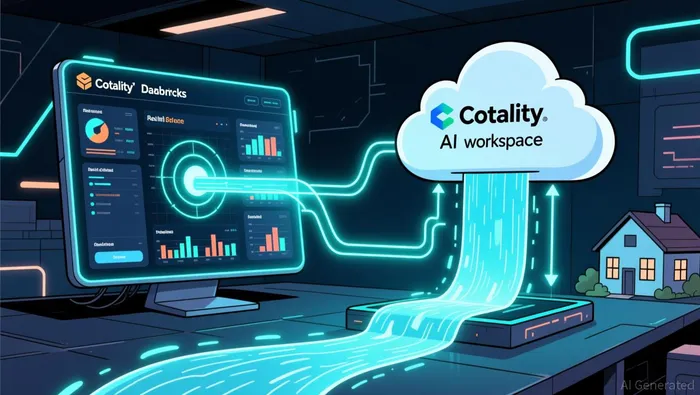
Databricks had an incentive to deepen the partnership
Context matters. In February 2026, Databricks introduced a unified Partner Tiering Program and AI-ready Well-Architected Framework specifically for ISVs and data providers. This was a structural shift in how Databricks organizes its ecosystem, designed to pull more third-party data onto its marketplace and deepen platform lock-in for customers.
Cotality's data marketplace integration came shortly after that program launch. The timing is not coincidental. Databricks needs credible, high-quality data providers on its marketplace to make the platform sticky. A company with Cotality's market dominance in property data is exactly the profile they want to highlight. The partnership validates Databricks' own ecosystem strategy as much as it validates Cotality's data distribution ambitions.
The numbers don't support an AI re-rating
CLGX (Cotality's ticker) trades around $80 with a market cap near $5.9 billion and a P/E ratio around 19.5x. For the quarter ended June 30, 2025, the company generated $502.9 million in revenue - a slight increase year-over-year. That is steady, not inflectional.
The stock is priced as a mature data company with decent margins and reliable revenue. An AI-themed partnership does not change that pricing unless the AI channel actually drives material new revenue. At this point, the evidence suggests the opposite: the Databricks integration is a way to protect existing revenue by making Cotality's data harder to replace, not a new growth vector.
What would change the thesis
Revenue mix shift. If Cotality could show that AI-channel revenue - data consumed through Databricks or other AI platforms - is growing at a materially faster rate than legacy channels, that would support a different narrative. Right now, there's no public evidence of that split.
Margin dynamics. Feeding data through a third-party marketplace like Databricks introduces a question about who captures the margin. If Databricks takes a cut of data marketplace transactions, Cotality's effective pricing power could be diluted even as volume grows. That's a classic infrastructure-playoff: more users, less per-unit economics.
Competitive response. Black Knight (owned by Fidelity National), Verisk, and BatchData all serve the same mortgage and real estate ecosystem. If Cotality's Databricks integration becomes a defensible moat against them, the strategic value exceeds the headline. If it's table stakes that competitors will replicate within a quarter, the moat doesn't move.
The cross-currents are distribution, margins, and competition; directionally, the Databricks partnership is a defensive move that preserves Cotality's dominance rather than a growth catalyst that expands it.
The stock doesn't need an AI re-rating to be a reasonable holding at 19.5x earnings. CLGX is a cash-generative monopoly in property data with stable demand from mortgage lending, insurance, and real estate - an ecosystem that doesn't go away regardless of which AI platform is fashionable. But don't confuse ecosystem participation with category reinvention. Cotality didn't earn an AI premium. They earned the right to sell their existing monopoly through a shinier storefront.
You decide which was marketing fluff and which one was analysis.