

The "a crisis is coming" headline shows up once or twice a year. It usually arrives on a cycle where someone has noticed leverage exists, debt is nonzero, and history is full of unpleasant surprises. The lazy reader gets the headline and stops. The useful reader asks: does the actual signal stack confirm something structural, or is it the same old inventory reshuffled?
This cycle, the signals are not generic. Three separate institutional sources - the Federal Reserve's own stress models, credit market behavior, and the CBO's fiscal math - are pointing in the same direction at the same time. That doesn't mean a crisis is locked in. It means the risk register is live, the question has shifted from whether to whether to how to position.
The question isn't whether the world might face financial stress. The question is what the stress indicators are actually measuring right now, whether the market has already responded, and what a barbell approach looks like when the process says uncertainty is rising.
What the Fed is preparing for
Start with the Federal Reserve's 2026 supervisory stress test scenarios, finalized in February. The severely adverse scenario - which is not a forecast but a downside envelope regulators force banks to survive - models a 5.5 percentage point spike in the unemployment rate to 10%, a 4.6% contraction in real GDP, and severe asset price declines across equities and credit. The Fed publishes these numbers so banks can prove they won't implode. They also tell you what the most careful risk modelers in the system consider plausible enough to prepare for.
The 2025 version of the severely adverse scenario was milder. The step-up isn't tiny, and it comes alongside the Fed's own baseline scenario aligning with a survey of private-sector forecasters that see persistent inflation pressure and higher commodity prices as the new environment. The Fed isn't predicting doom - it's acknowledging that the downside envelope has widened. That matters because banks price capital and lending based on these scenarios. When the envelope widens, credit availability tends to tighten before the economy does.
Credit spreads are widening - not crashing, but widening
Credit spreads measure the gap between what Treasuries yield and what riskier corporate bonds have to pay to attract buyers. When spreads widen, the bond market is saying: "if things go wrong, we want more compensation for owning your debt." It's one of the oldest early-warning instruments in fixed income.
Credit spreads between Treasuries and high-yield bonds have been widening through early 2026. CDX spreads - the broad index tracking credit default protection on investment-grade corporates - have also moved wider, which the bond market treats as a leading indicator of deterioration. The war in the Middle East, including conflict in Iran, has pushed oil prices higher and added a geopolitical premium into spread calculations. The spreads aren't screaming yet, but the direction is the thing to track. When spreads widen before earnings miss, the timing usually belongs to the bonds.
The fiscal layer most articles skip
Here's the structural driver that sits underneath the noise. The Congressional Budget Office projects the federal deficit at $1.9 trillion in fiscal year 2026 - roughly 6% of GDP - growing to $3.1 trillion by 2036. Through April 2026 alone, the cumulative deficit was $955 billion, which is 9% lower year-over-year at this point but on a trajectory the Treasury says will push the full-year figure toward $2 trillion. The fiscal year 2025 deficit was already $1.7 trillion, and new Treasury projections suggest FY2026 will be worse.
Why does this matter to a stock investor? Because the IMF's April 2026 Global Financial Stability Report names the "bank-sovereign nexus" as one of its most urgent vulnerabilities. The bank-sovereign nexus is the feedback loop where banks hold large amounts of government debt, so sovereign stress weakens bank balance sheets, which then reduces credit availability, which then weakens the economy further, which makes sovereign debt riskier. It's a loop, and right now both sides of it are loaded: elevated public debt and elevated private debt, with rollover risk on both.
The CBO says deficits this large by historical standards put upward pressure on inflation, boost interest rates, and can crowd out private investment. The IMF says elevated debt-to-GDP levels and rollover risk make sovereign bond markets more fragile. Both institutions are saying the same thing in different languages: the fiscal cushion is thinner than it used to be.
What the market is already doing
Capital doesn't wait for consensus. The market has been rotating for months.
Consumer staples stocks - which struggled to gain ground in 2025, widely underperforming the S&P 500 - showed strength in early 2026, with the Consumer Staples ETF (XLP) outperforming amid volatility. Utilities, with their non-cyclical demand profile, have been positioned as a defensive play during economic uncertainty, though they carry interest-rate risk. Morningstar's mid-April reporting showed industrial, consumer defensive, and energy stocks outperforming the broader market by a wide margin, offsetting losses in technology. This isn't a minor shift - it's the kind of cross-sector flow that usually precedes a regime change in relative performance.
J.P. Morgan has noted that utilities and healthcare may frame "a quieter defense" when inflation fears return, since traditional inflation hedges like commodities add oil and input-cost exposure to the problem rather than solving it. The market is building its own barbell without calling it one.
The barbell when the process says uncertainty is rising
Volatility is usually a signal that the market cannot figure out what comes next. The response is not more conviction - it is more structure.
When the stress indicators widen, the factor question becomes: which businesses still compound through the stress, and which ones depend on easy credit, strong consumer spending, and stable input costs? The answer shapes the portfolio.
On the defensive side, the positioning logic is straightforward. Consumer staples and utilities deliver non-cyclical demand and dividends - cash flow you don't have to forecast three years out. The risk is rate sensitivity for utilities and margin compression for staples if commodity costs stay elevated. Still, in a 10%-unemployment scenario, the people who buy toothpaste and keep the lights on are less discretionary than the people buying new laptops.
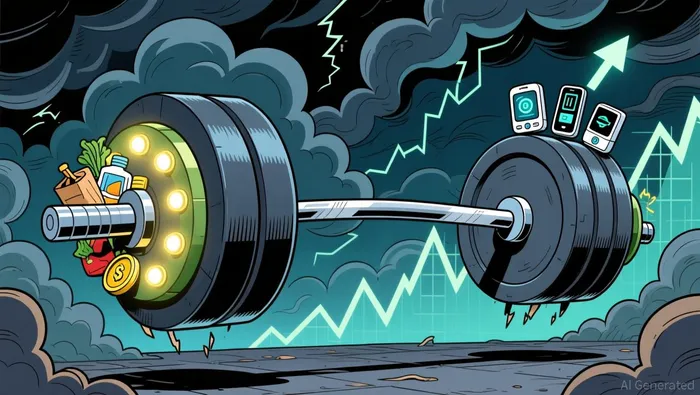
On the growth side, quality matters more than momentum. Not every tech name survives a credit tightening. The filter should be cash generation and balance sheet strength - companies that can fund their own growth without relying on debt markets that are widening. When CDX spreads move, it's the marginal borrower who gets priced out first.