Hedge funds poured into energy stocks in March as geopolitical tensions reshaped global markets, even as portfolios remained tightly concentrated in a handful of sectors, according to Hazeltree's latest Crowdedness Report.
It captures a moment when macro shocks, particularly the escalation of the conflict in the Middle East, began to ripple through both commodity markets and investor positioning. “Volatility and uncertainty intensified in March… [as] a ‘war premium’ in energy prices… has forced a repricing of risk, while oil and gas prices have surged,” Hazeltree said.
That dynamic is echoed in recent reporting. Reuters noted that natural gas prices jumped sharply following strikes on key energy infrastructure in the region while The Guardian reported that oil prices logged one of their strongest monthly increases in years because of the Iran war. The scale of disruption, affecting a significant share of global supply flows, has reinforced expectations of sustained tightness in both oil and liquefied natural gas markets. However, Brent crude oil is trading around $94–$96 per barrel and prices have stabilized near $94–$95 level following the ceasefire announcement between the U.S. and Iran,
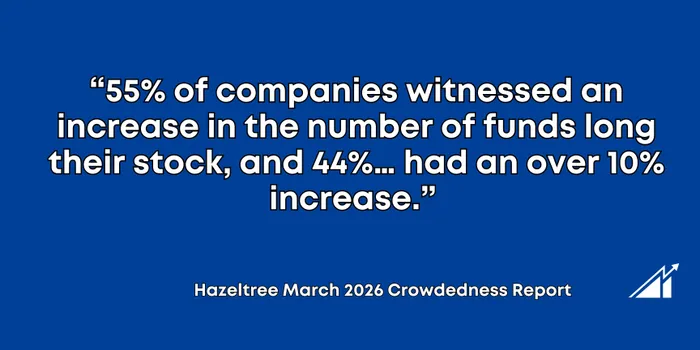
Against that backdrop, hedge funds moved decisively. Hazeltree found that “55% of companies witnessed an increase in the number of funds long their stock, and 44% of companies had an over 10% increase” in long positioning. The breadth of that shift suggests a coordinated rotation into energy rather than isolated stock picking.
At the same time, the report highlights a tension in hedge fund behavior: even as capital rotates, it remains highly clustered. Technology, financials, and health care continue to dominate crowded long positions, while technology and industrials are also heavily represented on the short side.
This concentration is not limited to the U.S. In Europe, industrials are the most crowded sector on both the long and short side, while in Asia-Pacific, technology leads in both directions. The pattern suggests that while funds are reacting tactically to macro shocks, their broader allocations remain structurally narrow.
Recent market activity supports Hazeltree's findings. Financial News London reported that major Wall Street banks generated roughly $43 billion in trading revenue in the first quarter, fueled by heightened volatility tied to the conflict. But, the International Monetary Fund warned in comments reported by AInvest that sustained energy price spikes could weigh on global growth and complicate inflation dynamics. That aligns with Hazeltree’s observation that volatility is being driven not just by geopolitics, but also by “inflation risks” and broader economic uncertainty.
Within energy, certain names are drawing particularly strong conviction. Hazeltree highlighted EQT Corp., where “the number of funds long the stock has increased by 24% while the number of funds shorting the stock has decreased by 36%.” The stock’s long-to-short ratio has climbed to roughly 3:1, underscoring how quickly sentiment has shifted.
Meanwhile, short positioning is beginning to broaden beyond its traditional focus in software. The report shows increasing bearish activity in sectors such as financials and industrials, indicating a more diversified approach to hedging risk.
Taken together, the data paint a picture of a market in transition. Hedge funds are clearly responding to the Iran war and its fallout, most visibly through a surge into energy, but they are doing so within portfolios that remain tightly crowded.
That combination can amplify market moves. When positioning is concentrated, even modest shifts in sentiment can lead to outsized price swings. March’s surge in energy may be the clearest example yet of how quickly capital can rotate when macro risks collide with crowded trades.