

A company can sell a thing people want and still go to zero. Cytosorbents is demonstrating that lesson in real time.
They make a device - the CytoSorb adsorber - that sits in an extracorporeal circuit and pulls inflammatory toxins from a patient's blood. Think of it as a dialysis-style filter for cytokine storms, sepsis, and transplant rejection. It's CE-marked in Europe, used in nearly 300,000 treatments, and generated $285 million in cumulative sales since launch. Nobody is questioning whether the product works.
The question is whether the company survives long enough to profit from it.
Q1 2026 revenue was $8.9 million, up 2% from the year-ago quarter. Gross margin was 69%. That sounds respectable until you see the rest of the income statement. Operating expenses were $9.2 million. Net loss widened to $5.1 million. The company burned $1.4 million in cash during the quarter, leaving $6.4 million on hand against $18.4 million in convertible debt.
Most people read this and think: a small biotech burning cash is normal. It's not normal when you have a commercial product with 69% gross margins that has been selling for years. A pre-revenue company burning cash is building something. A company earning $8.9 million per quarter with 69% margins and still losing $5 million per quarter is fighting its own math.
Management's answer is operating cash flow breakeven in the second half of 2026. They've reduced operating expenses from $10.1 million to $9.2 million year over year. If they can hold that discipline while revenue ticks up - and if there's no surprise cost, no pipeline setback, no need to hire - then by mid-year the burn stops. The quarterly revenue run rate of roughly $9 million covers the $9.2 million in expenses. Not by much. But enough.
I suspect the breakeven claim is directionally honest but fragile. One bad quarter of inventory build, one clinical trial overrun on the DrugSorb-ATR program, one surprise expense on the convertible notes - and the timeline breaks. The notes carry interest. They're convertible, which means if the stock stays around $0.50 the debt effectively dilutes holders into the ground rather than getting repaid.
That's the real structural problem. The company is trying to grow past its capital base. With $6.4 million in cash and a quarterly burn rate that was positive before recent cuts, there are maybe two quarters of runway if management delivers. Two quarters. That's not a runway. That's a tightrope.
The FDA angle complicates things further. In April 2025, the FDA denied Cytosorbents' De Novo request for DrugSorb-ATR - a version of the technology designed to filter antiplatelet drugs like ticagrelor (Brilinta) from patients' blood before cardiac surgery. The company filed an appeal. Now they're targeting a resubmission in late 2026 or early 2027. DrugSorb would represent a clear on-label use case in the US, where the core CytoSorb device currently operates under an Investigational Device Exemption. Approval would change the addressable market. But it would also burn cash to get there, and the timeline is already a year out.
Here's the frame most investors miss. This isn't a question of whether Cytosorbents has a defensible technology or a real market. The 13% growth in non-Germany direct sales territories tells you there's demand outside the single largest customer. The 69% gross margin tells you the unit economics work at scale. The question is whether the company can close the gap between $8.9 million in quarterly revenue and $9.2 million in quarterly expenses without issuing more dilutive equity or restructuring the debt - because those are the only two levers left if breakeven slips.
At a $38 million market cap and $0.50 per share, the market has already priced in a version of this risk. The stock has been trading in this range for months, which suggests investors are waiting for something - either the breakeven signal or the dilution event. The convertible debt overhang ($18.4 million on top of a $38 million equity value) means equity holders are the junior claim on any recovery.
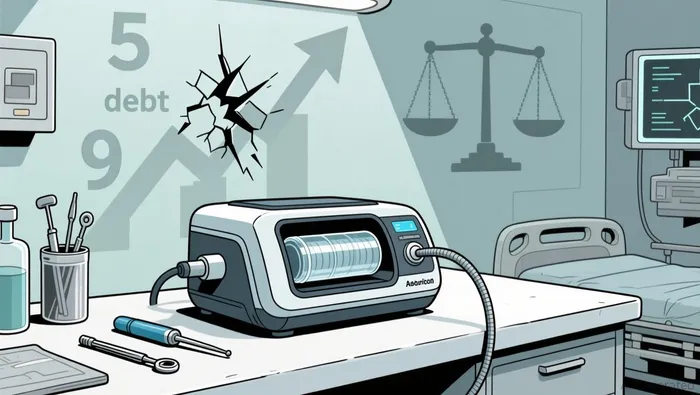
The way to evaluate Cytosorbents is not to debate the technology. It's to check one thing: does Q2 revenue come in at or above $9 million with operating expenses at or below $9 million? If yes, the breakeven narrative holds and the stock gets a chance to re-rate toward the intrinsic value of the European business. If no - and the cash pile drops below $4 million - then the company needs to raise. At $0.50 a share, that raise dilutes existing holders severely.
I haven't seen a company with this profile - real product, real margins, real demand, but a capital structure that eats equity every quarter - survive without either a breakthrough or a rescue. Cytosorbents is betting on the breakthrough arriving before the math runs out. The bet is honest. It's just very thin.