

Strategy - formerly MicroStrategy - sold 32 Bitcoin late last week for about $2.5 million. It's the first time the company has sold Bitcoin since December 2022, when it offloaded 704 coins as a tax-loss harvesting maneuver during the bear market.
Thirty-two coins is a rounding error against the roughly 843,700 Bitcoin the company holds. By the numbers, this barely registers. But the headline isn't about scale. It's about category.
When Michael Saylor built Strategy into the world's largest corporate Bitcoin holder, the thesis was simple: accumulate Bitcoin, never sell, and let the equity act as a levered proxy for the asset. Investors bought into that binary. The moment a company that built its identity on "never sell" begins selling for operational reasons - not to harvest tax losses, but to fund cash obligations - the thesis changes shape.
The obligation that broke the rule
The proceeds from this sale aren't going back into more Bitcoin. According to Coindesk's reporting, the cash is expected to fund distributions on Strategy's STRC preferred stock - a perpetual preferred share the company launched last year to raise capital for Bitcoin purchases.
Here's the plumbing: STRC pays an annualized dividend rate of 11.50 percent, which works out to about $0.96 per share each month. Strategy has issued roughly $887 million of these shares and set aside about $2.25 billion in reserves to cover dividend obligations. That sounds secure, until you remember the reserves are mostly denominated in Bitcoin and Strategy equity - both of which have been under pressure.
Saylor himself confirmed in early May that the company might sell Bitcoin to cover STRC dividends. At the time, MSTR shares dropped. Now it's happened.
This is the kind of second-order consequence that no one prices in until it arrives. Strategy raised capital by issuing instruments that pay fixed cash dividends, then bet everything on Bitcoin staying above its average acquisition cost of roughly $66,400. That worked beautifully through 2024. It stops working when Bitcoin falls - and you still owe the dividend.
The simultaneous equity sale tells the real story
The filing that disclosed the Bitcoin sale also revealed something the market paid more attention to: Strategy sold 801,994 shares of its own common stock during the same period, raising $128.3 million in net proceeds. Read the Bitcoin sale and the equity sale together, and the picture sharpens. This isn't a one-off tax trick. It's a company simultaneously liquidating equity and Bitcoin to manage its balance sheet.
For context, Strategy reported a $12.5 billion net loss in Q1 2026, driven by roughly $14.5 billion in unrealized Bitcoin losses. Bitcoin is trading around $73,500 now, still below the highs that funded the STRC offering and the convertible notes that made the whole machine possible.
Why the distinction matters
I want to separate two things here, because the market is going to confuse them.
The 2022 sale was a tax-loss harvest: sell at a loss, create a deduction, rebuy shortly after. Net result - more Bitcoin, not less. Saylor's team has acknowledged this current sale likely includes a similar tax-loss element. Bitcoin traded around $73,500 on June 1; the 32 coins were sold at an average of $77,135, meaning they were likely purchased at a higher price point and sold at a loss.
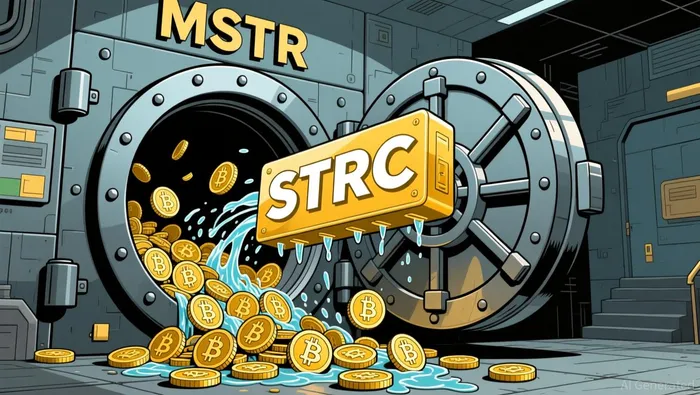
But the stated purpose is different this time. The cash goes to STRC dividend payments. A tax-loss harvest is a financial optimization. Funding a cash obligation by selling your core asset is a structural change. You can hold both ideas at once - the sale may include a tax-loss component while also being driven by genuine cash needs - but the STRC obligation is the part that changes the rules.
What this does to the proxy thesis
Strategy has spent years training the market to treat MSTR stock as a levered Bitcoin bet. The premium to net asset value, the convertible note raises, the constant accumulation announcements - it was all designed to make the equity more exciting than the underlying asset.
The problem with that design is that it creates obligations that Bitcoin alone can't satisfy. Dividends must be paid in cash. Convertible notes eventually mature. And when the asset you're levered against is down, you need liquidity from somewhere.
The company raised $1.56 billion through STRC in March alone, funding roughly half of that month's Bitcoin purchases. That was the growth phase. Now the machine has to service what it built.
I don't think this sale tells us that Strategy is abandoning its Bitcoin thesis. Saylor still holds an enormous position, and the company has been buying aggressively all year - 3,273 Bitcoin in the week ending April 26 alone. But the "never sell" promise was part of the product. Once that breaks, even for 32 coins, the question investors have to start asking is: under what future conditions does the company sell more?
The answer depends on whether Bitcoin rebounds fast enough to restore the spread between price and average cost, or whether the STRC dividend load becomes a persistent drain during extended weakness.
What I'm watching next is whether the STRC dividend rate stays at 11.50 percent - Strategy maintained it for June, which is one data point - or whether it begins to move in ways that signal stress. That variable dividend rate is the pressure valve in the whole system. If it starts climbing, or if the company pauses Bitcoin purchases entirely to shore up reserves, we'll know whether this 32-coin sale was a minor adjustment or the first crack in the machine.
The structural point is simpler than the headline: a corporate Bitcoin treasury that issues cash-paying obligations has a different relationship to the asset than one that doesn't. Strategy just proved that to itself.