

Elbit Systems just reported Q1 2026 revenue of $2.19 billion and non-GAAP earnings per share of $3.87. The EPS beat consensus by $0.54. Revenue beat by roughly $50 million. Net income nearly doubled year over year to $160.8 million. By the metrics that normally move a stock, this is the sort of quarter that gets a green arrow and a headline about unstoppable momentum.
The stock sold off after the Q4 beat in March, falling 14.3% in the weeks following a 22% earnings miss-to-beat reversal. The pattern around this quarter is worth checking too, though I don't have intraday data for today. But the mechanism is the same regardless: the company delivers, the market discounts it.
The odd thing is not that Elbit beats again. The odd thing is what sort of machine Elbit has become.
Elbit ended 2025 with an order backlog of $28.1 billion. Full-year 2025 revenue was $7.9 billion. That means the company has roughly 3.5 years of revenue already contractually booked.
If you want an old-finance analogy, this is basically a government-funded annuity. You don't need to win new business today to know what you're earning in two years. The backlog grew $5.5 billion in 2025 alone, with $2.9 billion of that added in Q4. The Q1 2026 revenue beat just means the production line is running a little faster than Wall Street expected.
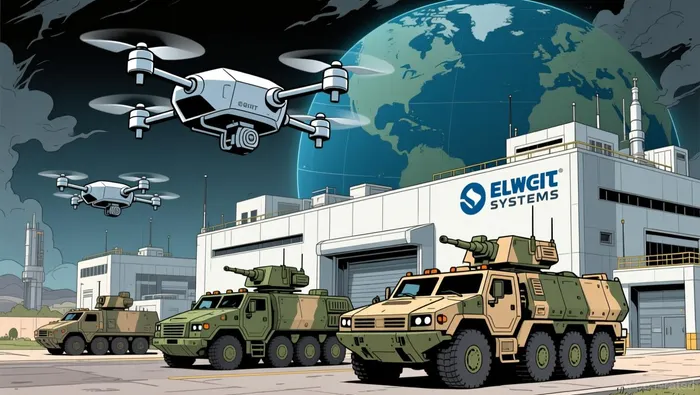
That's the plumbing. Revenue is not a question of demand right now. It's a question of execution on paper already signed.
The operating margins are where the business plan actually lives. In Q1 2025, non-GAAP operating income was $165.1 million - 8.7% of $1.9 billion in revenue. For Q1 2026, the $160.8 million net income on $2.19 billion of revenue implies a net margin near 7.3%, and the non-GAAP operating margin is presumably tracking the higher end of the range the company has been posting all year. For context, the Land segment - drones, armored vehicles, C4ISR systems - ran at 11.4% operating margin for full-year 2025. Aerospace came in at 7.4%. The mix is shifting, the margins are expanding, and the scale is growing. This is not a company that needs to convince anyone it can make money.
The dividend tells the same story. Management raised the quarterly payout to $1.00 starting in Q1 2026. That's $4.00 a year, or roughly 0.4-0.5% yield on a stock that's been trading in the $800-$950 range. Not a value-stock yield, but a signal: the board sees the cash flow as durable enough to raise the floor.
So then the interesting question is not earnings. The interesting question is: what is the market pricing?
The answer appears to be everything that isn't on the income statement.
NATO is the obvious one. In July 2025, NATO suspended 15 contracts in the largest corruption scandal in the alliance's history. Thirteen of those contracts were directly linked to Elbit Systems. Prosecutors are probing suspect contracts won by the company. The company hasn't been formally charged, and the full-year results didn't show a meaningful European revenue collapse - but the boundary between "under investigation" and "liable" is not a financial line item until it becomes one.
Then there's the geopolitics of the core customer. Elbit is Israeli. Its largest markets are national defense ministries. When the geography of conflict shifts, the flow of government spending doesn't pause - but the political willingness to pay, and the legal framework that authorizes the spending, can move in a quarter. Sanctions, export controls, congressional restrictions - these are the kind of risks that don't show up in guidance until they do.
ESG risk is the third overhang. Even by weapons-industry standards, Elbit carries elevated exclusion risk. Funds that hold it by conviction rather than by mistake are a narrow investor base.
The structural picture is this: Elbit is a company where the financials are getting better every quarter - revenue up, margins up, backlog growing, dividend raised - and the stock keeps selling into the good news because the non-financial risks are moving in the opposite direction.
That is not a classic value trap. In a value trap, the business model deteriorates. Here, the business model is stronger than ever. The problem is regime risk: the possibility that a legal, political, or diplomatic event outside the company's control shrinks the addressable market or raises the cost of doing business in a way the backlog doesn't protect against.
The backlog protects against execution risk. It does not protect against a customer being told it can't buy from you.
For an investor trying to decide what to do, the frame is simpler than it looks. You're buying a government-funded annuity with 3.5 years of contracted revenue that carries a premium for geopolitical and legal tail risk. The earnings will probably keep beating. The question is whether the discount the market applies to those earnings widens or narrows.
If you think the NATO probe fizzles, the US-Israel defense relationship holds, and no one in Brussels or Washington gets creative with export restrictions, then the stock is cheap relative to what the backlog promises. If you think regime risk compounds - new investigations, contract terminations, political pressure on the US government to limit purchases - then the earnings machine doesn't matter much when the customers get disconnected.
The mechanism is not earnings. It's classification: is this a defense stock, or is it a geopolitical trade dressed in defense-stock clothing? The financials say the former. The stock's behavior says the market isn't sure.