

Dell's 32% jump reflects a major upside surprise, not a routine beat
Dell's 32% jump looked more like a market reset than a standard earnings move. The key question is not simply that AI demand is strong, but whether Dell is becoming part of a durable AI infrastructure buildout rather than riding a short-lived sentiment spike.
The numbers explain the speed of the repricing. Dell reported $43.84B revenue vs. $35.43B expected and $4.86 adjusted EPS vs. $2.94. The surprise was broad enough that analysts had to rethink assumptions quickly, and it came alongside record results driven by unexpectedly strong AI-linked server demand.
Revenue also grew nearly 88% year over year, the fastest growth since Dell returned to the public market in 2018. That does not prove a permanent new regime, but it does show demand was much wider and stronger than expected. Bulls can argue Dell is becoming a direct beneficiary of enterprise and cloud AI spending; bears can argue hardware-linked AI demand can cool as supply chains normalize and spending spreads across more vendors.
AI server demand is becoming large enough to change the revenue mix
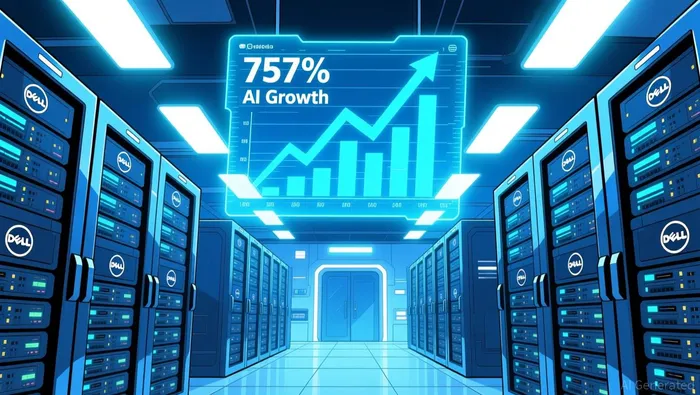
This matters because the quarter was not just a one-off pop. Dell's AI server business rose 757% to $16.1 billion in the quarter, making it a material part of the company's mix rather than a niche side line. At that scale, the market has to think about AI servers as a meaningful part of Dell's revenue base.
The demand backdrop is also broader than a handful of cloud projects. Reuters said U.S. tech giants plan to spend over $700 billion on AI infrastructure this year. That points to a larger market for AI compute and helps explain why investors quickly moved to a more bullish view of Dell's role in the buildout.
Tight supply can support pricing and margins in the short run
This is not only a volume story. Dell raised prices in January as higher input costs tied to the memory shortage flowed through the system. Reuters also said Dell was managing the memory chip crisis through pricing and supply-chain adjustments.
When demand is strong and supply is tight, the vendor sitting near the bottleneck can benefit on both units and pricing. That does not guarantee lasting margin expansion, but it does make a higher AI-server mix more valuable than the headline growth alone suggests.
Forecasts, not just the quarter, matter for a rerating
The forward-looking signal is what makes this more than a great quarter. Dell now expects about $60 billion of AI server revenue for fiscal 2027, up from its prior $50 billion outlook, and it lifted full-year revenue and earnings guidance as well. That helps explain why several analysts moved to more bullish views after the report.
If demand keeps broadening, Dell may start to look less like a cyclical hardware name and more like an important layer in AI infrastructure. If AI-server demand narrows or pricing power fades as supply eases, the story is more likely to look like an exceptional quarter with a shorter tail.
The real debate is durability: infrastructure buildout or tight-market upside?
The core question is no longer whether Dell had one huge quarter. It is whether this demand is broadening into a more durable infrastructure trend or whether Dell is mainly benefiting from a period of tight supply and concentrated spending.
What would support a more durable AI infrastructure story
The strongest bull case rests on two things: breadth and follow-through. Dell did not just beat; it also guided well above expectations. Reuters said Dell gave second-quarter forecasts above estimates, reinforcing the view that management sees the same AI buildout continuing into the next quarter.
Just as important, Dell said its server business was helped by widening AI adoption. That wording matters because it suggests demand is coming from more than a small set of customers or projects. If that trend holds, Dell has a stronger case for being treated as part of the broader compute infrastructure stack.
What could break the rerating
Bears have a credible argument: AI demand can surge and then compress quickly as supply expands and capex shifts to the next bottleneck. In that scenario, Dell remains a major winner, but the stock's recent rerating may have moved faster than the durability of the underlying demand.
The proof point is straightforward. Investors need to watch whether Dell can keep converting wider AI adoption into sustained revenue, earnings, and mix strength quarter after quarter.
What matters most after a 32% gap-up
After a move of this size, the trade shifts from reaction to verification.
Key signals to watch
- Follow-through against management's own bar. Reuters said Dell gave second-quarter forecasts above estimates. If Dell clears that bar again, the market is more likely to keep treating the business as a multi-quarter AI infrastructure story. If it misses, investors may start to question how much of the rerating was forward-looking versus tied to one explosive quarter.
- AI servers staying at the center of growth. AI server revenue reached $16.1 billion in the quarter. The next question is whether that remains the core engine and whether adjacent compute and storage demand follows.
- Whether scarcity continues to help pricing. Dell benefited from pricing and supply-chain adjustments during the memory tightness. If scarcity eases too quickly, some of that premium may fade.
The cleaner setup is to watch whether Dell turns this demand surge into another clean quarter and stable mix. If it does, the rerating can continue. If not, this may look like an exceptional operating quarter with a shorter trading window.