

If you're building a retirement portfolio that lives on income, why would you look at a stock that pays no dividends? That's the question Par Pacific Holdings (NYSE: PARR) forces us to answer after an institutional investor just added to their position.
Forest Avenue Capital Management increased its stake in the refining company by 78.96% to 1.42 million shares according to recent filings. The headline reads like a bullish signal to follow the smart money. But for income investors, the real story isn't about tracking institutional flows-it's about the cash-flow engine that could one day support a dividend.
First, let's look at what Par Pacific actually does. The company operates refineries in Hawaii, the Pacific Northwest, and the Rockies, with 219,000 barrels per day of combined refining capacity. It's not a dividend payer today-the yield is zero, and the company has no consecutive dividend years on record. But the cash flow picture has changed dramatically.
In the first quarter of 2026, Par Pacific reported net income of $54.5 million, or $1.10 per diluted share, swinging from a loss of $30.4 million in the same period last year. Adjusted EBITDA came in at $91.5 million, up from just $10.1 million a year ago. That's not just a recovery; it's a transformation of the underlying business.
The Hawaii operations, which had been a drag, saw refining throughput hit 89.8 thousand barrels per day-a record for the quarter. The Hawaii Index, a key margin indicator, averaged $31.11 per barrel versus $8.13 in the year-ago period. Meanwhile, the company's renewable fuels facility in Hawaii began commercial operations in April, adding another potential revenue stream.
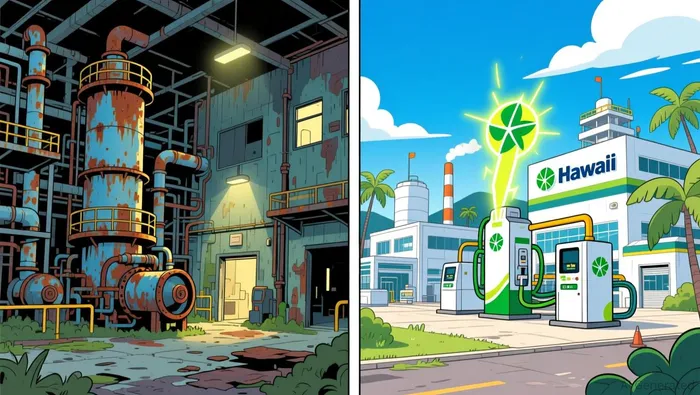
So why does this matter for income investors? Because strong, consistent cash flow is the foundation of any future dividend. Par Pacific trades at just 6.5 times trailing earnings and 4.9 times EV/EBITDA-cheap for a company showing this kind of operational improvement. The stock has already run up 187.8% over the past year and sits 67.3% higher year-to-date, which might give pause. But if the cash flow improvement is sustainable, the valuation could still have room.
The company has guided to $190 to $220 million in capital expenditures for 2026, with about $35 to $45 million earmarked for growth projects. Once these investments are made and the business stabilizes, the question becomes: what happens with the excess cash? Today it goes toward share repurchases-the company bought back $28 million of stock in Q1 at an average price of $37.96. But for a company trading at $58.79, those buybacks look increasingly accretive.
The institutional buying is interesting, but it's not the signal income investors should chase. Instead, watch the cash flow metrics. If Par Pacific can maintain this level of profitability, the pressure to return cash to shareholders will grow. The stock doesn't pay you today, but the machinery for future payments is being built quarter by quarter.
In a retirement portfolio focused on income, you'd typically want payments hitting your account now. But sometimes the best income stories start with companies that have stopped bleeding cash and started generating it consistently. Par Pacific's turnaround isn't complete, and there's execution risk ahead. Yet for investors willing to look beyond the dividend screen, the cash flow improvement suggests this might be one of those rare cases where a non-dividend stock deserves a place in the income conversation-not for what it pays today, but for what its cash engine could support tomorrow.