

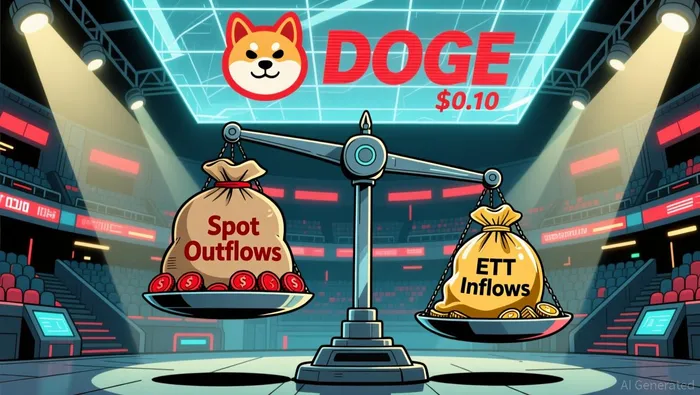
Dogecoin's price is stuck in a tight range, consolidating around $0.094 and failing to break above the key $0.10 resistance level. This stalemate is the direct result of a liquidity tug-of-war, where sharp short-term selling pressure is canceling out nascent institutional interest.
On one side, spot market flows have turned sharply negative. In a 12-hour period, outflows of $22.87 million slightly overwhelmed inflows, creating a net outflow of about $940,000. This immediate selling pressure, driven by trader caution ahead of macro events, is the primary force keeping the price capped.
On the other side, the institutional pipeline is slowly filling. Since its launch in January, the 21Shares Dogecoin ETF (TDOG) has drawn $6.41 million in cumulative net inflows. While this represents a real channel for capital, the scale is dwarfed by the recent spot outflow, highlighting that institutional demand is not yet sufficient to overpower short-term retail selling.
The bottom line is a battle of flows. For now, the net outflow of ~$940,180 in spot markets is the dominant force, explaining the price's consolidation. Until ETF inflows accelerate to match or exceed these spot outflows, the $0.10 level will likely remain a hard ceiling.
Network Momentum vs. On-Chain Reality
The price action is being pulled in two directions by conflicting signals. On one hand, spot market flows show clear selling pressure, with a net outflow of ~$940,180 in a recent 12-hour period. This short-term selling is the immediate force capping the price near $0.094.
On the other hand, underlying network activity suggests growing user participation, with active addresses surging by nearly 28% last week.
This divergence is key. The surge in on-chain usage indicates renewed interest and potential accumulation, which could support a longer-term move. Yet, this momentum is not translating into market flows; the data shows assets are being moved off exchanges, reducing immediate sell pressure but not creating the buying flow needed to break resistance.
The bottom line is that price is being driven by sentiment and short-term positioning, not by a clear flow of capital. The network activity provides a foundation for future demand, but without a shift in spot flows toward net inflows, the price will likely remain stuck in its current range until a decisive breakout occurs.
Catalysts and Risks: What Could Break the Range
The immediate price action hinges on a breakout above the $0.104 resistance. A confirmed move above that level would signal a shift in momentum, with the next target likely around $0.14. Failure to break, however, would confirm the current consolidation, leaving the price vulnerable to renewed selling pressure from spot outflows.
A major structural headwind is looming. The government DOGE department championed by Elon Musk is scheduled to shut down by July 4. This removes a key narrative driver that helped fuel retail sentiment and political visibility. Without this tailwind, Dogecoin must rely on organic adoption, a challenge that complicates the bull case for the rest of 2026.
At the same time, capital is rotating away from pure memecoins toward yield-generating protocols. Investors are moving toward platforms like T4urox IO, where AI agents trade pooled capital and stakers receive 80% of the profits. This trend highlights Dogecoin's fundamental lack of utility, as holders earn nothing from the network. For capital to flow back to DOGE, the token would need to offer a compelling return, a feature it currently lacks.