

The investment case for Dogtopia rests on a straightforward equation: a massive, growing market, a scalable franchise model, and a powerful brand moat. The total addressable market for pet care in the U.S. is substantial, valued at $1.87 billion in 2025 and projected to reach $2.85 billion by 2030, growing at an 8.78% CAGR. Within this, the core service-pet daycare-represents a global segment worth $4.66 billion in 2025 and forecast to expand at an 8.00% CAGR. This sets the stage for aggressive expansion.
Dogtopia's ambition is clear. The company enters 2026 aiming to cross the 300-store milestone this year, building on a pipeline of over 250 new agreements. Its long-term target is 500 stores by 2030. This growth trajectory is designed to capture a share of the fragmented, service-driven market where national chains are still a minority. The strategic advantage lies in customer loyalty. The brand achieved a 90 NPS score in 2025, a figure it describes as reflecting world-class trust. For a franchise model, this is a critical moat, driving both customer acquisition and retention at a lower cost.
The bottom line is that Dogtopia's growth potential hinges on its ability to scale profitably within this expanding market. The company has already demonstrated unit-economics improvements, being the only national brand over the past three years to reduce average initial investment cost. This efficiency, combined with the 90 NPS trust, provides a foundation to open more stores faster and more profitably. The path is set: leverage a loyal customer base to capture a growing slice of a $4.66 billion daycare market, aiming for 500 locations by 2030.
Technological Leadership and Unit Economics
The sustainability of Dogtopia's growth hinges on two pillars: cost control and operational innovation. The company has built a durable advantage by becoming the only major brand to reduce average build-out costs year-over-year. This is a critical win for scaling unit economics, as it directly improves the return on investment for franchisees. By leveraging an efficient store design, supply chain scale, and disciplined value engineering, Dogtopia has managed to increase revenue-generating space by more than 10% while cutting costs. This efficiency allows the company to open more stores faster and more profitably, directly fueling its ambition to cross the 300-store milestone this year.
This cost leadership is paired with a remarkably repeatable system. The brand's "10-peat" of positive year-over-year same-store sales growth demonstrates a system that works consistently across its network. This decade-long streak of compounding revenue from existing locations provides a stable financial foundation and validates the franchise model. It signals that new store openings are not just adding units, but are building on a proven track record of customer loyalty and operational execution.
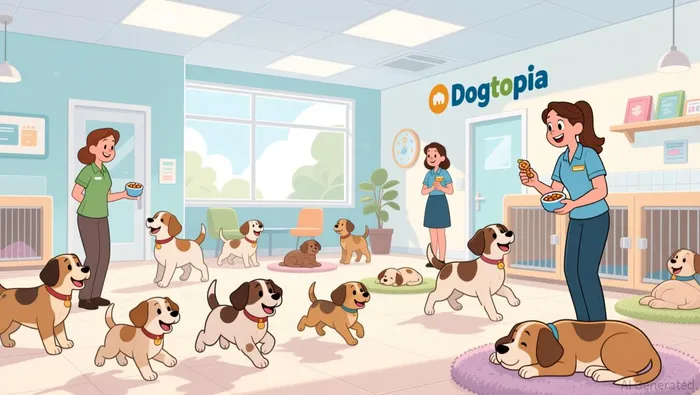
Technological innovation further strengthens this moat. The 2025 launch of DASH activity monitors and the new 3.0 store design are not just gimmicks; they are strategic tools to enhance service quality and operational efficiency. DASH, integrated with the mobile app, provides a gamified wellness ecosystem that tracks dog activity and offers unprecedented transparency to pet parents. This technology deepens engagement, reinforces the brand's wellness positioning, and creates a tangible differentiator in a fragmented market. The new store design itself improves unit economics by maximizing space and minimizing build-out costs.
Together, these elements form a self-reinforcing cycle. Lower build-out costs and higher unit economics attract more franchisees, accelerating store count. A proven, high-performing system ensures those new stores contribute positively to the top and bottom lines. And proprietary technology like DASH locks in customer loyalty, driving the same-store sales growth that funds future expansion. For a growth investor, this is the blueprint for scaling a profitable franchise: a durable model, cost leadership, and a technological edge that protects the moat.
Catalysts, Risks, and What to Watch
The path to scaling Dogtopia's 500-store vision is paved with specific catalysts and risks that will determine whether its 90 NPS moat translates into sustained market dominance. The most powerful near-term catalyst is the ongoing shift toward pet humanization. As the pet-humanization culture grows, owners increasingly treat pets as family, driving demand for premium, wellness-focused services. Dogtopia's brand positioning, reinforced by its 90 NPS score and technology like DASH, is perfectly aligned to capture this trend. This could enable higher spending per visit and justify a larger share of the growing pet care budget, directly fueling revenue growth per store.
The primary risk to this growth story is economic softness. While the broader pet industry has shown remarkable resilience, with total U.S. pet industry expenditures reaching $158 billion in 2025, discretionary spending on services like daycare could still be pressured. The industry's strength, however, suggests this is a manageable headwind rather than a fundamental threat. The key will be monitoring whether the brand's loyalty and perceived value insulate it from deeper cuts.
For investors, the leading indicators to watch are the metrics that signal execution and franchisee health. First, the pace of new store openings remains paramount. Dogtopia aims to cross the 300-store milestone this year with a pipeline of over 250 agreements; hitting this target consistently will validate the scalability of its model. Second, franchisee satisfaction is critical for maintaining the unit economics that attract investment. The company's focus on reducing build-out costs and improving ROI is designed to fuel this. Finally, any deviation from the 90 NPS score would be a major red flag, as it is the foundation of the brand's trust and low-cost customer acquisition. A sustained decline would signal erosion of the moat that makes the franchise model so powerful.
The bottom line is that Dogtopia's scalability thesis depends on executing its expansion while riding a favorable consumer trend. The catalyst of humanization could accelerate growth, but the company must navigate economic uncertainty and relentlessly monitor its core franchise metrics. Success will be measured not just by store count, but by the health of the network and the strength of its brand loyalty.