

The Justice Department cleared Paramount Skydance's $110 billion acquisition of Warner Bros. Discovery with no conditions. The antitrust division's statement says the deal is not likely to harm competition. They reviewed it for eight months and decided: go ahead, combine two of the remaining legacy media libraries, and the market will be fine.
That was weird. Or at least it should be. The DOJ didn't just approve a merger. It approved one of the largest leveraged buyouts since the financial crisis and treated it like a routine corporate combination. The antitrust story is a cover. The real story is debt.
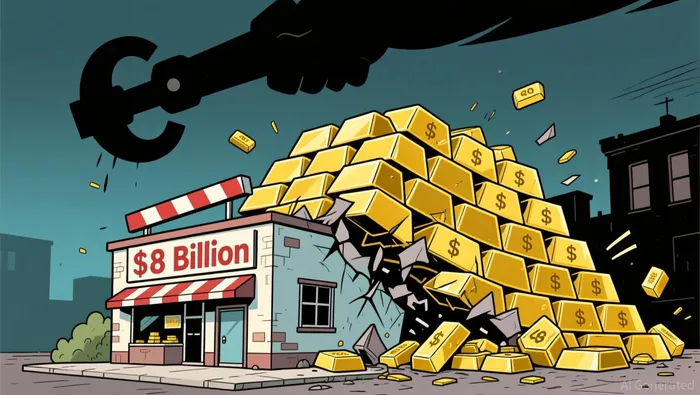
Here is the actual machine. Paramount Skydance is a company that spent roughly $8 billion to acquire Paramount last year, with the Ellison family putting in about $6 billion of their own money. It is now buying Warner Bros. Discovery for $110 billion. To finance the gap - a gap so large the buyer is literally smaller than the price tag - the deal is backed by $49 billion of long-term debt and a $15 billion leveraged loan that Pitchbook calls the largest since the GFC. That is the $15 billion bridge loan Warner Bros. Discovery priced in May, investment-grade loans that refinanced the company's existing short-term financing ahead of the takeover.
Let me say this in plain English: a company worth roughly $8 billion is buying something worth roughly $110 billion, and the difference is being covered by borrowing an amount that would qualify as sovereign-debt territory for a medium-sized country. The $30-per-share all-cash offer to WBD shareholders is being funded almost entirely by debt, wrapped inside a corporate structure that looks on paper like a strategic media merger but functions economically like a leveraged buyout with a movie studio attached.
The DOJ's reasoning makes sense only if you think the relevant market is linear television and streaming content - which is how the antitrust division framed it. The statement notes a "robust competitive landscape for live programming" and concludes the merger won't concentrate market power. That may be technically true in whatever antitrust test they applied. But it also means the DOJ evaluated whether consumers would have fewer shows to watch and completely ignored the question of whether a $110 billion media company carrying $49 billion of new debt is a structurally sound thing for capital markets to be supporting.
That distinction matters because the funding model of this deal is the oldest trick in finance: use other people's money to buy something bigger than yourself, then claim the combined entity will generate enough cost savings to service the debt. Paramount's public filings project roughly $6 billion in synergies - which in media company language means layoffs, content cuts, and the elimination of overlapping functions. Six billion dollars of savings on a $110 billion purchase is the sort of back-of-the-envelope math that convinces a board of directors to approve something a credit analyst would need to study much more carefully.
The $15 billion leveraged loan is where the plumbing gets interesting. A leveraged loan is debt issued by a company that is already heavily in debt. It is called "leveraged" because the borrower is already leveraged, and the lenders are accepting that risk in exchange for higher yields. Warner Bros. Discovery priced these loans at investment-grade spreads, which means the bond market is currently willing to treat a company about to be absorbed into a $110 billion leveraged deal as a safe borrower. Whether that rating survives the actual integration - when $49 billion of debt needs to be serviced from whatever cash flow the combined entity can produce - is a question the market will answer over the next few quarters, not the DOJ.
There is also the matter of state attorneys general. California, New York, and other states are preparing a lawsuit to block the deal, according to a June 5 Reuters report. The DOJ clearance doesn't settle the matter. State AGs can and do bring independent antitrust challenges even after the federal government signs off. This has happened before - the DOJ cleared a deal, states sued, and the legal fight dragged on for years while the companies sat in regulatory limbo. For a deal this leveraged, limbo is expensive because every month of delay adds interest costs on billions in bridge financing.
The odd thing is not that the DOJ approved the deal. The odd thing is what the DOJ didn't look at. Antitrust doesn't evaluate credit risk. It doesn't ask whether the combined company will be able to service $49 billion of debt when streaming economics are already punishing and linear television is in structural decline. It asks whether the merger reduces competition, and if the answer on its own narrow terms is no, the deal gets cleared and the credit markets have to deal with whatever comes next.
This is basically the same structure that drove media consolidation in the 1990s and early 2000s, except those deals were funded at a time when capital was cheaper and the companies involved were generating actual profit. Today's version swaps profit expectations for debt capacity and synergy projections. The wrappers have changed - Skydance is a private film studio that briefly became a public company to execute a reverse-merger acquisition of Paramount - but the economic machine is familiar. Buy something large with borrowed money, cut costs, hope the content library generates enough predictable cash flow to keep the lenders quiet.
The risk allocation tells the story. WBD shareholders get $30 in cash - they win no matter what happens next. David Ellison and the Skydance backers take control of a much larger company carrying enormous debt, which means they capture all the upside if the integration works and also bear all the downside if it doesn't. The lenders - whoever buys $49 billion of Paramount Skydance debt - are the third party in the deal, and they are the ones who need to be most careful about what they are actually financing. The official label is a media merger. The economic reality is a highly leveraged acquisition where the debt holders are the ones carrying the real structural risk.
State AG lawsuits can still complicate the timeline. The foreign regulatory picture is unclear. And the question of whether a combined Paramount-Warner entity can generate enough cash flow to support $49 billion of new debt without cutting the very content that makes those libraries valuable is one that won't get resolved by any regulator. It will get resolved by bond market pricing, quarterly earnings calls, and - eventually - the credit rating agencies.
The DOJ did its job. It found no antitrust violation. The question it didn't need to ask, and the market will have to answer instead, is whether a company that cost $8 billion to acquire should be allowed to borrow $49 billion to acquire something else. The antitrust answer is yes. The credit answer is still being written.