

A federal grand jury in the Eastern District of North Carolina returned an indictment Tuesday charging former FBI director James Comey with making threats against President Trump, marking the Justice Department's most direct legal assault on the former law enforcement official yet.
The indictment carries two counts. The first, under 18 U.S.C. § 871, alleges Comey knowingly and willfully made a threat to take the life of, and inflict bodily harm upon, the President. The second count, under 18 U.S.C. § 875(c), charges that he consciously disregarded a substantial risk his communication would be viewed as threatening violence and knowingly transmitted a threat in interstate commerce.
The alleged conduct traces to a single Instagram post dated May 15, 2025-an image of seashells arranged on a beach forming the numbers "86 47." Prosecutors argue a reasonable recipient familiar with the circumstances would interpret this as a serious expression of an intent to do harm. The grand jury returned the indictment on April 28, 2026, after a rigorous investigation by the FBI and DOJ, according to officials.
Comey has vowed to fight the charges. His attorney, Patrick Fitzgerald, said in a statement that Comey vigorously denies the allegations and plans to contest the case in court, framing it as a First Amendment defense. Comey himself posted a video statement saying, "I'm still innocent, I'm still not afraid and I still believe in the independent federal judiciary."
That defense may face steep hurdles-or it may not. Constitutional law expert Jonathan Turley told Fox News that a prosecution based solely on an image like the "86 47" seashell formation would likely be viewed as protected speech and face an immediate constitutional challenge. The case, Turley noted, would test the boundaries of what constitutes a true threat versus political expression on social media.
For now, the immediate stakes are clear: Comey faces felony charges carrying significant prison time if convicted, while the DOJ has signaled it will pursue this case to completion. The First Amendment question will be the pivot point-and the market's read on whether this indictment signals a pattern of aggressive enforcement against perceived enemies of the administration will depend heavily on how quickly the legal system moves forward.
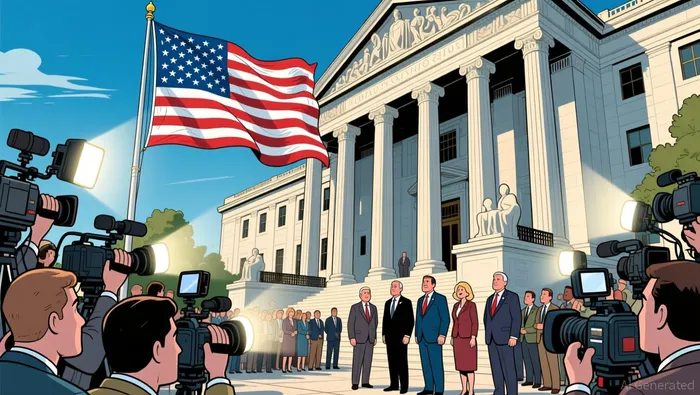
Pattern Recognition: DOJ Enforcement Trajectory
The Comey indictment does not exist in a vacuum. It arrives alongside a series of high-profile DOJ actions that, taken together, reveal a clear enforcement trajectory: aggressive, politically charged, and increasingly focused on punishing perceived enemies of the administration.
Consider the PayPal settlement announced earlier this week. Acting Attorney General Todd Blanche framed it explicitly as delivering on President Trump's vow to root out "illegal DEI" from corporate America. The DOJ is using fair lending laws as a wedge to dismantle diversity initiatives-a clear signal that the administration views DEI programs as illegitimate and worth pursuing with full enforcement authority.
Then there's the indictment of Dr. David Morens, a former senior official at the National Institute of Allergy and Infectious Diseases. The DOJ charged him with concealing COVID-19 records and falsifying documents. Blanche called it a profound abuse of trust-language that frames the prosecution as a moral imperative rather than a routine legal matter. The message is clear: former officials who served under the previous administration and allegedly obscured the truth will face maximum penalties.
But the most telling development comes from Alabama. A whistleblower alleges that Associate Deputy Attorney General Aakash Singh ordered federal prosecutors to rush through the indictment of the Southern Poverty Law Center despite serious concerns about the case's strength. Rep. Jamie Raskin characterized the move as an attempt to intimidate and stifle criticism-a direct assault on a organization that monitors extremist groups, many of which align with the administration's political base.
Even the Antitrust Division is shifting. Under new leadership-Acting Assistant Attorney General Omeed Assefi, formerly the deputy assistant attorney general for criminal enforcement-the division is signaling a renewed focus on criminal enforcement, individual accountability, and prison sentences. This isn't just about bigger fines; it's about putting people in jail.
What ties these cases together is not just aggression, but targeting. The DOJ is pursuing cases against: a former FBI director, a former NIAID official, a civil rights organization, and diversity programs in the corporate sector. Each prosecution carries a political dimension. Each sends a message about who the administration considers an adversary.
For the market, the question is whether this represents legitimate enforcement of the law or weaponization of the Justice Department. The pattern suggests the latter-and if true, it raises material risks for any company or individual that finds itself on the wrong side of the administration's political priorities.
Market Implications and Catalyst Watch
The Comey indictment carries no direct revenue or earnings exposure for public companies. The real market impact flows through policy uncertainty and the potential escalation of legal confrontations that could reshape the enforcement landscape.
For most companies, the immediate risk is reputational and regulatory-any business that has positioned itself against administration priorities now faces a DOJ that has demonstrated willingness to pursue aggressive legal theories. The PayPal DEI settlement earlier this week sent a clear signal that diversity programs are in the crosshairs. Companies with high-profile DEI initiatives should reassess their exposure.
The antitrust shift under Acting Assistant Attorney General Omeed Assefi means criminal enforcement and individual accountability are moving up the priority list. This isn't just about bigger fines-it's about personal liability for executives.
Key watchpoints will determine whether this remains a political story or becomes a structural market risk. The First Amendment ruling on the Comey indictment will set a precedent for what constitutes a "true threat" versus protected political speech. If the courts push back hard, it could constrain the administration's enforcement playbook. If the case proceeds, it validates the aggressive approach.
The Epstein files audit by the DOJ Office of Inspector General adds another variable. Any discovery of improper redactions or concealed identities could trigger a political firestorm that further politicizes the department.
Then there's the 2026 midterm calculus. If Democrats retake the House, they gain subpoena power to investigate DOJ conduct-potentially exposing the whistleblower allegations about the SPLC indictment and other enforcement actions.
The risk/reward setup is clear: short-term volatility in politically sensitive sectors if enforcement escalates, but long-term outcomes depend entirely on whether the courts provide a check. For now, the market is pricing this as political theater. That could change quickly if the DOJ's pattern of aggressive enforcement expands beyond high-profile individuals to corporate entities.