On Monday, Trump paused a planned attack on Iran and said there was a "very good chance" of a nuclear deal. Iran had just submitted a revised peace proposal through Pakistan. The dollar, which had spent months being treated as the world's go-to safety asset during the escalating Middle East conflict, gains strength as safe haven investment, immediately stopped going up.
That is the whole story. The odd thing is not that the dollar paused. The odd thing is that so many people treated its entire 2026 rally as evidence of something durable about the dollar itself, rather than what it actually was: a temporary war premium being paid into the safest large liquidity pool on Earth.
The US Dollar Index - which measures the greenback against a basket of six major currencies - pushed above 100 earlier this year, its highest level in months. It surged more than 5% off its yearly lows. The explanation every day looked the same: Iran war uncertainty, oil spike risk, geopolitical anxiety. Investors bought dollars not because the US economy looked suddenly better but because the dollar is the thing you buy when you are nervous about a military conflict in the Middle East. It is the world's favorite safe-haven asset. The premium was real. It was just not structural.
Now the DXY is around 99.1, back near where it was before the war premium fully loaded up. Reuters reported in mid-April that the dollar had shed the bulk of its Iran war premium. The recent dip on deal hopes just finished the job.
This is basically the same mechanism as any event-driven flow. You get a shock, money moves into the standard liquid refuge, the asset re-prices higher, and then when the shock starts to fade, the flow reverses. The dollar doesn't magically become weaker as a currency. The war premium just goes away. The same thing happened in reverse during the first weeks of the pandemic, during the 2022 Russia invasion spike, and during basically every other geopolitical crisis the dollar has fronted in the past two decades. The dollar is not a particularly interesting trade here. The war is.
The deal economics are still fuzzy. The US wants Iran to accept a 20-year moratorium on uranium enrichment. Iran offered to suspend enrichment... for a shorter period. Trump called Iran's May 11 counter-proposal "unacceptable." Then, on May 18, he called off the attack after personal requests from the Qatari and other Middle East leaders and started talking deal again. Iran's proposal would involve the US lift U.S. sanctions and release frozen Iranian funds in return for nuclear constraints and the reopening of the Strait of Hormuz, which Iran had been threatening to close.
The market is pricing the version of events where something happens - not necessarily the clean 20-year deal Washington wants, but enough de-escalation to remove the imminent-conflict premium. That is a tradeable gap between "very good chance" and the actual text of any agreement. If the deal falls apart, the premium could come back. But right now, the market is betting that the thing that was pushing the dollar up was never about the dollar at all.
The yen piece is where the plumbing gets more interesting. USD/JPY - the exchange rate you look at to see how many yen buy one dollar - breached above 160 (21-month high at the end of April, a 21-month high. That number matters because 160 is the level where the Japanese government's tolerance for a weak yen runs out. Japan intervened in the foreign exchange market on April 30, and then intervened again during the Golden Week holiday in early May. The yen briefly strengthened to around 155, then surrendered more than half of its gains.
As of May 20, USD/JPY sits around 158.8490. The Japanese Ministry of Finance has vowed to "shield" the yen. On May 19, the pair pushed toward 159 before finding some stability.
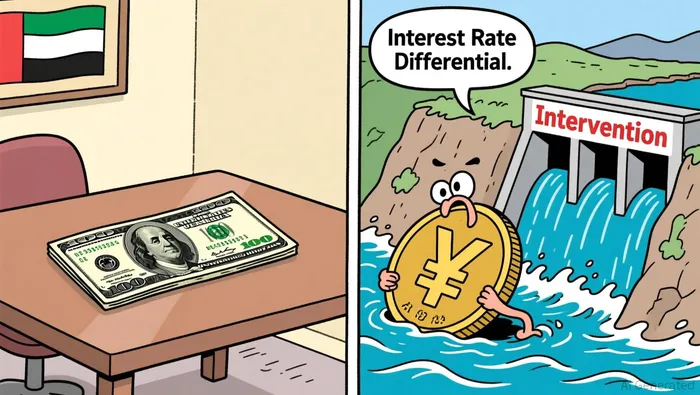
Here is the mechanical problem. The yen is weak because Japanese interest rates are still very low relative to the US. The BOJ has been painfully slow to raise rates. That interest rate differential is the gravity well pulling yen sellers. Japan can intervene - the Ministry of Finance sells dollars and buys yen - and it can move the price for a few days. But intervention does not change the interest rate differential. It is a temporary dam on a permanent flow. Once the intervention stops, the yen drifts back toward 160 unless the BOJ does something to close the rate gap.
Japan has already intervened twice in about a week. That is the "yen bazooka" strategy: fire a big shot, buy some political breathing room, then hope the market forgets. The problem is the market remembers, and the interest rate differential keeps pushing it back. Every intervention is a signal that the BOJ is behind the curve on rates and has to use the foreign exchange buffer to make up for it.
The simplest model is this: the dollar's 2026 rally was a geopolitical risk premium, not a fundamental strength signal. It was paid into the dollar because the dollar is liquid, big, and the default choice when oil might get disrupted and supply chains might break. Now that the disruption risk is fading, the premium is unwinding. The dollar is not collapsing - it is just returning to whatever its baseline is when the Middle East isn't about to catch fire.
The yen story is an adjacent mechanical issue. The BOJ is trapped between raising rates aggressively (which would hurt a fragile domestic economy) and letting the yen slide (which creates political liability and import inflation). Intervention is the middle path: expensive, temporary, and increasingly visible. It works until it doesn't, and right now it is approaching the "doesn't" part.
The structural implication is straightforward. The dollar's recent strength was borrowed - from fear, not from economic fundamentals. The question is what happens to it once the war premium is gone and the Fed is still dealing with the inflation legacy of tariffs and rate cuts. That is a different story. But it is the one that actually matters.