

The market just discounted the deal story against flat revenue
The market's first clean read on Domo's latest headline cycle was a 10.5% stock drop after the company reported flat year-on-year revenue at $79.4 million. Because the deal update came on the same day as earnings, investors were forced to weigh two narratives at once: a possible relief rally versus a market that is still pricing weak operations.
Deal hope is not operating proof
The bullish case is straightforward: the board says it is in advanced negotiations regarding a potential transaction, which can attract speculative interest in a small-cap name. Domo has also said a deal could be announced in the near term if discussions continue.
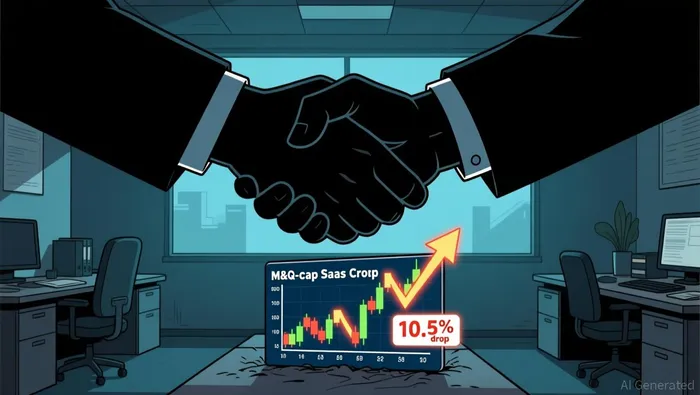
But this is still a process, not a closing. Domo has disclosed noncompliance with the minimum annualized recurring revenue covenant and said it entered into a forbearance agreement with its lender. That keeps the M&A angle in the category of possible rerating catalyst, not proof that the business model improved. If talks fail, the market goes back to pricing flat revenue. If they succeed, the real question is what a buyer is actually paying for.
Retention improved, but demand is still the valuation problem
The better operating story is in retention: gross retention rose to 86.7%, and net revenue retention reached 95.5%. That suggests Domo is getting better at keeping customers and footprint value over time.
The problem is that stabilization is not growth. For any buyer, the more important question is whether the business is improving fast enough to justify more than a distressed multiple.
What a buyer will actually underwrite
The demand signals are still mixed. In the quarter reviewed, subscription revenue was $69.8 million, down 2% year over year, and billings fell to $60.4 million from $63.9 million. Year-end subscription RPO was only up 8%, after the company had highlighted subscription RPO up 24% a year earlier. That does not point to accelerating demand.
Better renewals help, but they do not fully offset weaker new money coming into the system. A 95.5% NRR is an improvement, yet it is still in a range that typically does not support premium SaaS valuation.
Why the debt miss narrows the buyer pool
The balance-sheet issue matters because it changes the set of likely buyers. Domo did not meet the minimum ARR covenant, and that contributed to debt classification pressure. Strategic acquirers may still look at the customer base and product, but leveraged buyers are likely to focus first on lender friction and restructuring risk.
There is still some operating flexibility. At year-end, Domo reported cash and cash equivalents were $43.0 million and non-GAAP operating margin was 10%. That suggests the business is not falling apart. It does not, however, create strong buyer leverage.
If Domo closes a deal soon, the market is more likely to price visible contracts and retention than a new growth curve. Until billings and forward metrics improve, the premium case remains speculative.
For traders, the key is deal proof, not the AI pitch
Domo's board initiated a formal strategic alternatives review in February 2026, and at that time it also reaffirmed certain FY2026 guidance. That means the market has had months to underwrite an exit story before this quarter's update that the board is now in advanced negotiations regarding a potential transaction. That reads less like evidence of organic momentum and more like management is pursuing the clearest visible path to value.
Process is not commitment
Saying a transaction is the best path can be constructive. It can also simply keep options open while the company shops for terms. Domo itself says no definitive agreement has been executed, so any rally before that milestone is a bet on execution, not proof of it.
That is why the AI branding should not get a free pass. CEO Josh James is still leaning on the shift from AI experimentation to AI embedded in everyday work, and the company has been promoting AI capabilities. For this trade, product narrative matters only if it shows up in deal terms or harder operating proof.
What to watch next
Watch these signals in roughly this order:
- A definitive agreement, not just continued negotiation language.
- Clearer demand proof, especially billings and subscription RPO.
- Any concrete change in balance-sheet flexibility that would broaden buyer interest.
Treat Domo as an event-driven stock until a signed deal exists. The bullish case gets stronger only if a buyer commits real terms. If talks slip or the company returns to flat revenue and weaker billings without a clear buyer in sight, the bearish case remains intact.